Articles in this Volume

Research Article Open Access
Research on the Adjustment of Commercial Bank Credit Allocation Strategies under Green Finance Policies
Green finance provides an effective tool for sustainable development. As the center of capital allocation, the credit behavior of commercial banks directly determines the effectiveness of the green implementation policy. Based on the institutional environment of China, this study chooses three types of banks as the research samples: large state-owned banks, joint-stock commercial banks, and city commercial banks. Focusing on the micro perspective, this paper analyzes the adjustments in credit strategies, divergences in implementation practices, and existing barriers among these three categories of banks under the construction of green finance policies. It finds that these three categories generally take a shift in credit structure, retreating from "two-high" industries and enhancing green support as a tendency. Large state-owned banks, taking advantage of scale, stand out in total green credit volume. The joint-stock banks have developed a head start in green loan ratios and product innovativeness with international standards; city commercial banks suffer from small absolute scale and low system infrastructure, so they follow a "weak foundation, catch-up development" pattern. At the same time, all these categories encounter common difficulties in developing green finance. Internationally, there exist widespread issues of risk-return imbalance, a shortage of interdisciplinary professionals, and insufficient data system support. Externally, imperfect policy incentives, lack of uniformity in green standards, and immaturity in the development of the carbon trading market lead to long-lasting bottlenecks. This research provides references for policymakers in increasing the differentiated institutional design and for various banks to improve the green credit operations.
Show more
Read Article PDF
Cite
Research Article Open Access
Capital Circulation, Digital Platform Expansion and the Solow Paradox—An Analysis of Total Factor Productivity Based on Marxist Political Economy
Article thumbnail
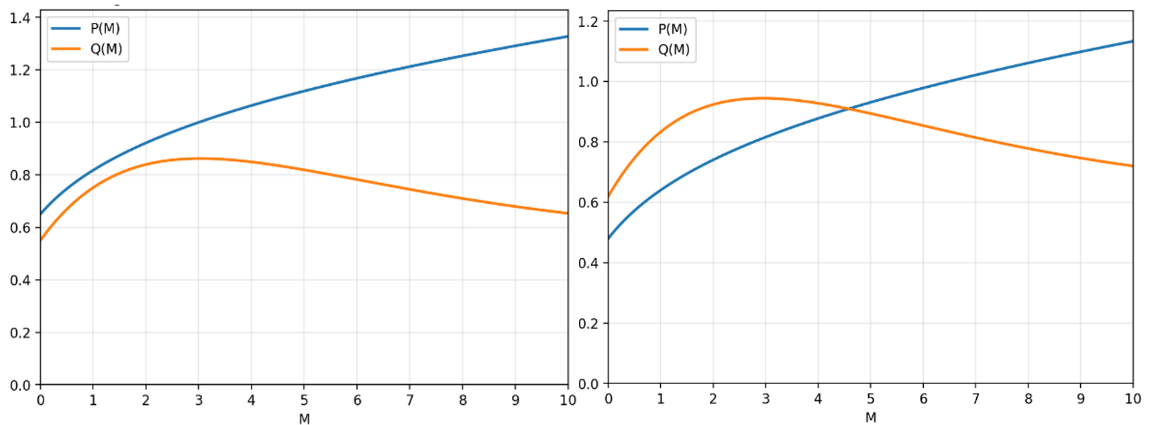
Starting from Marxist political economy, this paper reconstructs the Solow growth model with the theory of capital circulation, and redefines total factor productivity as capital appreciation efficiency jointly determined by production efficiency, value realization efficiency and the technical composition of capital. As a new form of commercial capital, digital platforms exert two opposite effects on industrial capital: "accelerating turnover" and "value extraction". In the early stage of development, platforms can shorten circulation time and improve capital turnover efficiency, thus promoting productivity growth. However, with the expansion of platform scale, the rise of market concentration and the enhancement of bargaining power, the effect of value extraction gradually surpasses that of turnover acceleration. Unproductive circulation costs continuously squeeze the profit margin and reproduction capacity of production sectors, turning total factor productivity from growth to decline, thus giving rise to the Solow paradox.
Show more
Read Article PDF
Cite
Research Article Open Access
World Football Derivatives and Fan Economy Development: A Research Analysis and China's Pathway
The football industry has evolved from a simple athletic competition into a vast global commercial system, where derivative product development and fan economy operations are becoming core engines for club revenue growth. This paper adopts a comparative research perspective to systematically review the evolutionary trend of the world football derivatives market—shifting from "event merchandise" to "lifestyle products"—analyzes the bubble cycle of fan tokens from capital frenzy to value regression, and reveals the risk of player card markets shifting from a collectible culture to a speculative tool. Based on this analysis and the current state of China's football industry, the paper examines three structural challenges: weak intellectual property protection, underdeveloped IP operation capabilities, and insufficient data application. The study finds that adopting international best practices to build an integrated "cultural identity—IP licensing—precision operation" development model—by strengthening defensive IP layouts, deepening cross-border integration and innovation, and establishing a unified industry licensing platform—is the critical pathway for China's football derivative market to break through bottlenecks and achieve high-quality development.
Show more
Read Article PDF
Cite
Research Article Open Access
The Impact of Interest Rates on Consumer Spending in the United States: Evidence from 2015–2026
Article thumbnail
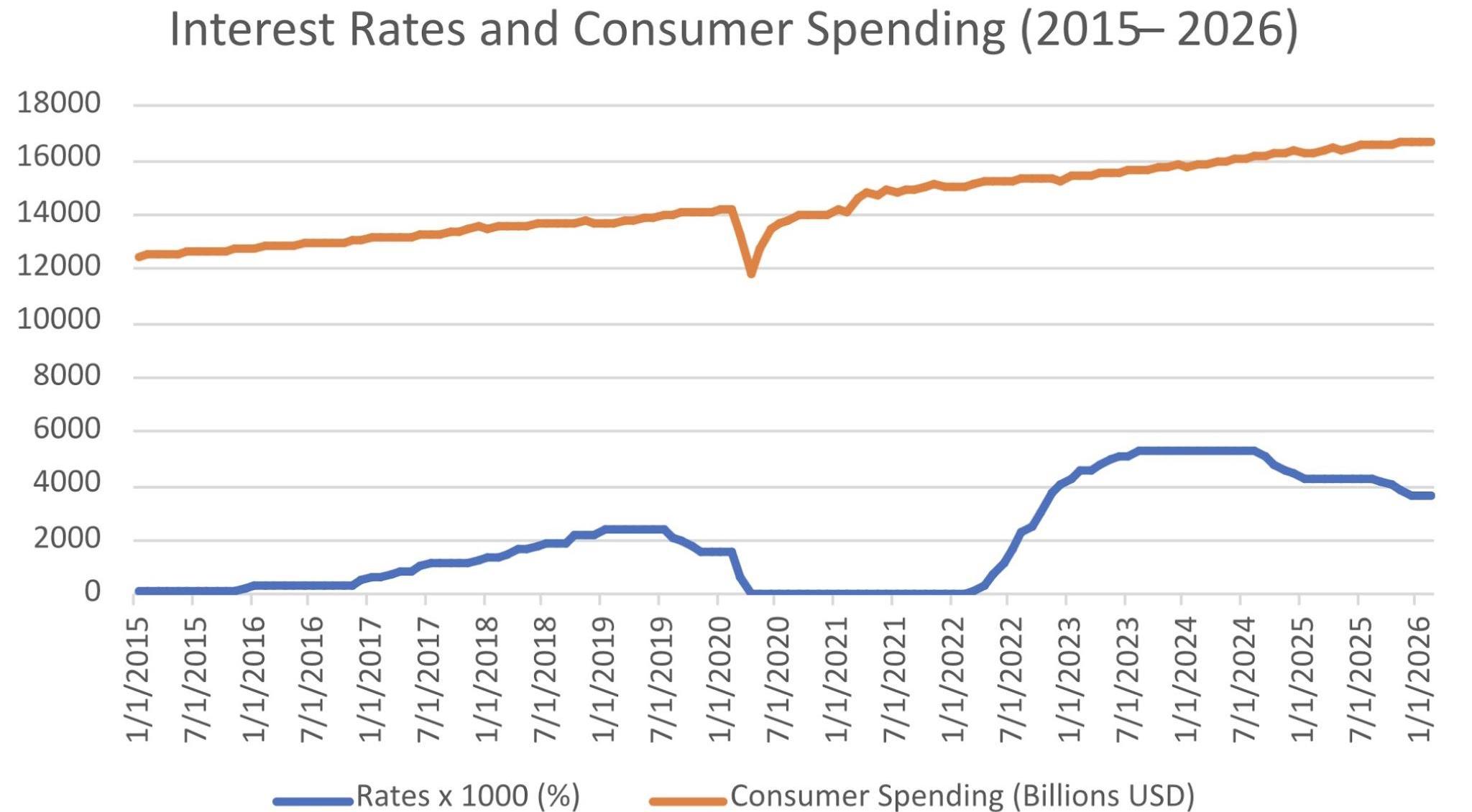
As one of the issues happened in the United States, this paper aims to analyze the effect of interest rates on consumer spending in the United States from 2015 to 2026. The analysis uses FRED economic data that has been analyzed using descriptive and regression methods as well as correlation. It is easy to hypothesize that high-interest rates would generally be negatively related to growth in consumer expenditures because borrowing is more expensive resulting in savings rather than expenditures. However, it is also essential not to assume that there is a simple relationship between interest rates and consumer expenditure because there are many other factors that affect consumer expenditures, including inflation rates, unemployment, and income. Therefore, at times, increased interest rates will potentially have no relationship to increase in consumer expenditures, although there is a positive relationship between consumer expenditures and the timeframe chosen to this point, particularly following the adverse effects of the COVID-19 pandemic.
Show more
Read Article PDF
Cite
Research Article Open Access
Carbon Leakage in International Trade: A TWFE and Spatial DID Analysis of the EU Carbon Border Adjustment Mechanism's Impact
Article thumbnail
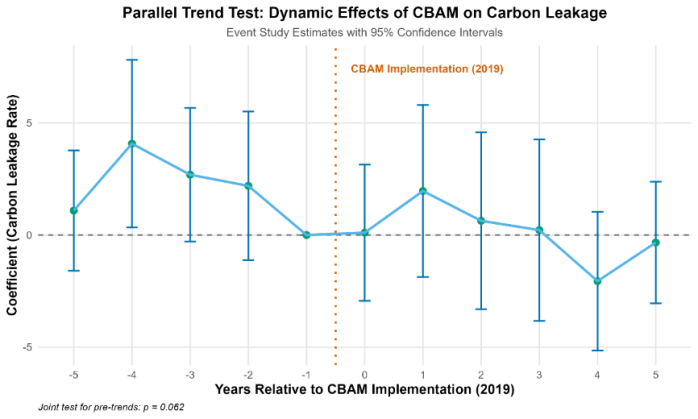
This study examines the impact of the Carbon Border Adjustment Mechanism (CBAM) on carbon leakage, focusing on the European Union (EU) as the policy-implementing region and EU trading partner countries. By applying a two-way fixed effects (TWFE) difference-in-differences specification with dynamic event-study analysis, complemented by spatial Durbin model (SDM) extensions, this research evaluates the economic impact of CBAM while addressing fundamental methodological challenges in international environmental policy evaluation, namely the staggered adoption of CBAM across trading partners and the spatial interdependence of emission outcomes through trade networks. The findings indicate that implementing the CBAM significantly reduces carbon leakage for countries exporting to the EU, with the magnitude of these reductions varying systematically with the intensity of trade exposure and the sectoral composition of exports. The results underscore the necessity for coordinated international policies to address climate change while minimizing adverse trade impacts, and demonstrate that proper accounting for spatial spillovers substantially modifies causal effect estimates relative to standard approaches.
Show more
Read Article PDF
Cite
Research Article Open Access
The Causes of the 1997 Asian Financial Crisis: A Comparative Analysis between China, Japan and South Korea
The 1997 Asian Financial Crisis (AFC) was a crisis that affected much of East and Southeast Asia during the final years of the 20th century. It began with a series of events in Thailand before affecting other countries through a chain reaction. Even though later recovery was relatively quick, this crisis could be considered a prime example of financial contagion. This paper employs a comparative case study of South Korea, Japan, and China to adjudicate between these competing theories: one that stresses the importance of a unique Asian developmental model in causing the crisis and another that looks at the AFC through the lens of globalization. This paper uses a comparative analysis method to examine key countries affected by the crisis, through which an overarching cause can be extracted. The conclusion of this paper is that even though both theories have merit in explaining the causes of the AFC, they do not necessarily need to be rival explanations and the cause of the AFC could be better explained as an outcome of individual nations' response mechanisms.
Show more
Read Article PDF
Cite
Research Article Open Access
Analysis of the Pop Mart Marketing Case Study
The global trendy toy market has experienced rapid growth in recent years, driven by the rise of emotional consumption among Gen Z consumers. This study examines Pop Mart, the leading Chinese trendy toy brand, to analyze the innovative marketing strategies that have transformed it from a small stationery store into a global IP empire valued at over HK$350 billion. Using a case study approach, the research investigates Pop Mart's IP incubation ecosystem, blind box marketing model, omni-channel retail strategy, and community marketing practices. The findings reveal that Pop Mart's success stems from its ability to create emotional connections with consumers through carefully designed IP characters, leverage scarcity and surprise elements in blind boxes, and build loyal fan communities. However, the company also faces challenges, including market competition, regulatory scrutiny, and IP sustainability issues. This study concludes that Pop Mart's marketing strategies offer valuable insights for brands seeking to succeed in the era of the emotional economy, and suggests future directions for sustainable growth in the global market.
Show more
Read Article PDF
Cite
Research Article Open Access
Research on the Impact of Carbon Emission Trading on the Utilization Efficiency of Resource and Environmental Factors from the Perspective of New Quality Productivity
Article thumbnail
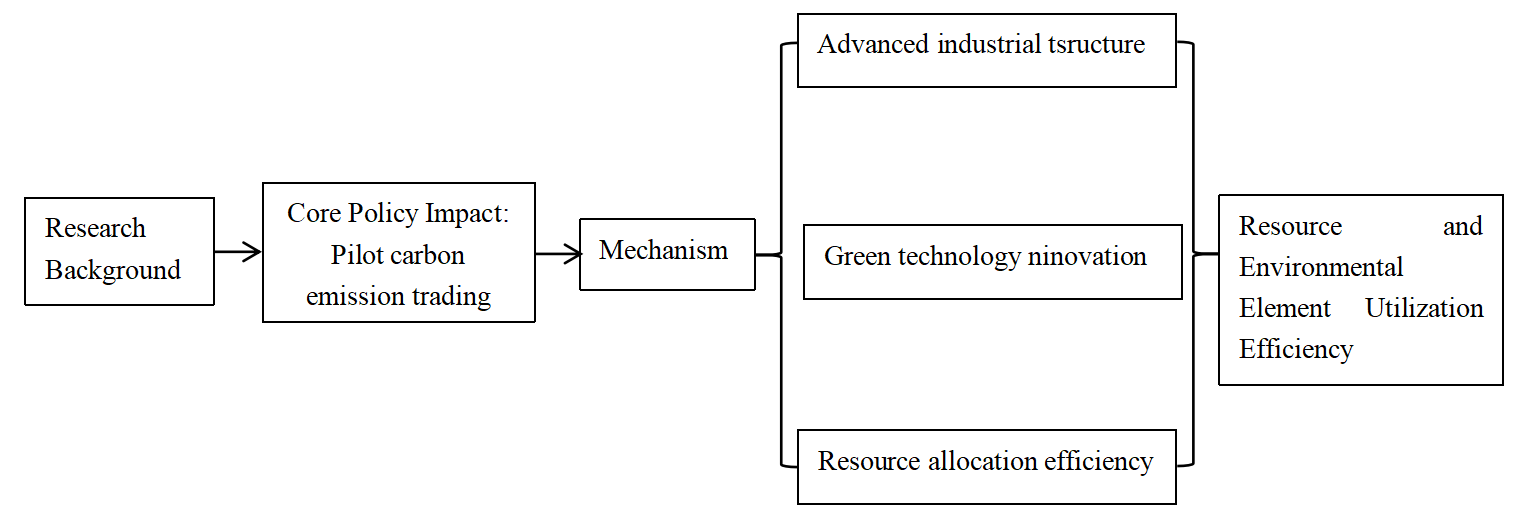
Using panel data of 30 provinces in China from 2004 to 2023, this paper adopts the multi-period difference-in-differences method to verify the impact and functioning mechanism of the carbon emission trading pilot policy on the utilization efficiency of resource and environmental factors. The findings are as follows: First, carbon emission trading significantly improves the utilization efficiency of resource and environmental factors. Second, mechanism analysis shows that the policy exerts its effects by activating the fostering factors of new quality productivity. Third, heterogeneity analysis indicates that the policy effect of comprehensive pilots is stronger than that of industrial pilots, and the policy effect of provinces and municipalities where national-level urban agglomerations are located is significantly higher than that of non-urban agglomeration areas. The results of this study suggest that in the process of improving the construction of the national carbon market, we should expand the scope of industry coverage and strengthen the institutional synergy advantage of urban agglomerations, so as to realize the systematic improvement of the utilization efficiency of resource and environmental factors under carbon constraints.
Show more
Read Article PDF
Cite
Research Article Open Access
An Analysis of the Revenue Structure of Mercedes-Benz in the Chinese Market
Article thumbnail
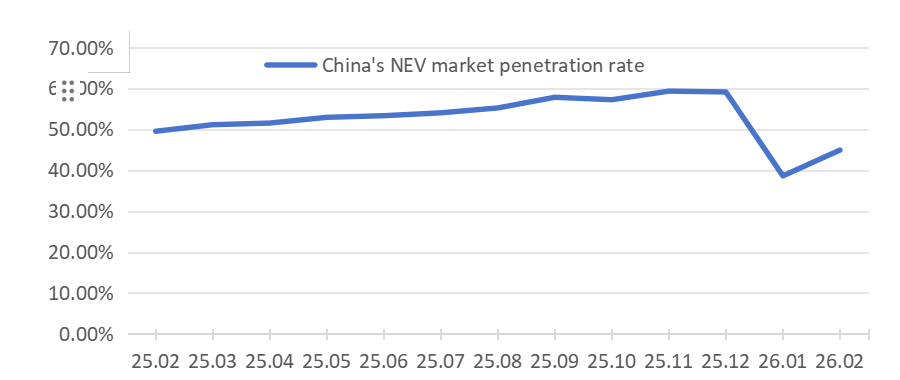
As China's NEV (new energy vehicle) penetration rate in the passenger car market (the penetration rate) passed 50%, Mercedes-Benz, a traditional luxury carmaker, lags behind in electrification. This paper takes Mercedes-Benz as an example, focusing on its revenue structure in China. Using descriptive statistics, the gradient descent and the SIR model, it explores the reasons and risks behind the slow electrification transformation and offers recommendations. This study found that Mercedes-Benz's revenue structure in China is highly imbalanced: fuel vehicles accounted for 97% of its revenue, while electric vehicles (EVs) made up only 3%. This contrasts sharply with the market trend. The main reasons were that changing core technology and adhering to safety standards both slowed down electrification. Meanwhile, multiple risks were building up: an imbalanced revenue structure, continuous loss of market share to NEV brands, and higher compliance costs due to the dual-credit policy. The response strategy should be phased. In the short term, the company should strengthen its hybrid line as a transition. In the long term, it should prioritize electrification, set up an independent EV unit, and follow NEV policy incentives. The challenges of Mercedes-Benz show that electrification is irreversible, and traditional carmakers must follow the trend. Companies facing similar transformation difficulties should first clarify their position and then make a clear strategic plan.
Show more
Read Article PDF
Cite
Research Article Open Access
Localisation Marketing Strategy of Luxury Fashion Products
The global luxury fashion market facing the structural adjustment, such as resale market, experiential retailing and digital disruptions. The strategic positioning of Chinese market is relevantly stable compare with other countries, even though Chinese market faced a decline trend in 2025, but it may recovery in 2026 under the market uncertainty and unpredictable fashion trend. This study aims to analysis the marketing strategy of transferring global standardization to localization in the luxury fashion market, the change of Chinese's customer purchasing behaviour, such as Gen Z consumers and millennials consumer different buying behaviour, and luxury fashion brands adopt localization strategy to achieve brand consistency and the expansion in the Chinese market. This study discusses the potential challenges and risks of global luxury fashion market's localization strategy, such as brand dilution risks. Additionally, case studies of Ralph Lauren and Gucci are used to analysis the practice and effects of its Chinese localization strategies and compare differentiation of brand strategies, such as the sponsorships and omnichannel strategy of Ralph Laure and limited-editions and marketing strategy of Gucci.
Show more
Read Article PDF
Cite