


About AEMPSThe proceedings series Advances in Economics, Management and Political Sciences (AEMPS) is an international peer-reviewed open access series that publishes conference proceedings from a wide variety of methodological and disciplinary perspectives concerning economic and management issues. AEMPS is published irregularly. The series welcomes empirical and theoretical articles concerning micro, meso, and macro phenomena. Proceedings that are suitable for publication in the AEMPS cover domains on various perspectives of economics, management and political sciences and their impact on individuals, businesses and society. |
| Aims & scope of AEMPS are: · Economics · Management · Political Sciences |
Article processing charge
A one-time Article Processing Charge (APC) of 450 USD (US Dollars) applies to papers accepted after peer review. excluding taxes.
Open access policy
This is an open access journal which means that all content is freely available without charge to the user or his/her institution. (CC BY 4.0 license).
Your rights
These licenses afford authors copyright while enabling the public to reuse and adapt the content.
Peer-review process
Our blind and multi-reviewer process ensures that all articles are rigorously evaluated based on their intellectual merit and contribution to the field.
Editors View full editorial board

London, UK
canh.dang@kcl.ac.uk

Leeds, UK
S.Amini@lubs.leeds.ac.uk

Cardiff, UK
EshraghiA@cardiff.ac.uk

London, UK
alexandre.loktionov@kcl.ac.uk
Latest articles View all articles
With the quick growth of social media, influencer-owned DTC brands have emerged as a new business form, which differs from the traditional influencer who endorses third-party brands. Taking MrBeast's Feastables Chocolate as a single case, based on Source Credibility Theory and Parasocial Interaction Theory, and relying on multiple public secondary data sources, including the official Feastables website, open‑access YouTube videos and social‑media public metrics, industry analysis reports, and mainstream news‑media coverage, to explore the brand promotion mechanism, performance, benefit, and potential risks of influencer-owned DTC brands. The results show that influencers' credibility and parasocial emotional role can help brands achieve remarkable cold‑start brand awareness in beginner. However, this IP transfer also faces a lot of risks, such as influencer reputation, which means some negative events involving an influencer will directly affect the brand's reputation, over‑reliance on personal IP, and so on, and thus lead to the brand being unable to transform or extend.

 View pdf


Cashless payments are commonly evaluated in terms of speed, convenience and technical risk, but these criteria do not explain why the public regards some financial institutions as credible and others as untrustworthy. This paper argues that cashlessness does not eliminate trust; it transfers trust from a tangible instrument and bilateral exchange to banks, payment platforms, clearing systems and regulators. To analyse that transfer, the paper defines trust costs as the verification, monitoring, privacy, redress and switching or exclusion burdens that users bear when relying on institutions they cannot fully observe. It then proposes a Public Financial Credibility Framework with six dimensions: operational reliability, integrity and accountability, transparency and data stewardship, fairness and inclusion, redress and contestability, and resilience and public backstops. The framework is applied to loyalty points, algorithmic credit and buy now pay later, financial exclusion, central bank digital currency and payment failures. Existing theory, official data and regulatory evidence provide preliminary theoretical and content validity. However, the framework is presented as a testable research programme rather than an empirically validated index. Future validation should combine survey measures, behavioural outcomes and event studies of outages, data breaches and redress decisions.
View pdf
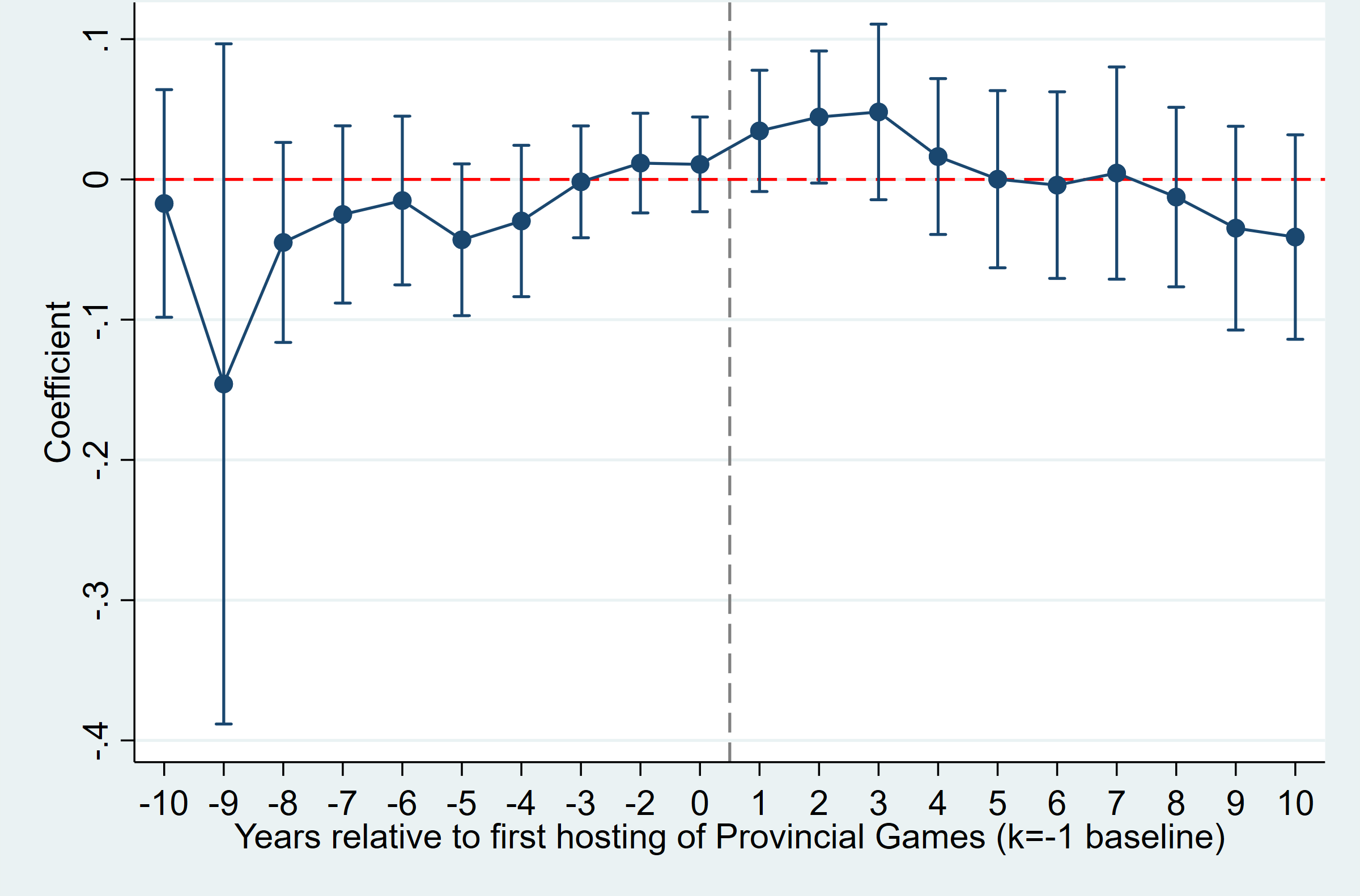
Although sporting events are widely studied, sub-national multi-sport events remain largely neglected in the literature. To address this gap, this study uses a staggered difference-in-differences (DID) design based on an unbalanced panel of approximately 280 prefecture-level cities from 2003 to 2020, to estimate the economic impact of China's provincial games on host cities, supplemented by stacked DID and event-study analyses. Results indicate that hosting provincial games raises fixed-asset investment by roughly 8-10%, social retail sales by about 4.5%, and gross domestic product (GDP) per capita by approximately 4%. These effects are mostly seen in the first two to three years after the event, and no statistically significant effects are found for GDP growth, industrial structure, local fiscal revenue, or employment. Findings suggest that the stimulus mainly works through the infrastructure-investment channel and is stronger in eastern and central regions, in small and medium-sized cities, as well as resource-based cities. Overall, provincial games mostly serve as a short-term demand injection and investment catalyst rather than an engine of sustained growth.
View pdf

FinTech refers to the new business model, application, process and product formed after digital technology enters the financial services sector. This article distinguishes between the external shock caused by the entry of FinTech enterprises into traditional financial markets and the internal transformation carried out by commercial banks through the application of digital technology. It examines the impact of FinTech on the operations of commercial banks from three aspects: profitability, risk-taking and business structure, and analyzes three transmission mechanisms: information asymmetry, market competition and liquidity creation. The research shows that the external development of FinTech will divert bank deposits, payment services and credit customers, putting pressure on traditional income; after banks apply digital technology to customer identification, credit approval and internal operations, they can reduce information processing costs and expand service scope. FinTech helps to reduce the credit risk of individual banks, while deposit competition, profit constraints, model convergence and enhanced inter-bank connections may increase risk-taking or expand systemic risks. These impacts vary with bank size, property rights and business model, as well as the level of digital infrastructure and technology application in the region. Regulatory authorities need to implement classified supervision based on the source of technology, bank type and risk level, while commercial banks should choose a transformation path that is compatible with their customer base and technical capabilities.
View pdf
Volumes View all volumes
Volume 310October 2026
Find articlesProceedings of the 10th International Conference on Economic Management and Green Development
Conference website: https://2026.icemgd.org/
Conference date: 28 September 2026
ISBN: 978-1-80915-060-8(Print)/978-1-80915-061-5(Online)
Editor: Florian Marcel Nuţă
Volume 309October 2026
Find articlesProceedings of the 10th International Conference on Economic Management and Green Development
Conference website: https://2026.icemgd.org/
Conference date: 28 September 2026
ISBN: 978-1-80915-058-5(Print)/978-1-80915-059-2(Online)
Editor: Florian Marcel Nuţă , Canh Thien Dang
Volume 308October 2026
Find articlesProceedings of ICFTBA 2026 Symposium: Strategic Management & Business Analytics: Data-Driven Performance Models
Conference website: https://2026.icftba.org/
Conference date: 29 October 2026
ISBN: 978-1-80915-056-1(Print)/978-1-80915-057-8(Online)
Editor: An Nguyen
Volume 307October 2026
Find articlesProceedings of the 5th International Conference on Financial Technology and Business Analysis
Conference website: https://2026.icftba.org/
Conference date: 18 December 2026
ISBN: 978-1-80915-054-7(Print)/978-1-80915-055-4(Online)
Editor: An Nguyen
Announcements View all announcements
Advances in Economics, Management and Political Sciences
We pledge to our journal community:
We're committed: we put diversity and inclusion at the heart of our activities...
Advances in Economics, Management and Political Sciences
The statements, opinions and data contained in the journal Advances in Economics, Management and Political Sciences (AEMPS) are solely those of the individual authors and contributors...
Indexing
The published articles will be submitted to following databases below:
