Articles in this Volume

Research Article Open Access
The Linkage Analysis of Real Estate and Securities Markets Integrating Machine Learning and Data Visualization
Article thumbnail
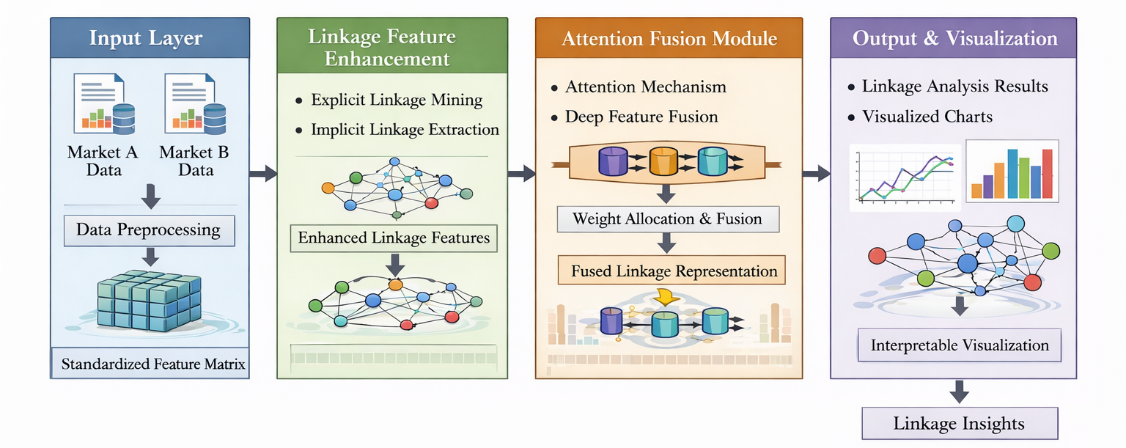
This paper selected monthly time series data from both markets from January 2018 to December 2023. Data preprocessing and feature design were performed, and several experiments were carried out with LSTM, CNN-LSTM and Transformer as models. MAE, RMSE and LCE, which can achieve a lower 0.023, 0.031 and 0.018, respectively, with R2 =0.942, are achieved by TLAEFNA. The prediction accuracy and linkage feature capture are much superior to mainstream time series models, and are stable and robust when the data is insufficient and outlier interference is present. By implementing a visualization module, our algorithm intuitively presents linkage trends, attention weights and factor importance, which reveal the temporal and regional differences in the linkage between the real and securities markets and identifies the principal linkage factors such as housing price changes, real estate stock transaction volumes and funds and expectations transmission paths. This algorithm solves the black-box problem of machine learning that provides accurate and interpretable technical support for cross-market investment decisions, risk warnings and policy regulation.
Show more
Read Article PDF
Cite
Research Article Open Access
The Impact of ESG Rating Discrepancies on Supply Chain Resilience
Using 2014-2024 data from Chinese A-share listed companies, this research examines how inconsistent ESG ratings affect corporate supply chain resilience. Greater rating disagreement is linked to a notable drop in resilience. Industry competition amplifies this effect: higher concentration makes the negative impact stronger. The eastern region shows the strongest effect, while pollution level does not matter—heavily and lightly polluting firms are similarly affected. The results give fresh insight into ESG rating inconsistency and offer practical direction for regulators pursuing uniform ESG criteria, as well as for firms striving to boost supply chain resilience.
Show more
Read Article PDF
Cite
Research Article Open Access
Supply Chain Finance and Enterprise Off-site Investment
The relationship between supply chain finance and corporate off-site investment emerges a counterintuitive paradox: theoretically easing financing constraints to boost off-site expansion, yet in reality blocked by cross-domain trust fractures and institutional adaptation gaps. Using 2001–2024 A-share listed company panel data and a time-fixed effect model, this paper examines the impact, mechanism, and boundary conditions of supply chain finance on off-site investment scale and location choice. Results show a significantly positive effect, empirically supporting the core hypothesis. This effect operates through three pathways—reconstructing cross-domain credit evaluation, driving resource integration platforms, and upgrading cross-domain governance contracts—forming a closed loop of financial innovation, trust-capability reconstruction, and investment activation. Integrating financial geography, institutional theory, and social network theory, the study constructs a cross-domain supply chain finance analysis framework, fills the systematic research gap, and provides theoretical and policy basis for optimizing cross-regional capital allocation in building a unified national market.
Show more
Read Article PDF
Cite
Research Article Open Access
Research on the Impact of Enterprise Digital Transformation on Enterprise Greenwashing Behavior
Considering how deeply integrated is our dual-carbon objective with a digital economy now, what kind of corporate greenwashing would there be during that whole transition period into something called green development and maybe digital changes could give us some sorta tech route towards resolving this dilemma. A-Share companies from 2014 till 2023 as sample to explore what will happen after Digital Transformation of Corporate in Greenwashing through ESG information Disclosure along with ESG rating's mediating effect. It analyses the heterogeneous nature from three points: Region and industry technological characteristics, Pollution of industry. And also we have the following result here which indicates to me it's quite clear right away, if an organization does digital transformation they might actually reduce chances for it to just not look like there even existed this practice at all; furthermore those ratings given out concerning environmental standards can go from low up till really good when comparing everything about making money while trying one last chance instead than going over each others heads regarding doing more environmentally friendly things around here – because then nobody feels compelled anymore! From heterogeneity point-of-view view its inhibition of Digital change towards Green-washing shows strong signs within Companies found mainly inside areas where East exists alongside Tech Industry plus Pollutants Industries. And I passed robustness checks on my study. In this investigation is about showing digital transformations' environmental governance values for empirical support as well as references to both corporations for improving their disclosure practices and regulatory powers overseeing such actions called greenwashing and so forth helping our nation's growth towards becoming greener.
Show more
Read Article PDF
Cite