Articles in this Volume

Research Article Open Access
Research on the Financing Decision of Spring Airlines
Article thumbnail
With the rapid development of China's airline industry, more and more funds have been needed for new construction. Capital shortage will be an important reason restricting the expansion of the company. To alleviate the problem of lack of funds, this paper investigates all factors inside and outside the company that influence financing decisions, studies the case of Spring Airlines Co., Ltd., explores ways to optimize its capital structure and monetary funding plan in the aviation industry, and proposes some relevant suggestions. This paper finds that these three specific issues--a single source of funding, a high debt-to-asset ratio, and a low proportion of internal financing--will affect all the sources of funds for the company, increase its leverage-to-asset ratio, and reduce the amount of new domestic funds available for construction. Some specific suggestions have been put forward to address the above problems: restructurise liabilities, increase the channels for attracting overseas capital, and strengthen the internal capital system. With the continuous increase in demand for aviation around the world, Chinese airlines have been raising aircraft purchase plans and have faced higher financial pressure. As a budget airline that focuses primarily on commercial air navigation and passenger transport, the financial situation and capital strategy of Spring Airlines are very representative of the sector.
Show more
Read Article PDF
Cite
Research Article Open Access
IP Ecosystem-Driven Value Creation in China's Designer Toy Industry: A Case Study of Pop Mart
China's designer toy industry has shifted from a niche subculture to a visible sector of cultural consumption. Unlike traditional toys, designer toys combine artistic design, emotional experience, symbolic identity and collectible scarcity. This paper examines how the industry creates value and how this value can be sustained, using Pop Mart and the Labubu-related IP boom as the main case. It adopts a qualitative case-study approach based on academic literature, public company information, regulatory documents and secondary industry materials. The analysis focuses on three questions: how consumer demand transforms manufactured objects into cultural and emotional goods; how Pop Mart converts IP assets into commercial growth through blind boxes, channels, communities and globalization; and what risks may threaten the long-term development of this model. The paper finds that value creation in designer toys depends less on manufacturing itself than on an IP ecosystem that links artists, products, retail spaces, online platforms, resale markets and fan communities. However, blind-box uncertainty, speculative resale, dependence on hit IPs, product homogenization and cross-cultural expansion risks can weaken sustainability. Future growth should shift from hit-driven sales to transparent operations, diversified IP, responsible consumer protection, and sustainable innovation.
Show more
Read Article PDF
Cite
Research Article Open Access
Comparing Likes and Favorites as Signals of Purchase-Oriented Behavior in Social E-Commerce Beauty Content
Article thumbnail
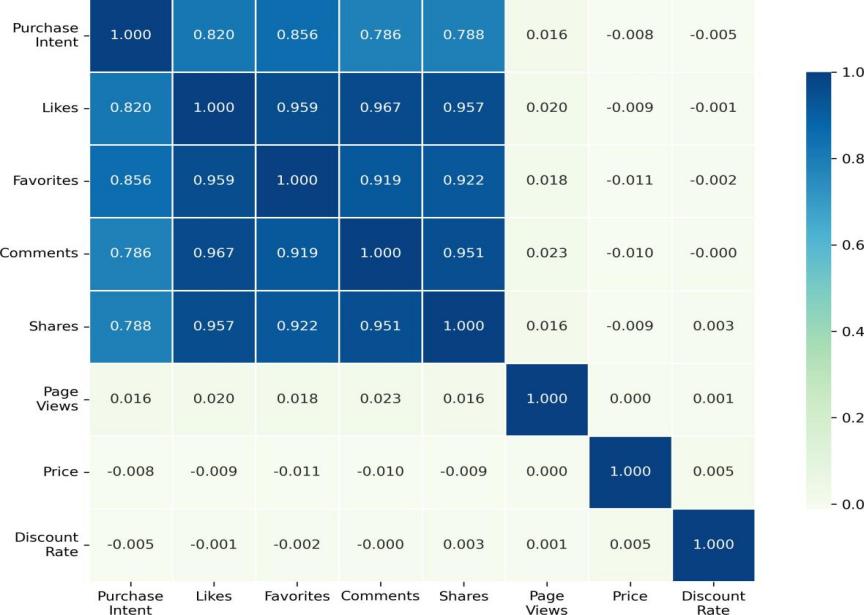
With the development of Social Commerce, consumers increasingly rely on User-Generated Content, platform interaction data and engagement metrics for product evaluation and purchase-related decision-making. In the beauty-related Social E-Commerce context, likes, comments, shares and favorites/collects not only represent content popularity, but also may reflect different levels of consumer interest. This article mainly studies whether favorites/collects are closer to purchase-oriented behavioral signals than likes. This article uses Alibaba Cloud Tianchi Social E-Commerce User Purchase Behavior Dataset as the main public dataset and focuses on beauty and personal care category. Research methods include descriptive statistics, correlation analysis, verification of derived behavioral indicators, stepwise Ordinary Least Squares regression, standardized coefficient comparison, Wald test and robustness checks. The results show that favorites/collects present a more stable positive association with derived purchase-oriented behavioral index, while likes weaken or turn into a negative coefficient after controlling favorites/collects. However, the binary purchase label check did not show significant results. Therefore, the conclusion of this article should be interpreted as exploratory association evidence, not causal evidence of actual purchase conversion.
Show more
Read Article PDF
Cite