
Articles in this Volume

Research Article Open Access
The Calendar Effect of Investor Attention Based on Baidu Search Index
Article thumbnail
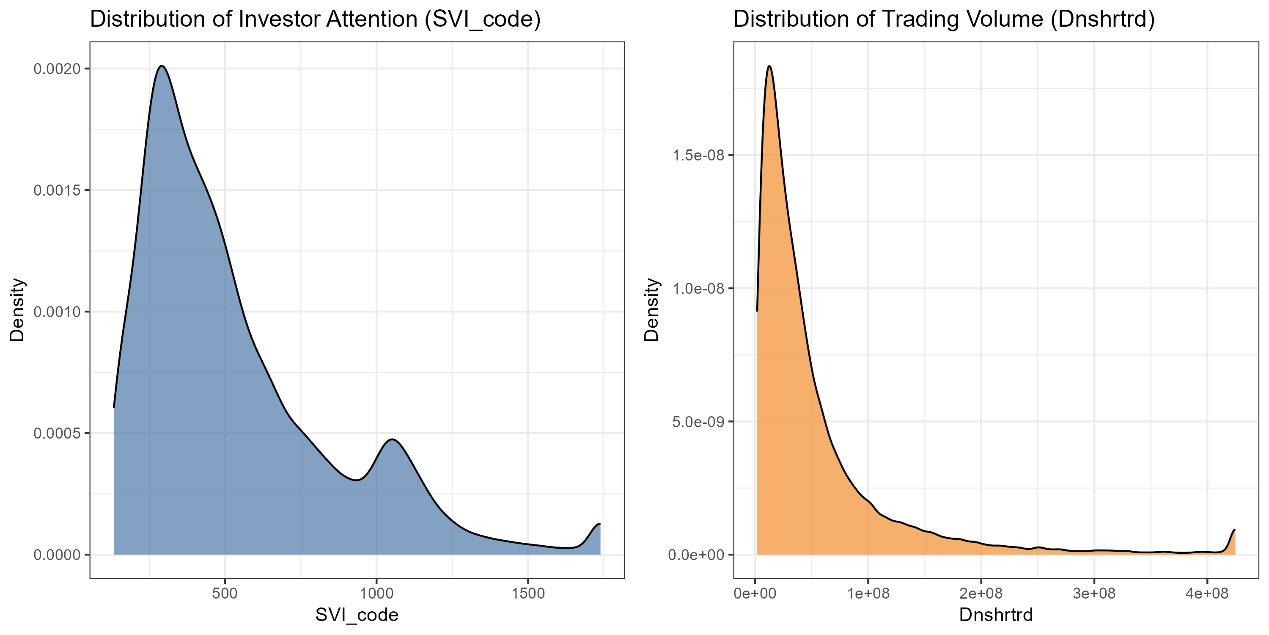
Within the framework of behavioral finance, investors' limited attention is a crucial factor influencing information transmission and asset pricing, and the Baidu Search Index(BSI) serves as an effective tool for directly measuring investor attention. The research sample of this study is the constituent stocks of the CSI 300 Index. It also employs the BSI based on individual stock codes as a proxy variable for investor attention. This study empirically examines the weekly and monthly calendar effects of investor attention and their impact on individual stock trading activity. The statistical results imply that there is a significant difference in investor attention among stocks, exhibiting a right-skewed distribution. Furthermore, it showed a significant positive correlation with the daily trading volume of individual stocks. Investor attention does not exhibit a significant intra-week calendar effect, but it shows a very strong calendar effect at the monthly level. The differences in attention and trading volume across different months are highly significant at the 1% level. The results suggest that investor attention distribution shows an obvious monthly cyclical pattern, which provides a new empirical basis for understanding the temporal characteristics of investor behavior in China's A-share market.
Show more
Read Article PDF
Cite
Research Article Open Access
Time-Varying Dependence Between Bitcoin and Gold under Geopolitical Risk and Market Uncertainty
Article thumbnail
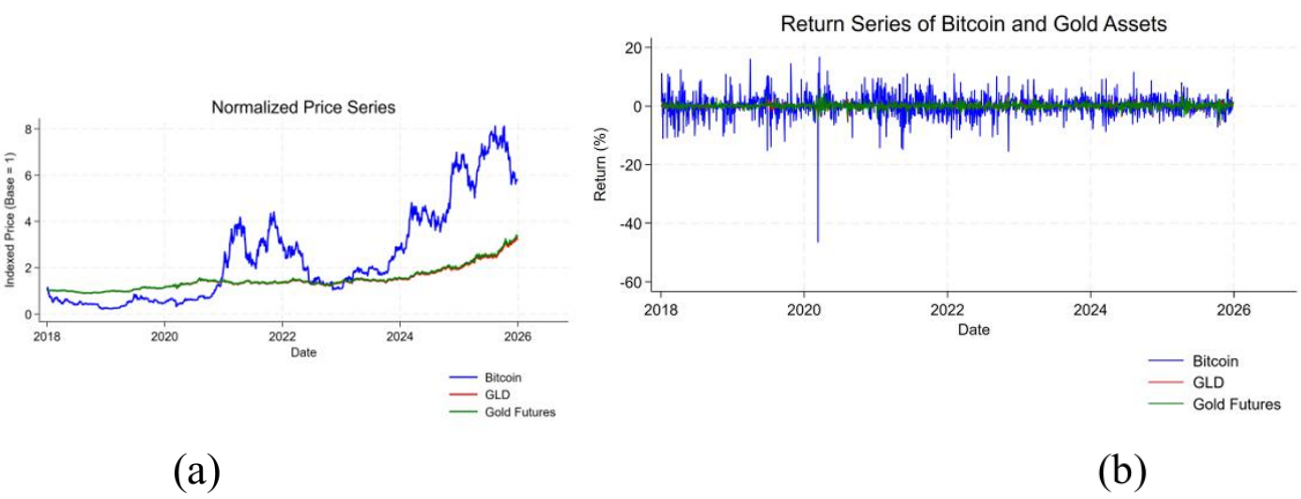
We study the time varying spillover relation between Bitcoin, gold and two variables, geopolitical risk and market uncertainty for the period 2018-2025.The daily data of important event happening in the word are utilized to with respect to the COVID-19 pandemic and the Russia – Ukraine conflict, this paper initially uses the EGARCH and APARCH models for analyzing the dynamic behavior of Bitcoin and gold volatilities. We finally applied the DCC-MGARCH model to estimate their dynamic conditional correlation and use a regression to find out what are the macro-financial determinants of spillover intensity. Our empirical evidence shows that Bitcoin has much more volatility, more pronounced asymmetry, and more speculatory features than the latter while gold still preserves its relatively steady-state safe-haven property. The dynamics of correlation between Bitcoin and gold are also shown to be very persistent and time-varying. Moreover, geopolitical risk severely dampens the co-movement of both assets while market uncertainty, proxied by the VIX index enhances their correlation. The effect of realized geopolitical acts appears to be more negative in terms of their impact on spillover strength than geopolitical threat. In total, these results indicate that the role of gold, which is considered a conventional safe-haven asset, is not completely substituted by Bitcoin. This research adds to the body of knowledge about digital assets and safe-haven markets and has practical implications in portfolio diversification and risk management amidst a world full of uncertainties.
Show more
Read Article PDF
Cite
Research Article Open Access
Understanding Stock Market Volatility and Financial Market Stability: Causes and Policy Responses
The stock market is an integral part of the financial market and has significant importance in the process of allocating and financing assets. The price changes are normalization and transmission and that directly affect the current operational order and stability of the financial market. This paper has taken stock market volatility as its research object and in this paper, it has been analyzed the main causes of stock exchange volatility, and some policies are discussed for maintaining stability in stock exchange. Based on literature analysis and theoretical study, this paper analyzes the formation mechanism of stock market volatility from three aspects: macroeconomic factors, policy factors and external factors. It has been discovered that the stock market has a set of factors that impact its fluctuations such as the economy, policies and the external environment. It affects the expectations of the market, the actions of investors and the flow of capital, causing changes in the price of the stocks and increasing the volatility of the market. Based on the above, the paper proposes some countermeasures for maintaining the stability of the market, including improving the regulatory system, improving the structure of investors and strengthening risk prevention ability. The research results can help to better understand the causes of the volatility of the stock market, and give some theoretical support to the stable and healthy development of the stock market.
Show more
Read Article PDF
Cite
Research Article Open Access
The Impact of Digital Transformation of Enterprises on the Quality of ESG Disclosure
The degree of digital transformation at businesses and its relationship to the amount of ESG disclosure have recently come under investigation due to the economy's shift to a new model. This study empirically examines the impact of digital transformation on the quality of ESG information disclosure using Chinese listed businesses from 2015 to 2024 as the research sample. It is based on the theory of information asymmetry and resource allocation. The above results indicate that the level of ESG reporting in the new business model will be relatively high. Based on the above analysis, the attention of analysts is a partial mediator, and marketisation positively strengthens the link between digitalisation and the quality of ESG disclosure. This effect is more pronounced for state-owned businesses and high-polluting industrial locations, according to the study of heterogeneity. In addition to the previous studies on the economic effects of digitalisation. The above research provides references to support the promotion of high-quality development in both areas.
Show more
Read Article PDF
Cite
Research Article Open Access
Analysis of the Formation and Evolution of the "Dual-Track Pattern" in the Mobile Payment Market Under the Promotion of the Digital Yuan
This paper takes the mobile payment market as the research object, and conducts relevant analysis based on platform economy theory, market structure theory, fiat currency theory, and evolutionary economic theory. This article defines the connotation and characteristics of the dual-track pattern, and reveals the mechanism of its formation and the three-stage evolutionary path. This study utilizes panel data from 31 provinces spanning from the first quarter of 2019 to the fourth quarter of 2025, with a total sample of 260 observations. The article empirically examines the impact of the promotion of the digital yuan on the market share and competitive efficiency of mobile payments. This article posits that China's mobile payment has evolved into a dual-track operating system, with digital yuan serving as the public track and third-party payment as the private track. The two payment modes are primarily complementary, with local competition existing between them, and the division of labor in related businesses is clear. The promotion of digital yuan can significantly reduce the market share of leading payment institutions. Relevant measures can optimize the existing market structure of the industry, and the promotion of digital yuan can effectively enhance the overall competitive efficiency of the mobile payment industry. Based on empirical conclusions, this article proposes corresponding countermeasures and suggestions from four dimensions: positioning clarification, scenario expansion, regulatory coordination, and ecological integration. The relevant content of the article can provide reference for promoting the steady evolution of the dual-track pattern and facilitating the high-quality development of the payment market.
Show more
Read Article PDF
Cite
Research Article Open Access
The M echanism and P ath of G reen F inance of C ommercial B anks to E mpower R ural Areas Under the D ual C arbon G oal
Under the macro background of the " double carbon " goal and the in-depth implementation of the rural strategy, the green allocation of financial resources has become the key driving force to promote the transformation of agriculture and rural areas. At present, rural areas are facing practical difficulties such as poor financing of green industries, a lack of realization mechanism of ecological resource value, and insufficient motivation for green transformation of traditional industries. This paper focuses on the rural green finance of commercial banks, combs the research hotspots and evolution context, and constructs a ' direct-indirect ' two-dimensional mechanism framework. And explore the collaborative path from the government, financial institutions, and agricultural business entities. This paper deepens the theoretical cognition of the coordinated development of green finance and rural areas, provides theoretical and practical reference for the green financial products and services of commercial banks and improving the relevant policy system, and is of great value to promote the comprehensive green transformation of the rural economy and society and common prosperity.
Show more
Read Article PDF
Cite
Research Article Open Access
Changes in Financing Constraints During Intergenerational Succession in Family Businesses - The Case of New Hope
As Chinese family enterprises are entering a peak period of intergenerational succession, changes in financing constraints have important practical and theoretical significance for sustainable development. Taking New Hope Group as an example, and using literature analysis, case study, and exploratory comparative analysis, this paper examines how intergenerational succession affects financing constraints in family businesses. The results show a U-shaped pattern during succession. Financing constraints are relatively low before succession, but rise sharply during succession because the founder's implicit guarantee weakens, external stakeholders lack sufficient confidence in the successor, and the firm pursues expansion that increases capital demand. As governance is modernized, risk-taking becomes more prudent, and positive signals are sent to the market, trust is gradually rebuilt and financing constraints ease. Intergenerational succession is therefore not only a transfer of control, but also a reconstruction of governance and external trust. Professionalized management, gradual adjustment of risk-taking strategies, and the joint role of institutions and performance are key to easing financing constraints and supporting long-term development.
Show more
Read Article PDF
Cite
Research Article Open Access
Digital Penetration and Value Reconstruction: An Analysis of the Paradigm Shift in the Innovative Economy Driven by Fintech
Fintech, as a new generation of universal technology, is profoundly reshaping the value creation and distribution logic of the economic system. Based on the theory of technological economic paradigm, this article systematically reviews the existing literature on how digital penetration and value reconstruction promote the transformation of economic paradigm. By tracking the theoretical evolution of economies of scale, economies of scope, and network effects, three key mechanisms of financial technology to enhance network connectivity, reduce transaction friction, and promote value co creation are summarized. Research has shown that the positive impact of financial technology on macroeconomic efficiency has been widely recognized, but the continued widening of the digital divide and the potential accumulation of systemic risks have also raised deep concerns in academia. Finally, this article points out that current research is relatively lacking in cross-border comparative analysis, and exploration of long-term structural impacts is also insufficient. Based on this, future research directions and policy recommendations are proposed.
Show more
Read Article PDF
Cite
Research Article Open Access
Mechanisms and Environmental Applications of Biochar for Heavy Metal Remediation in Contaminated Soils
Soil contamination by heavy metals poses significant threats to ecosystems and human health. Biochar, a carbon-rich material produced from biomass pyrolysis, has emerged as a promising and cost-effective amendment for immobilizing heavy metals in polluted soils. This paper provides a critical review of the key mechanisms governing the immobilization of heavy metals (e.g., Pb, Cd, Cu, Zn) by biochar, including electrostatic attraction, ion exchange, surface complexation, and precipitation. Furthermore, this study evaluates the primary factors influencing remediation efficiency, such as pyrolysis temperature, feedstock type, and soil conditions. The results synthesized from existing literature indicate that biochar application can effectively reduce metal bioavailability and leachability, while also improving soil physicochemical properties. In summary, understanding the mechanism-property relationship of biochar is essential for optimizing its field application. This review therefore provides a theoretical basis and practical guidance for using biochar in sustainable soil remediation.
Show more
Read Article PDF
Cite
Research Article Open Access
Heterogeneity in Data Asset Capitalization and Market Reactions: A Comparative Case Study of YTO Express and STO Express
In August 2023, the Ministry of Finance issued the Interim Provisions on Accounting Treatment Related to Enterprise Data Resources, allowing enterprises to recognize data resources as assets. However, in practice, there are significant differences in the way various companies record these assets on their balance sheets. This paper takes YTO Express and STO Express, two A-share-listed courier companies, as comparative case studies. Using event study methodology and financial sensitivity analysis, it examines the market response and financial impact of differences in data asset recognition. The study finds that during the policy issuance window, YTO Express's CAR was -1.66%, while STO Express's was -7.16%, a difference of 5.5 percentage points. During the first announcement window of asset recognition, YTO's CAR was 2.33%, whereas STO's was -8.22%, exceeding a 10-percentage-point difference. The research suggests that the capital market value of data asset recognition is mainly reflected in its signaling function; aggressive strategies receive positive market feedback, while cautious strategies face negative pricing. This research expands the application of signaling theory in data assetization and offers practical references for express enterprises and regulatory authorities.
Show more
Read Article PDF
Cite