Articles in this Volume

Research Article Open Access
Brand Entertainment Communication under the Background of Algorithmic Recommendation—A Case Study of Douyin Live Streaming Marketing
With the rapid growth of short-video live streaming, algorithmic recommendation has become the core driver of traffic distribution on Douyin. Many brands now use entertaining livestream content to reduce the stiff, promotional feel of marketing and attract viewers. This paper focuses on Douyin livestreaming, employing literature review and case analysis as its primary methods. It mainly explores how recommendation algorithms affect brand content dissemination and analyzes effective strategies for brand entertainment communication. The results show that algorithms enable accurate audience matching via user tags and behavioral data, while entertaining livestream content tends to sustain traffic advantages. Nevertheless, problems such as content homogenization still exist. Brands need to combine algorithm rules to innovate entertainment forms so as to achieve better communication and marketing effects. This research enriches the theoretical framework for algorithm-driven brand livestream communication in China's short-video ecosystem and offers actionable suggestions for physical-goods brands to implement long-term entertainment livestream marketing on Douyin.
Show more
Read Article PDF
Cite
Research Article Open Access
ESG Rating Divergence, Information Frictions, and Capital Market Efficiency: A Mechanism-Based Synthesis from China
The rapid expansion of ESG (Environment, Society and Governance) investment has placed ESG ratings at the core of capital market decisions. Nevertheless, the significant differences among various rating agencies have drawn widespread attention to the reliability of ESG information and its impact on market efficiency. To this end, this paper establishes a comprehensive analytical framework to assess the impact of ESG rating discrepancies on the information of the capital market, with stock price synchronicity serving as the measurement indicator. Based on a review of the relevant literature, it integrates studies on information asymmetry, limited investor attention, and analyst information intermediation. On this basis, it summarizes three main transmission paths through which ESG rating discrepancies impact information efficiency: heightened information asymmetry, scattered investor attention, and reduced analyst prediction quality. The results suggest that, taking into account the institutional features of China's capital market, including the dominance of retail investors, relatively weak information disclosure, and the strong policy-driven ESG, the aforementioned effects may be significantly amplified in the Chinese context.
Show more
Read Article PDF
Cite
Research Article Open Access
Scale Efficiency and Local Legitimacy—The Overseas Expansion Strategy of Chinese Social Media Platforms
The core tension in the transnational expansion of social media platforms lies between scale efficiency and local legitimacy. Taking TikTok as its primary case, with RedNote (Xiaohongshu) and WeChat as comparisons, this paper decomposes overseas expansion strategy into four pillars: mode of entry, algorithmic distribution, the monetization loop, and governance architecture. It traces how ByteDance bought out the cold-start cost of network effects through the acquisition of Musical.ly, externalized content production to local creators so that the cultural discount never arose, extended an advertising–live-streaming–commerce loop at speeds that varied by market, and finally exchanged equity and governance rights for continued market access through the TikTok US data security joint venture formed in January 2026. The two comparative cases sharpen the argument from opposite directions: RedNote acquired scale by accident in the "TikTok refugees" episode of 2025 but could not consolidate it without institutional preparation, while WeChat, lacking a distribution mechanism independent of the social graph, has been unable to cross network barriers already occupied abroad. The paper argues that expansion follows two curves separating by stage. In the early phase algorithmic and product capability permit low-cost replication, the further expansion proceeds, the higher the legitimacy costs imposed by compliance, data governance and geopolitics, and the deeper institutional pressure reaches from operations into ownership itself. What ultimately sets the ceiling is not product capability but institutional adaptability. On this basis the paper draws out four strategic patterns and offers recommendations at two levels: for platform firms, and for policy and industry.
Show more
Read Article PDF
Cite
Research Article Open Access
The Impact of Generative AI Applications on Creative Labor and Commercial Sustainability in the Hollywood Film Industry
In Hollywood, generative artificial intelligence (GenAI) is becoming a growing part of filmmaking, introducing innovative solutions but also new challenges for the workforce, authenticity, and the future of the film industry. This research explores the implications of GenAI applications for creative work, redefining notions of originality, and their impact on the economic viability of the Hollywood film industry. The research draws on a literature review and conceptual analysis of the latest studies on AI-assisted filmmaking, creative labour, digital replicas, copyright, and AI governance, which have appeared since 2022 to this day. The results indicate that GenAI does not so much replace or support the human creative as it re-distributes creative work, authority, and responsibility among workers, technologies, and production organizations. AI-assisted screenwriting, AI-generated performances, digital replicas, and visual generation are also selected technologies that erode the lines between human creativity and machine-generated content, further emphasizing the importance of human input and control in the creation of original works. Although GenAI can enhance production efficiency and open up new creative possibilities, it can also lead to issues of labor instability, IP risks, and potential loss of creative legitimacy and stakeholder trust. The study raises several key questions, one of which is whether or not GenAI can become a financially viable commercial entity in Hollywood while ensuring that human creative control is upheld, labor practices are fair, and legal and governance frameworks are sound.
Show more
Read Article PDF
Cite
Research Article Open Access
Research on Export Opportunity Identification and Coping Strategies of New Energy Lithium Batteries under Dual-Carbon Constraints: A Case Study of Do-Fluoride New Materials Co., Ltd.
The global implementation of dual-carbon strategies is reshaping the energy and transportation landscape. Meanwhile, carbon control and battery localization trade policies issued by European Union (EU) and the United States (U.S.) have raised the entry barriers for lithium battery exports. Existing studies mostly explore policy impacts and industry-level analysis, while in-depth discussions on the path mechanisms through which enterprises can identify and convert export opportunities under dual-carbon constraints remain insufficient. This paper identifies segmented export opportunities for lithium batteries in overseas markets under dual-carbon constraints, and analyze the operating mechanisms of corporate exports amid multiple trade, market and technological constraints. Based on the case study of Do-Fluoride, this paper conducts analysis combining industry data, corporate operating data and texts of low-carbon trade policies of various countries. The results show that energy storage, new energy passenger vehicles, and light electric vehicles represent the three major growth areas driving incremental demand for lithium battery exports. The integrated industrial chain endows Do-Fluoride with advantages in cost and product adaptation, yet carbon compliance barriers, intensifying industry competition, and fast-evolving technologies continue to put pressure on overseas market profitability. Furthermore, enterprises need to adopt combined strategies including hierarchical regional layout, low-carbon technology R&D and product structure upgrading to achieve sustainable overseas development.
Show more
Read Article PDF
Cite
Research Article Open Access
A Study on the Multidimensional Construction and Innovative Pathways of Art Sponsorship Models
Art sponsorship serves as a crucial mechanism to address the lack of creativity in art product creation and the dilemma of sustainable development. Its systematic construction holds significant theoretical and practical significance in the context of the current cultural governance transformation. However, the existing relevant research is limited in quantity and lacks systematicness, failing to form a complete theoretical framework. This paper systematically reviews the relevant literature on art sponsorship at home and abroad in the past decade, integrates various academic viewpoints, aiming to clarify the subject relationships, behavioral motivations, model types, and effectiveness evaluation mechanisms of art sponsorship, analyzes the research commonalities and development trends, and summarizes them into three major research directions: sponsorship subjects and relationships, motivations and value cognition, and sponsorship models and effectiveness evaluation. The study finds that art sponsorship is a dynamic system shaped by diverse subjects, motivations, models, and evaluation mechanisms. Moreover, effective coordination among stakeholders and scientific evaluation are essential for sustainable development. In the future, attention can be paid to the power dynamics in crisis situations, the interaction between globalization and local culture, and the application of digital models in practice.
Show more
Read Article PDF
Cite
Research Article Open Access
Diversification Beyond Stocks and Bonds: A Mean-Variance Assessment of Gold and Real Estate in a Multi-Asset Portfolio
Article thumbnail
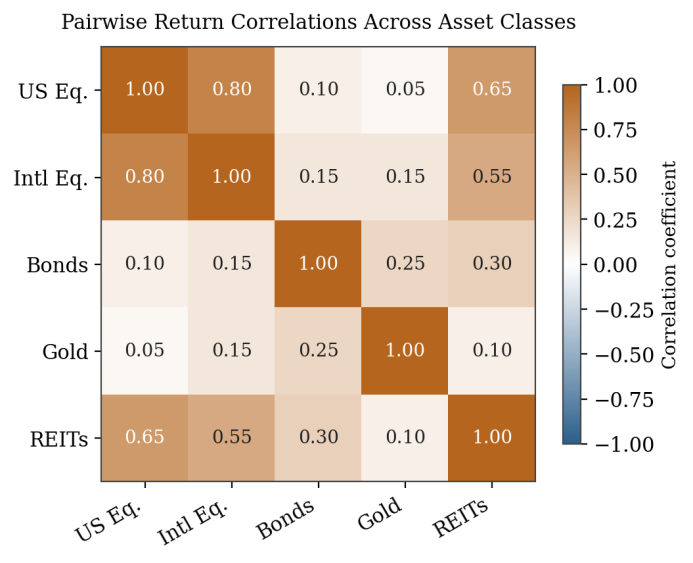
Modern portfolio construction increasingly extends beyond the traditional combination of equities and fixed income to include alternative assets such as gold and real estate. This study evaluates whether the inclusion of these alternatives improves the risk-return efficiency of a conventional two-asset portfolio. Using representative long-run annualized estimates of returns, volatilities, and correlations for five asset classes, including domestic equities, international equities, investment-grade bonds, gold, as well as real estate investment trusts, the study uses a mean-variance optimization framework to construct efficient frontiers, global minimum-variance portfolios, and tangency portfolios under a long-only constraint. The results show that alternative assets provide different diversification benefits. Gold receives an allocation of approximately 15% in the optimal risky portfolio despite its low standalone Sharpe ratio, as its low correlation with equities reduces portfolio risk. In contrast, the allocations to real estate and international equities remain limited due to high correlation with domestic equities. At the portfolio level, the expanded opportunity set increases the maximum Sharpe ratio by approximately 4-5% and lowers the volatility required for a given return target. The results confirm that diversification benefits depend more on covariance with existing holdings than on standalone performance.
Show more
Read Article PDF
Cite
Research Article Open Access
From Blind-Box Draws to Multiple Consumption Contexts: A Longitudinal Archival Case Study of POP MART
Existing studies of POP MART mainly explain purchasing and brand diffusion through blind-box uncertainty, gamification, and platform circulation, while paying less attention to how product form, channel arrangements, and communication environments enable multiple consumption contexts over time. Drawing on POP MART's 2020 prospectus, annual-results announcements for 2020-2025, and external archival sources, this study adopts a longitudinal archival case-study design and develops an integrative framework of action, space, and visibility. Visibility is differentiated into the material conditions for consumer-carried visibility, its realized enactment in specific settings, and firm-orchestrated visibility. The case shows three broad periods: the digitalization of purchasing and elevation of collection, the expansion of content and experiential spaces, and changes in material structure accompanied by differentiated visibility. Growth in plush revenue demonstrates the rising commercial importance of plush categories and tactile materials, but does not by itself establish company-wide portability. Miniature pendants indicate that attachment and portability became a visible design direction, while their revenue contribution remains undisclosed. The study therefore offers a bounded process explanation of consumption-context expansion without treating corporate disclosures as direct evidence of general consumer behavior or causal revenue effects.
Show more
Read Article PDF
Cite
Research Article Open Access
Financially Material ESG Factors in DCF Valuation: A Retrospective Scenario Analysis of BYD
BYD's 2025 financial statements highlight a challenging valuation problem: while revenue continued to grow, operating cash flow weakened as capital expenditure reached RMB 140.2 billion. This essay constructs three retrospective free cash flow to the firm (FCFF) scenarios extending to 2035 based on BYD's annual report and sustainability report. Sustainability indicators are only considered when they affect forecast inputs; no additional ESG premium is applied. Assuming a weighted average cost of capital (WACC) of 6.6%, the estimated equity values per share under the downside, base-case, and upside scenarios are RMB 56.60, RMB 98.88, and RMB 130.66, respectively. In the base-case scenario, the present value of terminal value contributes 78.8% of enterprise value, indicating substantial dependence on long-term assumptions. Consequently, valuation outcomes are highly sensitive to assumptions regarding margin improvements, capital expenditure normalization, and terminal value parameters. By linking financially significant sustainability disclosures to specific DCF input parameters, this study provides a transparent framework for integrating ESG information at the corporate level without arbitrarily adding ESG premiums. The findings offer practical insights for investors assessing capital-intensive firms, whose valuations are heavily dependent on long-term reinvestment and terminal value assumptions.
Show more
Read Article PDF
Cite
Research Article Open Access
The Relationship Between Academic Major and Smartphone Brand Preference: A Contingency Table Analysis
Article thumbnail
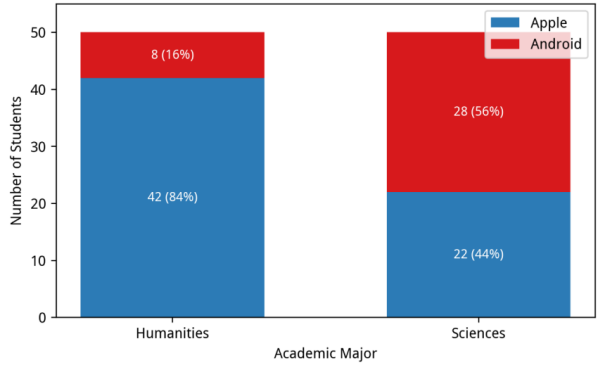
The choice of smartphone brand has become a topic of interest in consumer behavior research, with factors such as age, income, and social influence being widely studied. However, the role of academic background—specifically, whether a student's major field of study is associated with brand preference—remains underexplored. This study aims to investigate the association between university students' academic major (humanities vs. sciences) and their smartphone brand preference (Apple vs. Android). A questionnaire survey was conducted among 100 university students, comprising 50 humanities majors and 50 science majors. The data were organized into a 2×2 contingency table. Descriptive statistics, including percentage calculations and a stacked bar chart, were used to visualize the distribution. Inferential analysis was performed using the chi-square test of independence to examine whether the two categorical variables were statistically independent. Standardized residuals were calculated to identify cells contributing most to the overall chi-square value. The results show a significant association between academic major and brand preference (χ²=16.61, df=1, p<0.001), with humanities students showing a stronger preference for Apple and science students showing a stronger preference for Android. These findings suggest that academic discipline may shape consumer preferences, potentially through peer influence or value alignment.
Show more
Read Article PDF
Cite