Articles in this Volume

Research Article Open Access
The Impact of Blockchain Technology Applications on Enterprise Financial Performance — A Case Study of China Telecom
Against the backdrop of the digital economy, blockchain technology, with its decentralization, immutability, and fulltraceability features, has become an important technical pillar for enterprises' financial digital transformation. To examine the real effects of blockchain adoption on corporate financial performance, this paper takes China Telecom as the research object, using case study and financial indicator comparison methods to review the application history and current implementation of blockchain in corporate financial scenarios. It analyzes the change in financial performance before and after blockchain implementation in a systematic manner using five dimensions, namely, profitability, operating capacity, cost and expense control, solvency, and development capacity. The research indicates that blockchain is very effective in improving the performance of companies financially through the optimization of the settlement process, reduction of operational expenses, and improvement of data credibility and the quality of internal controls, creating a pathway of transmission of technology adaptation - process reengineering - value enhancement. In turn, existing applications have drawbacks such as poor technical coordination, coverage of a few scenarios, and a lack of interdisciplinary skills. The conclusions give useful references to the financial digitalization of the telecommunication sector.
Show more
Read Article PDF
Cite
Research Article Open Access
The Impact of ESG Rating on Enterprise Financing Cost -- Taking Longji Green Energy as an Example
This paper mainly takes Longji green energy, the leader of the photovoltaic industry in the new energy industry, as the main research object, and makes full use of signal transmission theory to analyze the impact of ESG rating on enterprise financing costs. The change trend of enterprise financing cost is reflected by the change in enterprise ESG rating. This paper mainly uses case analysis to analyze the relationship between Longji green energy's ESG rating performance and financing cost from many aspects, and learned that ESG rating has a significant impact on green bonds and bank loans. The research shows that the ESG rating is negatively correlated with the financing cost of enterprises. Companies with better ESG ratings can obtain more green bonds and more bank loan policies. The better the ESG rating, the lower the financing cost. Based on the results of this study, suggestions to promote ESG rating are put forward to optimize the financing cost structure.
Show more
Read Article PDF
Cite
Research Article Open Access
Economic Growth and Low Fertility Trap: A Comparative Study of China and the US from the Perspective of Childbearing Costs
Article thumbnail
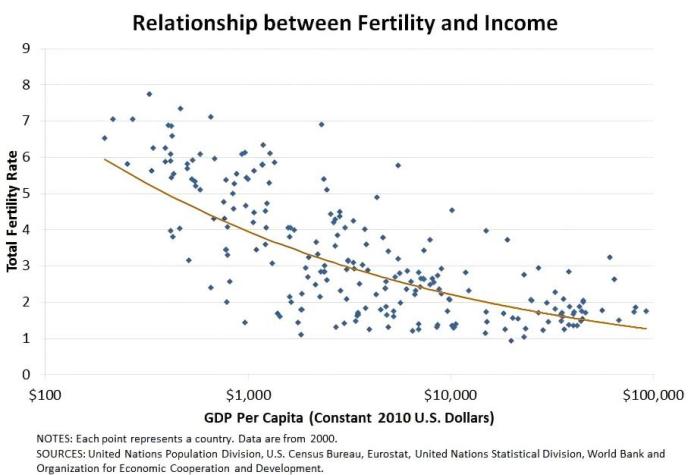
The concomitant decline in fertility rates with economic growth has become a core issue hindering sustainable socioeconomic development globally. Based on classical fertility economics theories, this paper takes China and the United States as research samples to analyze the mechanisms of economic growth on fertility behavior, and compares the differential effects of four core economic variables—income level, housing costs, education expenditure, and social welfare—in the two countries, while sorting out the evolution and regulatory effects of their fertility policies. The study finds that economic growth suppresses fertility intentions by increasing the opportunity and direct costs of childbearing, rather than boosting fertility rates automatically. Both countries face sub-replacement fertility rates, but China is more severely affected by high housing prices and education costs, falling into an ultra-low fertility trap. In contrast, the US forms a fertility floor through tax credits and immigration policies, with a significantly higher fertility rate. This paper argues that alleviating the long-term impact of low fertility and providing demographic support for sustainable economic development requires a systematic fertility support system that integrates economic and social policies to reduce the costs of childbearing, childcare, and education.
Show more
Read Article PDF
Cite
Research Article Open Access
Research on the Influence Mechanism of Artificial Intelligence Application on Enterprise Innovation Efficiency
Based on the data of Shanghai and Shenzhen A-share listed enterprises from 2012 to 2023, this paper empirically examines the impact of artificial intelligence (AI) application on enterprise innovation. The study finds that AI application can significantly improve enterprise innovation efficiency, and the transmission mechanism is mainly realized through the mediating effects of enterprise new-quality productivity, enterprise data factor utilization level, and enterprise ESG performance. Meanwhile, market segmentation, fiscal support intensity, and human capital structure exert moderating effects on the above benchmark relationship. In addition, heterogeneity analysis shows that the impact of AI application on enterprise innovation efficiency is stronger in central and western state-owned enterprises that are asset-intensive and labor-intensive.
Show more
Read Article PDF
Cite
Research Article Open Access
The Effect of Moneyness on the Pricing Accuracy of Monte Carlo Simulation: Evidence from European Call Options
Option pricing is a central issue in financial economics because derivative valuation is essential for risk management, hedging, and investment decision-making. Among pricing methods, Monte Carlo simulation is widely used due to its flexibility and applicability in computational finance. However, for European call options, it is already well proved that Monte Carlo simulation can generate valid prices and that larger simulation sizes generally improve accuracy. Therefore, this study focuses on a more specific question: whether the finite-sample pricing accuracy of Monte Carlo simulation differs across in-the-money (ITM), at-the-money (ATM), and out-of-the-money (OTM) European call options. Using the Black-Scholes model as an analytical benchmark, the study applies an R-based Monte Carlo simulation framework to compare pricing performance under different moneyness scenarios and simulation sizes. The analysis shows that Monte Carlo pricing performance is not same across option states, as differences in payoff structure lead to different levels of pricing error and stability. The study points out that moneyness is an important factor of finite-sample simulation accuracy in European call option pricing.
Show more
Read Article PDF
Cite
Research Article Open Access
Does Trade Drive Per Capita GDP Growth? Evidence from the Developing World
Trade is an important component of national income accounting. The GDP identity implies a positive relation between net export and GDP level, but the GDP identity does not establish causality. This paper plan to study the causal effect of trade on income growth using a panel data of 111 developing countries over 1970–2020. To address endogeneity, both ordinary least squares (OLS) and instrumental variable (IV) approaches are implemented, where the instrument is constructed by the average GDP of countries' top five trading members with air freight capacity to generate exogenous variation in trade exposure. The IV results indicate a not only positive but also significant effect of countries' trade on income: one-percentage-point increase in the trade growth raises GDP per capita by 0.11 percent over 1997–2020. These findings show a causal link between trade growth and economic growth, while leaving the underlying mechanisms—such as technology diffusion and capital accumulation—for future research.
Show more
Read Article PDF
Cite
Research Article Open Access
Mandatory ESG Disclosure in China–A Structured Review and Integrative Framework
Article thumbnail
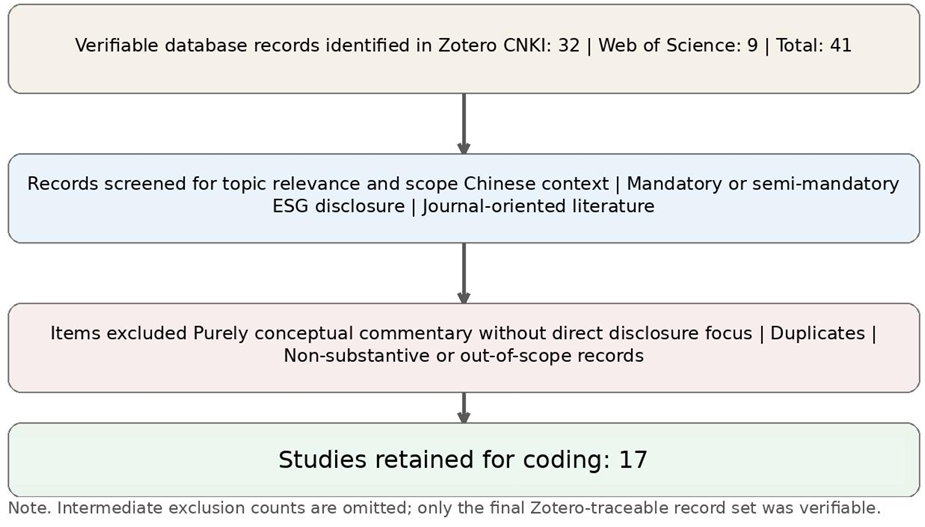
China's stock exchanges moved from a largely voluntary or comply-or-explain model toward mandatory sustainability reporting in 2022, placing China within a broader global shift toward harder-law ESG disclosure. To assess what that transition is likely to achieve, this paper draws on a structured set of 17 coded studies and synthesises the core evidence on China's mandatory or semi-mandatory ESG disclosure regime. The review indicates three recurrent benefits: lower default risk and, conditionally, reduced crash risk; improved earnings quality; and stronger innovation-related investment or performance. At the same time, the literature does not support a simple "more disclosure, better outcomes" claim. Effects vary with enforcement credibility, governance quality, firm resources, ownership structure, and the verifiability of reported data. Persistent rating divergence, strategic disclosure, and short-run compliance costs show that disclosure mandates are necessary but not self-executing. Building on these findings, the paper synthesises the evidence through a four-link framework connecting mandate design, information quality, stakeholder response, and corporate outcomes, and identifies unresolved issues concerning materiality, safe-harbour design, and technology-governance complementarity.
Show more
Read Article PDF
Cite
Research Article Open Access
Research on Manufacturer Channel Strategies with the Cost Transparency Role of Blockchain and the Impact of Investment Efforts
Article thumbnail
In cross-border supply chains under the Belt and Road Initiative, longer supply chains, greater institutional heterogeneity, and limited information transparency exacerbate cost information asymmetry following supply disruptions. To capture this setting, this study develops a sequential game-theoretic model consisting of a single manufacturer and a single retailer to examine the interplay among blockchain investment, information sharing, and manufacturer encroachment. The results show that blockchain investment serves both as a market-expansion mechanism and as a cost-discovery mechanism; accordingly, both partial sharing and full sharing dominate non-sharing. However, the relative superiority of partial versus full sharing hinges on the threshold structure defined by recognition efficiency. Manufacturer encroachment strengthens the manufacturer's ability to internalize the returns to blockchain investment and thus intensifies its incentive to adopt more transparent governance. Nevertheless, such a strategy does not necessarily lead to a supply chain–wide optimum, as the retailer's profit remains jointly shaped by the channel substitution effect and the market expansion effect.
Show more
Read Article PDF
Cite