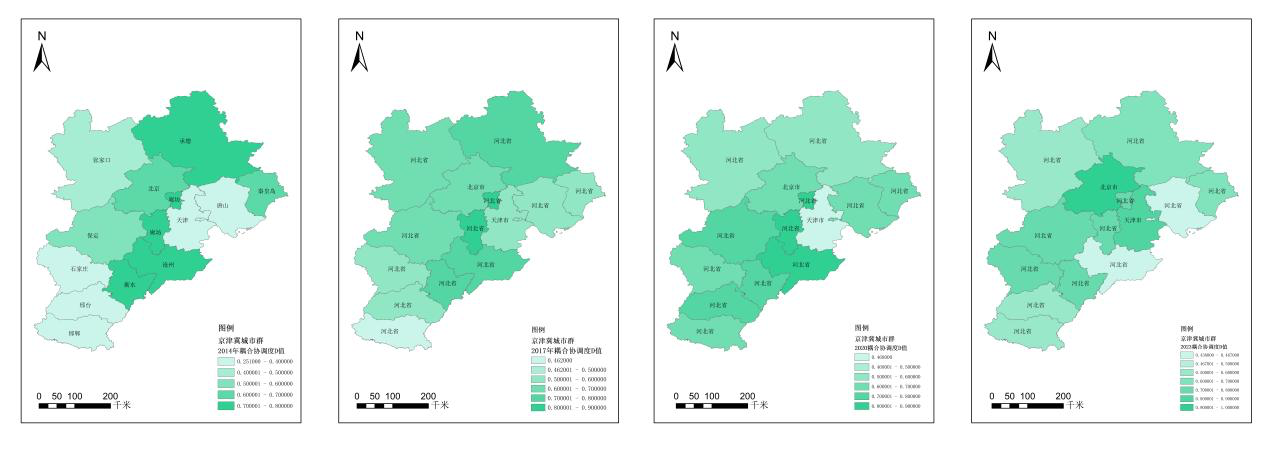
To elucidate the dynamic equilibrium between urban land use efficiency (ULUE) and ecological carrying capacity (ECC) and to devise a bi-dimensional regulatory strategy that enhances economic performance while establishing ecological safeguards, this study employs panel data from the Beijing-Tianjin-Hebei (BTH) urban agglomeration spanning the period from 2014 to 2023. Utilizing the SBM-Undesirable model, comprehensive index method, and coupling coordination degree model to construct the ULUE and land ecological security index systems, we assess the spatiotemporal dynamics of ULUE-ECC coupling coordination within the BTH region. Results indicate a differentiated evolutionary trend among the 13 cities' coupling coordination indices from 2014-2023. Beijing and Langfang exhibited persistently high coupling coordination, while Tianjin and Shijiazhuang showed significant increases in coupling coordination. Conversely, cities like Tangshan and Hengshui experienced degradation in later stages. Spatially, regional coordination displays a "core-periphery" gradient, with central cities maintaining high-quality coordination while south-central Hebei and resource cities exhibit moderate dysfunction. Cross-sectional data from 2023 reveal an overall evolution toward higher-order coupling coordination, with an increased proportion of high-quality coordinated cities. However, localized ecological security risks are evident, exemplified by Tangshan's plummeting coupling coordination index, underscoring the staged imbalance between ULUE and ecological protection.