Articles in this Volume

Research Article Open Access
Monte Carlo Simulation of European Option Prices under the Heston Stochastic-Volatility Model
Article thumbnail
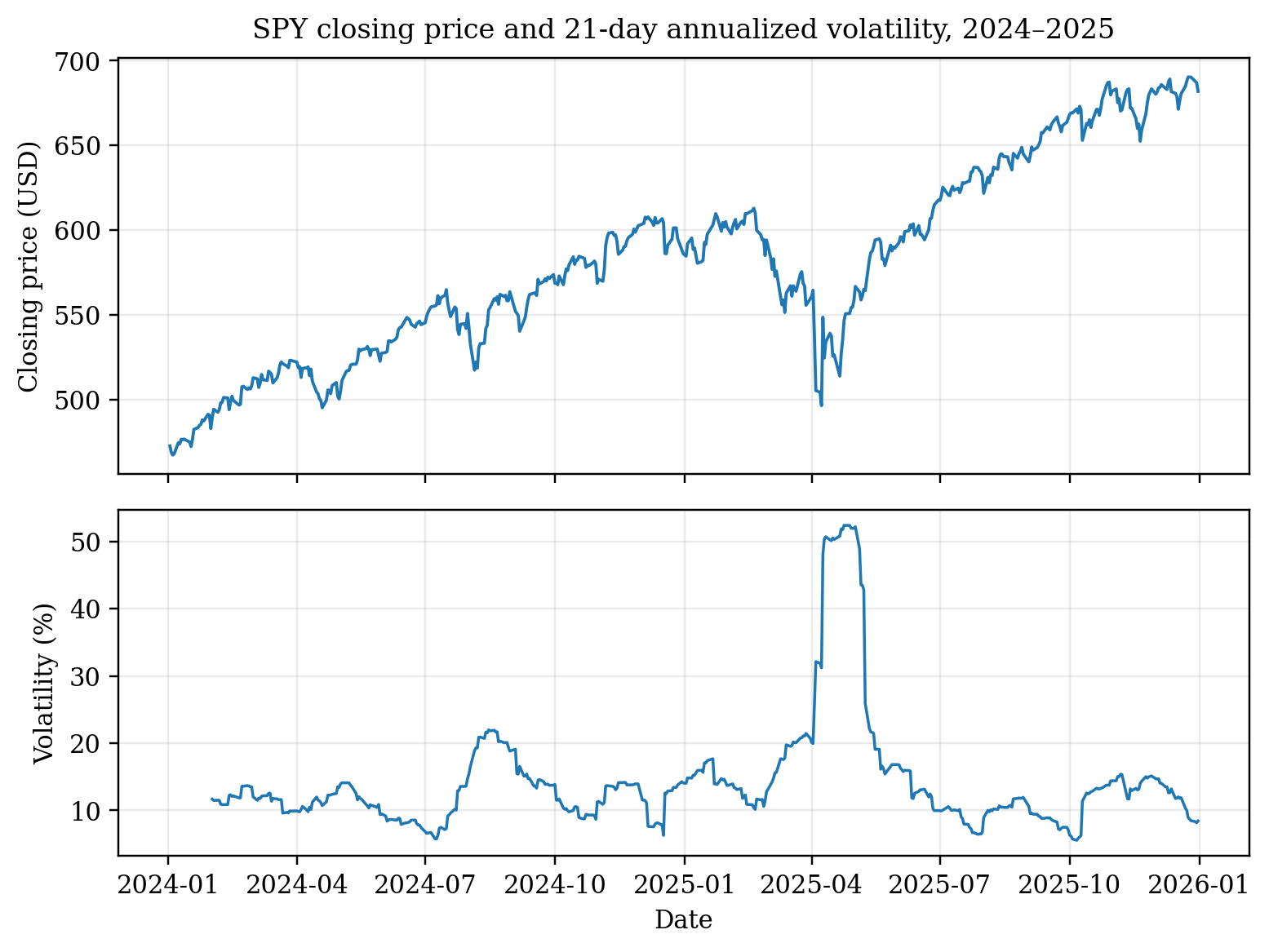
When volatility is not assumed to be constant, there are no closed-form solutions for the prices of European options; hence, numerical estimation is needed. In this paper, the accuracy and convergence of Monte Carlo simulation for pricing European call options under the Heston model is investigated. The empirical volatility process was characterised on the basis of the daily closing prices of the SPDR S&P 500 ETF Trust for the period January 2024 to December 2025 (502 trading days), and a standard literature parameter setting is used for the full market calibration. The paths of stock prices and variances were simulated using the Full Truncation Euler scheme with 252 time steps, while the terminal payoffs were discounted and averaged under the risk-neutral measure. These simulations were performed 20 times for 1,000, 10,000 and 100,000 paths and compared to the semi-analytical Heston price of 9.2425. As the number of paths increased, the mean standard error and the root mean square error decreased in the manner of 1/sqrt(N) rate of contraction with the relative bias being < 0.25 % throughout. The Black–Scholes special-case test was used to correctly replicate the closed-form price to within 0.073%. The estimator is thus correct at this scale but an additional discretisation error remains which cannot be eliminated by any number of additional paths.
Show more
Read Article PDF
Cite
Research Article Open Access
No-Arbitrage and CPT Consistency in Generative Option Pricing Models: A Systematic Literature Investigation
Generative artificial intelligence models are increasingly used for option pricing and market simulation. However, the mathematical consistency of these model outputs and their alignment with real investor behavior remain unclear. Current research on generative pricing models follows two unrelated paths: one verifies mathematical consistency in no-arbitrage, while the other examines whether investor behavior conforms to cumulative prospect theory (CPT). However, no research has yet tested both criteria simultaneously within the same generative framework. This paper, through a systematic literature review, identifies this research gap. First, this paper decomposes the no-arbitrage assumption into four testable criteria: put-call parity, strike price convexity, intertemporal spread consistency, and martingale consistency. Then, it decomposes the consistency of cumulative prospect theory into three testable criteria: the shape of the probability-weighted function, two-tailed pricing bias, and the decomposition of probability-weighted and loss-averse factors. These seven criteria were then applied to eight generative pricing papers covering four model architectures (Generative Adversarial Networks, Neural Stochastic Differential Equations, Diffusion Models, and Variational Autoencoders). A review of the results revealed that convexity and intertemporal spread conditions were tested most frequently, martingale consistency was tested in only three papers, and put-call parity and all three CPT criteria were completely unaddressed in all eight papers. This consistent gap indicates that current generative pricing research narrows arbitrage compliance to a static, curved surface condition without verifying the authenticity of investor behavior, which has practical implications for the reliability of these models in hedging and risk management.
Show more
Read Article PDF
Cite
Research Article Open Access
Linear and Nonlinear Models for Ames Housing Prices
Article thumbnail
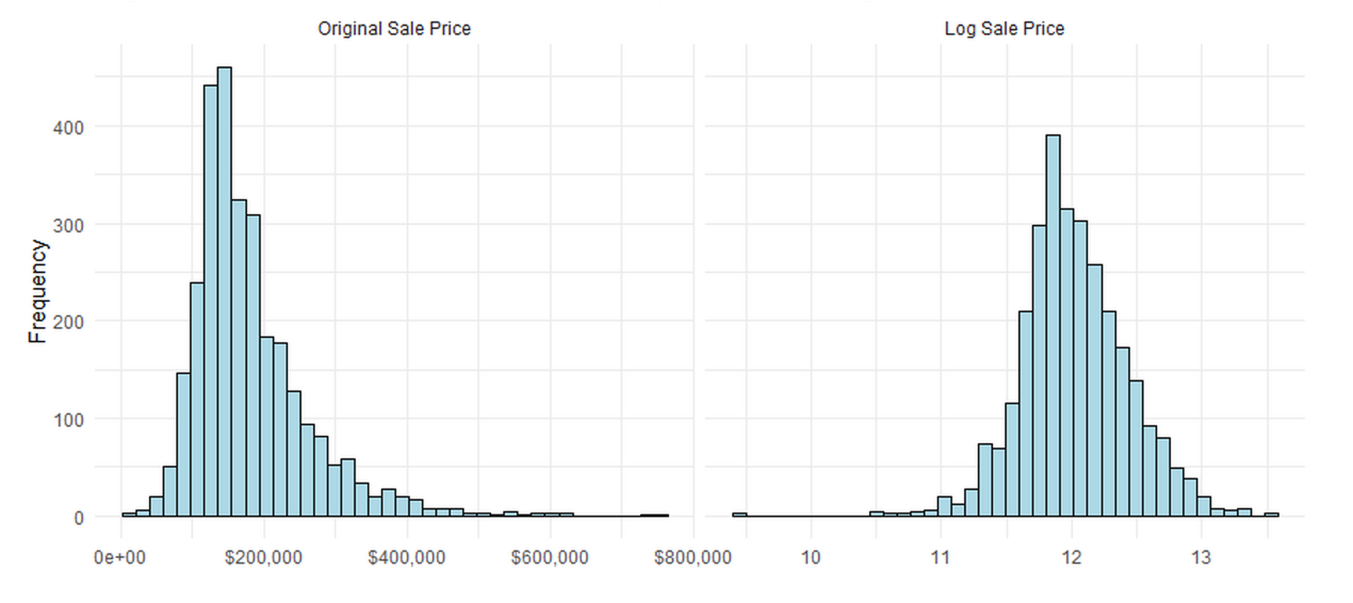
Predicting residential sale prices requires models that can handle both additive patterns and more complex relationships among property characteristics. This study compares four approaches using the Ames Housing data: raw linear regression, log-transformed linear regression with smearing retransformation, a cross-validated regression tree, and a Random Forest. The 2,930 observations were divided into 70% training and 30% test samples, and all models were evaluated on the same held-out data using RMSE, MAE, and out-of-sample R 2 . The log transformation improved the linear benchmark, reducing RMSE from $29,623.62 to $27,731.26 and MAE from $19,349.74 to $18,347.86, while increasing R 2 from 0.8700 to 0.8861. Cross-validation improved the single tree, but its final test performance remained below both linear models. Random Forest achieved the strongest overall accuracy, with an RMSE of $26,561.86, an MAE of $17,864.80, and an R 2 of 0.8955. Permutation importance identified above-ground living area, overall quality, and neighborhood as the strongest predictors. The results indicate that nonlinear flexibility was most useful when many trees were combined, while the transformed linear model remained a competitive and more interpretable alternative.
Show more
Read Article PDF
Cite
Research Article Open Access
The Impact of Government Policies and Price Changes on Tesla's Performance in Chinese Electric Vehicle Market
China has already become one of the world's largest electric vehicle (EV) markets. This brings not only opportunities but also huge pressure for Tesla. Government policies and frequent price changes have become critical factors influencing Tesla's performance in the Chinese market. This research discusses how government policies and price movements affect Tesla's sales, market position, profitability, and long-term competitiveness in the Chinese market, using literature analysis, case analysis, and content analysis. It aims to examine the history of Chinese EV development, Tesla's localization and pricing strategies, and the changing environment of the Chinese EV market. The research indicates that government subsidies, tax incentives, infrastructure development and support for local manufacturing promote the expansion of the EV market and help Tesla reduce production costs through localization, thereby improving its productivity and cost efficiency. At the same time, price cuts could augment affordability and stimulate consumer demand; however, frequent price movements also reduce profit margins and intensify competition among domestic EV companies. The connection between policies and pricing strategies is close, because local production and policies can provide more flexibility for Tesla. The study suggests that Tesla's long-term competitiveness in the Chinese market depends on a balance between price competitiveness, cost control, localization, technological development, and adaptation to changes in government policies.
Show more
Read Article PDF
Cite
Research Article Open Access
Research on the Effect of Path Optimization on Supply and Demand Coordination in the Fresh Food Cold Chain
The fresh food cold chain is characterized by significant demand fluctuations, high product perishability, and numerous supply chain nodes, posing substantial challenges to supply-demand coordination. Traditional research on route optimization has primarily focused on logistics efficiency factors such as transportation time, cost, and product loss, while relatively limited attention has been paid to the value of supply chain coordination. From a supply chain coordination perspective, this study analyzes route optimization factors—including transportation time, cost, product loss, and dynamic demand—based on theories of supply chain coordination, information sharing, and the bullwhip effect. It further explores how these factors enhance supply-demand alignment and supply chain collaboration efficiency. Research has found that route optimization can, on the one hand, directly improve the alignment between supply and demand by enhancing logistics operational efficiency, reducing product loss, and boosting a company's effective supply capacity; on the other hand, it can connect various supply chain participants through information sharing, promote the coordinated allocation of inventory and logistics resources, and enhance the overall responsiveness of the supply chain. It offers valuable insights for optimizing supply chain coordination in fresh food enterprises.
Show more
Read Article PDF
Cite
Research Article Open Access
AI in the Game Industry: Latest Research Advances and Future Direction
The paper is a summary of the current developments of AI in the gaming sector between 2023 and 2026, including automated generation of content, intelligent game agents (NPCs) and large language models (LLMs), game testing and quality assurance by means of AI, modeling of players and dynamic difficulty management, as well as reorganization of the industry and the new concept of the so-called AI-native games. This study reveals that the use of AI will not be used to assist in the creation of contents but rather become part of the core elements of game mechanics. Real-time diffusion models can model game engines (GameNGen), LLM agents are already implemented in commercial QA systems (TITAN framework), reinforcement learning and player modeling can be applied to adjust the difficulty of the game dynamically based on the data. At the same time, there exists a discussion in the field of efficiency of the process, the creative aspect of it, and how much restructuring of the organization should be done. The authors also suggest some of the criteria which can be used to determine whether a game is an AI-native game (counterfactual testing) and indicate the open issues like automatic playability tests, user acceptance, safety of the contents and ownership of the copyright.
Show more
Read Article PDF
Cite
Research Article Open Access
Data Quality Challenges in Artificial Intelligence: Impacts of Missing, Mislabeled and Biased Data on Machine Learning
Artificial Intelligence (AI) is developing at a high speed and is now used in many places. AI models need a large amount of data to some extent; therefore, problems in the data can lead to errors in the model. The three main types of harmful data that are the subject of this study are biased, mislabelled and missing data. If a large part of the data set is missing, it will result in information loss and a lower-performing model. In addition, the model may be incorrectly trained due to mislabelled data and thus unreliable. If the data are biased, then there will be discrimination against some groups. Some possible countermeasures have also been mentioned in the discussion. Imputation or Deletion Methods are used to address missing values. Data cleaning, label verification and noise-robust learning can all reduce mislabelled data. Bias in the data can be addressed before, during and after model training. Generally speaking, there is no single way to handle all the data problems. Different datasets and problems have different solutions, so they will be different.
Show more
Read Article PDF
Cite