Articles in this Volume

Research Article Open Access
Optimization of Revenue Management Strategies for Cathay Pacific Based on Dynamic Pricing Theory
This study optimizes revenue management strategies for Cathay Pacific Airways amid post pandemic market volatility and intensified Asia-Pacific competition. Addressing critical issues including demand forecast lag, imprecise price elasticity measurement, channel pricing inconsistencies, and insufficient transit passenger segmentation, this research proposes quantitative finance-driven solutions. Key strategies include rebuilding dynamic demand price elasticity models, implementing real-time cost fluctuation pricing mechanisms, and adopting differentiated unbundled pricing for premium cabins. Implementation safeguards encompass digital system upgrades, organizational restructuring, and compliance framework to enhance Revenue per Available Seat Kilometer (RASK). By integrating financial engineering with airline revenue management, this paper provides a replicable optimization framework that helps airlines maximize revenue, respond rapidly to cost changes, and innovate dynamic pricing during structural market shifts. Ultimately, these recommendations offer a forward-looking blueprint for sustaining profitability and long-term resilience in an increasingly global aviation landscape. Meanwhile, help airlines to chase profit maximization and decrease the pressure form fuel price or other cost fluctuation
Show more
Read Article PDF
Cite
Research Article Open Access
A Machine Learning Framework for S&P 500 Directional Classification and Kelly-Optimal Position Sizing
Article thumbnail
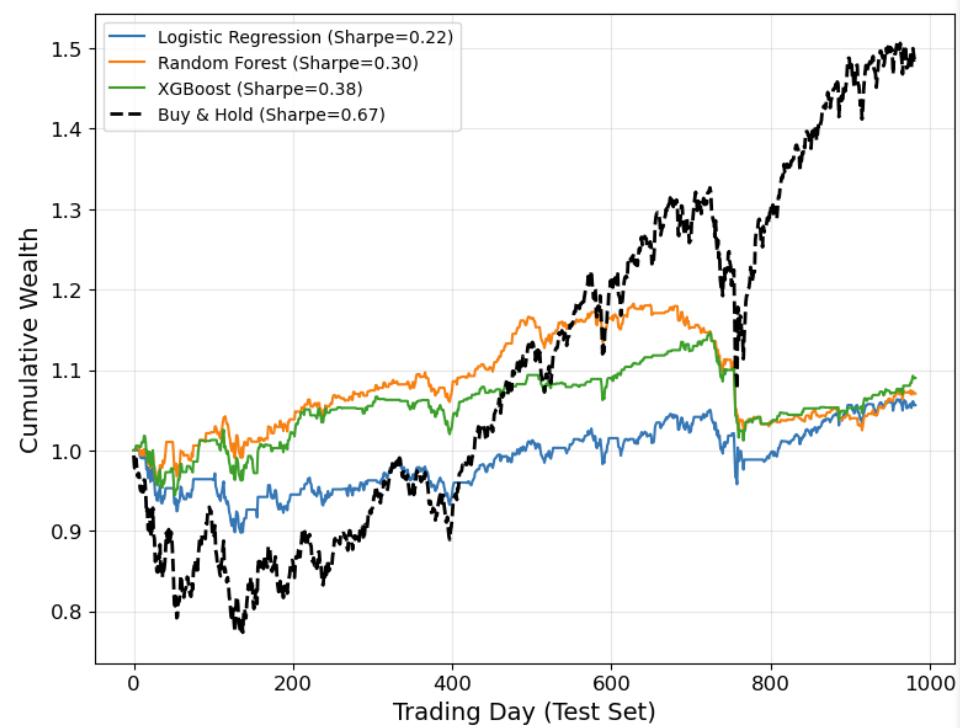
This study investigates whether supervised learning models can predict short-term directional movements in the Standard & Poor's 500 (S&P 500) and whether these predictions can be converted into a viable trading strategy using the Kelly Criterion. Using 26 years of daily Open, High, Low, Close, Volume (OHLCV) data (2000–2026), 18 features — including lagged returns, technical indicators, volatility and volume measures, and calendar effects — were engineered, and three classifiers — Logistic Regression, Random Forest, and eXtreme Gradient Boosting (XGBoost) — were compared. Model outputs were transformed into optimal position sizes via the Kelly Criterion and evaluated on cumulative return, Sharpe ratio, and maximum drawdown, benchmarked against a full-investment variant and Buy-and-Hold. Results show that all models achieved approximately 40% test accuracy — above the 33% random baseline — with Logistic Regression performing best on accuracy (40.69%) and Area Under the Curve (AUC) (0.589). Kelly-based strategies cut maximum drawdown by more than half relative to full investment, to between 10% and 14%, though Buy-and-Hold still achieved a higher Sharpe ratio. These findings suggest that while supervised learning offers a modest predictive signal, the Kelly Criterion is effective primarily as a risk-management tool rather than a return-enhancing strategy.
Show more
Read Article PDF
Cite
Research Article Open Access
U.S. Technology Stock Market Returns and the Hang Seng TECH Index: Evidence on Cross-Market Spillovers
Article thumbnail
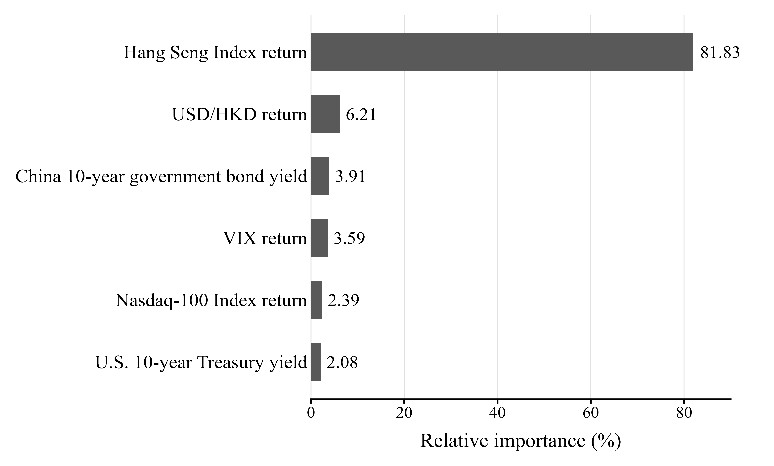
Against the backdrop of growing interconnectedness of global tech asset pricing, this paper investigates cross-market return spillovers from U.S. tech stocks to China's Hong Kong technology sector. Using 733 daily observations spanning January 2023 to December 2025, the study aligns each trading day in China's Hong Kong market with the prior completed U.S. session before China's Hong Kong opens, and adopts OLS and XGBoost to examine linear linkage, out-of-sample performance and feature contributions. After controlling for Hang Seng Index returns, USD/HKD returns, VIX and Sino-U.S. 10-year bond yields, the Nasdaq-100 return coefficient remains significantly positive at the 5% level, revealing the U.S. tech market delivers modest yet robust incremental information for Hang Seng TECH Index returns. Out-of-sample results show OLS marginally outperforms XGBoost, meaning nonlinear tree models fail to boost fitting power within this sample and variable set. SHAP analysis verifies Hang Seng Index returns dominate model explanatory power, while Nasdaq-100 returns carry limited feature importance. By matching non-overlapping trading hours and interpretable machine learning, this paper distinguishes average marginal effects from variable fitting contributions, offering new empirical evidence for tech stock co-movement and risk evaluation of China's Hong Kong tech market.
Show more
Read Article PDF
Cite
Research Article Open Access
Corporate AI Adoption Announcements and Stock Market Reactions
Since the launch of ChatGPT in late 2022, generative AI has become a major focus for global capital markets. However, the market reactions to AI-related announcements of listed companies are very heterogeneous, and the underlying mechanisms are still underexplored. In this study, this paper analyze AI announcements by firms in a fixed list of S&P 100 constituents over the period 2023–2024. Researchers test, using event study methods and cross-sectional regressions, whether implementation intensity and technological capabilities are associated with short-term market reactions. The mean cumulative abnormal return (CAR) for the [-5, +5] window is 3.0%, which is statistically different from zero at the 5% level and is based on 26 announcements with complete return data. This paper find that implementation-oriented announcements are associated with CARs that are about 4.6 percentage points higher than intention-oriented announcements, although the effect is only marginally significant at the 10% level and becomes insignificant under alternative specifications. The implementation hypothesis is thus supported in a suggestive but not robust way. The interaction of implementation stage with R&D intensity is not significant. Hence, the technological-capability hypothesis is not supported. Overall, the observed implementation evidence seems to be associated with more positive market reactions within the short window, but the small sample and the sensitivity of the results to the specification urge caution in interpretation.
Show more
Read Article PDF
Cite