Articles in this Volume

Research Article Open Access
Optimizing Green Portfolios: Navigating the ESG-Risk Paradox in China's New Energy Investments
The volatility of the new energy industry in China, especially with the background of the global energy transition toward the so-called Dual Carbon strategy, has become a major challenge to the old approach to investing in China. This paper empirically examines how ESG constraints affect new energy investment portfolio optimization. The research samples, which are 10 major enterprises within the industry, such as CATL and BYD, will provide their weekly trading data and Huazheng ESG rating indicators in 2024-2026. Using the Markowitz mean-variance model and solver programming, it identifies risk-minimizing efficient portfolios. According to the empirical findings, the variance of the investment portfolio following the imposition of the ESG ≥ 85 constraint decreases by 36.61 percent as compared to the equal-weight benchmark portfolio. Nonetheless, the research also finds that there are important implementation issues, such as a green allocation paradox (high-ESG assets with high volatility are left out) and excessive concentration (the two largest holdings constitute 88.35%), which can negatively affect diversification returns. This paper suggests optimization strategies, such as the creation of a dynamic ESG monitoring system, the establishment of weight caps in subdivided industries, and improved active governance participation, in order to address these pain points. This paper adds a quantitative model of including ESG in portfolio development, providing not only a risk-management perspective to green investors but also practical suggestions toward the high-quality, capital-markets-appropriate development of the new energy sector in China.
Show more
Read Article PDF
Cite
Research Article Open Access
An Analysis of the Linkage Between PV Expansion and Silver Prices—Evidence from Monthly Data, 2018–2025
Article thumbnail
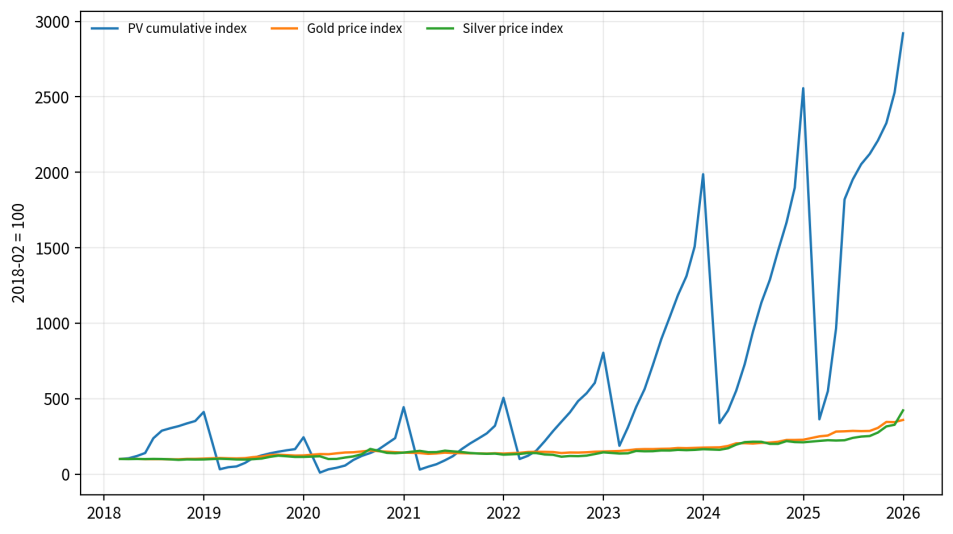
Against the backdrop of the ongoing energy transition, whether the expansion of the photovoltaic (PV) industry affects silver prices through the channel of industrial demand is an important question for understanding the dual attributes of silver. Using monthly data from February 2018 to December 2025, this paper constructs indicators for price levels, relative prices, monthly returns, and year-on-year changes based on cumulative PV installed capacity, the monthly average gold price, and the monthly average silver price. OLS regressions are employed, supplemented by HAC/Newey-West robust standard errors. The results show that, in price-level regressions, the PV variable is significantly and positively associated with silver prices. However, after controlling for gold prices, this effect becomes insignificant, indicating that silver prices are still mainly driven by the common movement of gold. Under specifications based on relative prices, relative returns, and year-on-year measures, the PV variable likewise fails to exhibit robust significance. Overall, PV expansion and silver prices display a clear linkage, but the existing evidence lends more support to a co-movement relationship reinforced by the demand background than to the claim that PV has already exerted an independent pricing effect on silver.
Show more
Read Article PDF
Cite
Research Article Open Access
A Study on Perceived Fairness in AI-Driven Personalized Pricing: A Consumer Perspective
In recent years, AI-driven personalized pricing has proliferated across industries such as retail, mobility, and aviation. While enhancing firms' revenue efficiency, this practice has also raised growing concerns regarding transactional fairness. From a consumer-centric perspective, this paper examines the formation mechanisms of perceived price fairness in AI-driven pricing contexts and its influence on market behavior. As a theoretically oriented review, this study integrates literature analysis and logical reasoning, drawing on consumer behavior theories, the principle of dual entitlement, and representative governance practices to construct an analytical framework spanning technological foundations and policy responses. The findings indicate that algorithmic opacity and information asymmetry are key antecedents of perceived unfairness, which in turn trigger strategic consumer responses, including intensified price search, identity obfuscation, delayed purchasing, and channel migration. At the firm level, this paper proposes equilibrium-oriented strategies such as value-anchored tiered pricing, selective disclosure of pricing logic, and protective pricing mechanisms for high-value customers. At the regulatory level, it highlights the need for calibrated algorithmic transparency, clearer consumer data rights, and well-defined legal boundaries for exploitative pricing, aiming to strike a balance between algorithmic efficiency and social equity.
Show more
Read Article PDF
Cite
Research Article Open Access
Cooperation and Competition in China's Telecom Triopoly: A Repeated Prisoner's Dilemma Analysis
Article thumbnail
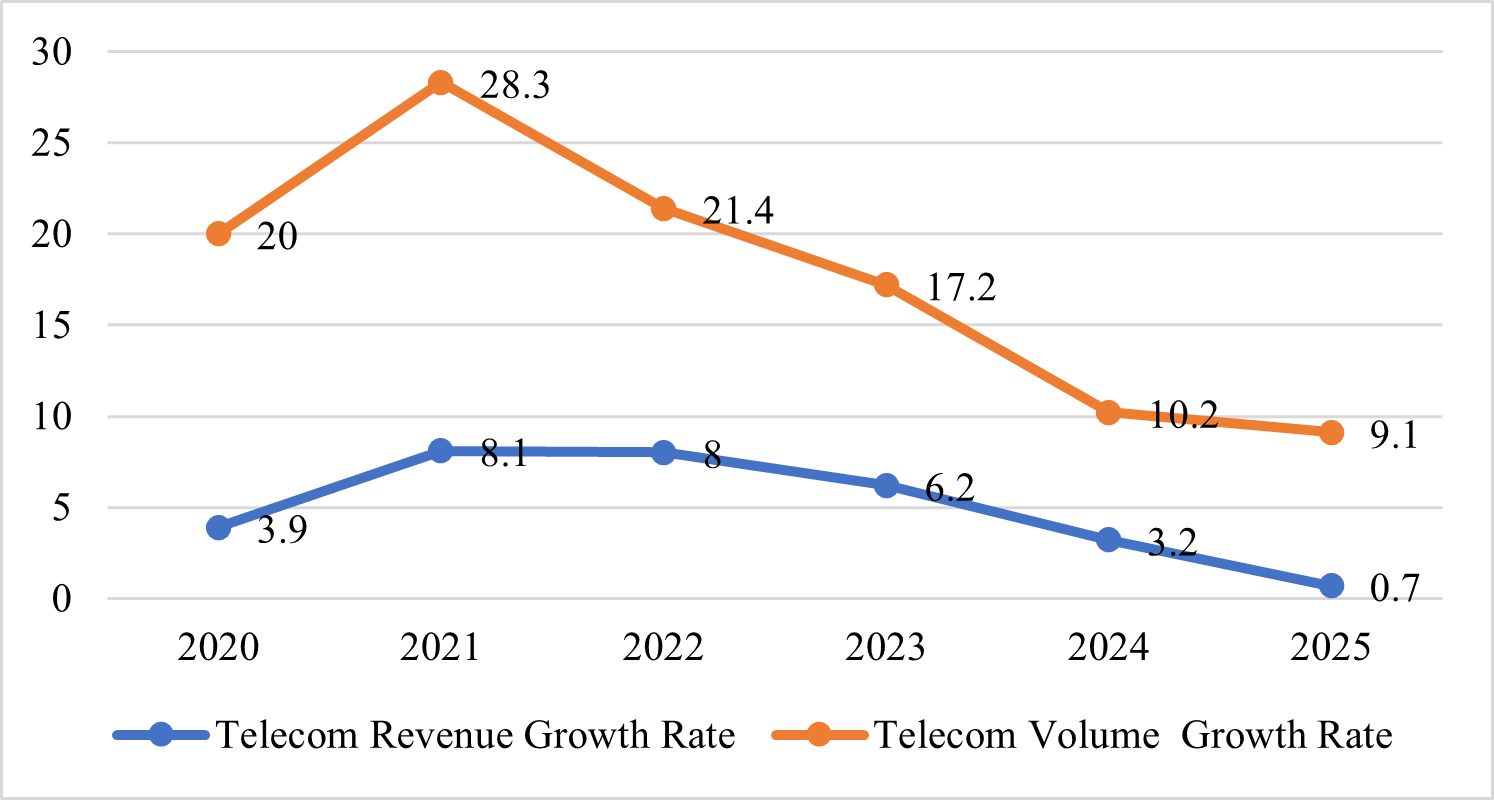
As an important infrastructure to the digital economy, the telecommunications industry in China now shows a triopoly market structure by three operators: China Mobile, China Unicom, and China Telecom. Currently, this structure triggers vicious price wars, constraining the industry revenue and development. This paper uses the theory of the repeated Prisoner's Dilemma and a case study of China's 5G market from 2019 to 2025 to explore this dilemma. After investigation, the study finds three main obstacles to the formation of trustworthy cooperation: the concern of merely profit in the short term, the degree of information transparency, and the ineffective punishments for betray actions. To solve this dilemma, a mathematical model is constructed to try to find the conditions for accessible cooperation. As a result, the finding indicates that sustainable cooperation requires various conditions, such as the net benefits of cooperation. To do this, the study recommends creating policies that include mechanisms such as a tit-for-tat response strategy to defend from betray actions, third-party information platforms to ensure information transparency, and a hierarchical information sharing to guarantee the stability of collaboration. Consequently, cooperation will occur among the operators, contributing to the overall health and sustainability of the telecommunication industry.
Show more
Read Article PDF
Cite
Research Article Open Access
Trade Policy Uncertainty, Tariffs, and Firm-Level Innovation
Article thumbnail
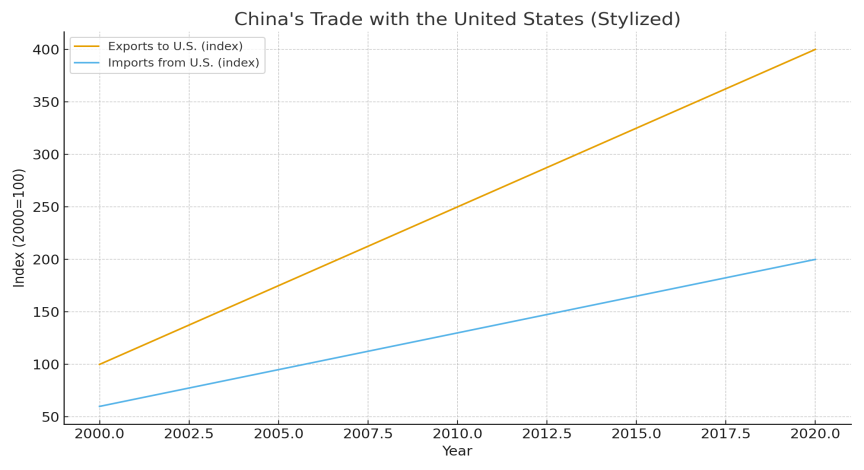
The study investigates the effect of trade policy uncertainty and tariffs on firm-level innovation in China. Our firm-year-level measure of innovation is defined as the logarithm of R&D spending as well as the logarithm of patent applications. Multiple regression specifications are employed, including trade policy uncertainty and tariff regressions with and without firm fixed effects and year fixed effects, tariff-only regressions, and five-fold cross-validation regressions. The core findings show that trade policy uncertainty and tariffs are not robustly associated with firm-level innovation once firm fundamentals are controlled for. Regression specifications that only use tariffs to explain innovation have large coefficient estimates that are often statistically significant. However, these large effects all vanish once controls for firm size, profitability, and financial capacity are included, implying omitted-variable bias. Conversely, firm-level fundamentals, particularly firm size and profitability, are robustly and strongly associated with innovation. Five-fold cross-validation regressions confirm the high stability of firm-level predictors of innovation relative to policy-related variables. These results suggest that innovation is best explained by firm fundamentals as opposed to short-run changes in trade policy uncertainty.
Show more
Read Article PDF
Cite
Research Article Open Access
Option Implied Sentiment and Stock Return Forecasting: A XGBoost-Based Analysis
Article thumbnail
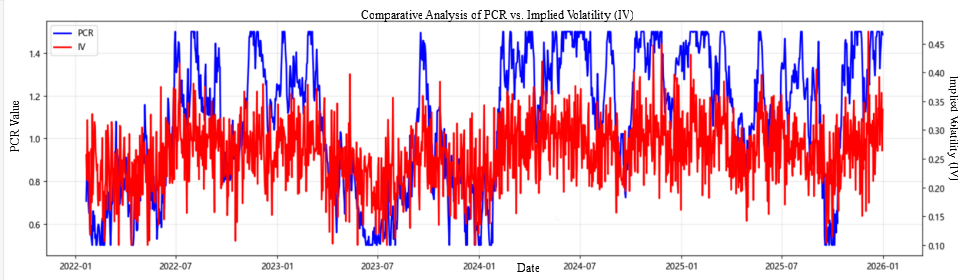
As an important component of the derivatives market, trading activity in the option market directly reflects investors' expectations of future market trends. Taking 50 ETF options as the research object, this paper uses the XGBoost machine learning algorithm to integrate sentiment proxy variables, such as implied volatility and volume ratio of options, to predict daily returns. Results show that the XGBoost model achieves a test-set R-squared of 0.091 and a directional prediction accuracy of 58.3%, outperforming linear regression and the support vector machine significantly. The analysis of characteristic importance shows that the yield of the previous day contributes 66.5%, 5-day volatility contributes 19.1%, and the short-term momentum and volatility aggregation effect constitute the main drivers of the forecast. Through the dynamic analysis of sentiment indicators such as PCR, this paper reveals the nonlinear relationship between option market sentiment and yield. This paper constructs trading strategies based on sentiment factors and evaluates their economic value, so as to provide a quantitative reference for risk management and directional trading of option market makers.
Show more
Read Article PDF
Cite
Research Article Open Access
The Impact of Supply Chain Concentration on the Stability of EVA in Manufacturing Firms: A Moderating Effect Analysis Based on Industry Competition Level
This paper uses A-share listed manufacturing companies in China from 2003 to 2024 as a research sample to empirically examine the nonlinear impact of supply chain concentration on the stability of corporate economic value added (EVA) and explores the role of industry competition intensity (HHI) in this process. The results show that: First, supply chain concentration has a significant inverted U-shaped impact on the stability of manufacturing companies' EVA. Within a moderate concentration range (below the critical inflection point of approximately 52.5%), the synergistic effect brought about by concentration dominates, significantly reducing transaction costs and enhancing the robustness of value creation. However, once this threshold is crossed, the "lock-in effect" and risk lock-in caused by over-reliance become dominant, thus exacerbating the company's operational volatility. Second, industry concentration (high HHI) has a significant direct positive promoting effect on corporate EVA stability, but it does not play a significant moderating role in the aforementioned inverted U-shaped relationship. This indicates that the impact of supply chain structure on value stability stems more from internal corporate governance decisions and resource allocation than from shifts in the external industry competitive landscape. This study breaks through the traditional linear debate on the economic consequences of supply chain concentration and provides empirical evidence for manufacturing enterprises to optimize their supply and demand structure.
Show more
Read Article PDF
Cite