Articles in this Volume

Research Article Open Access
Quantitative Impact of ESG Factors on the Valuation of A-Share Listed Companies Using R: A Case Study of BYD
Article thumbnail
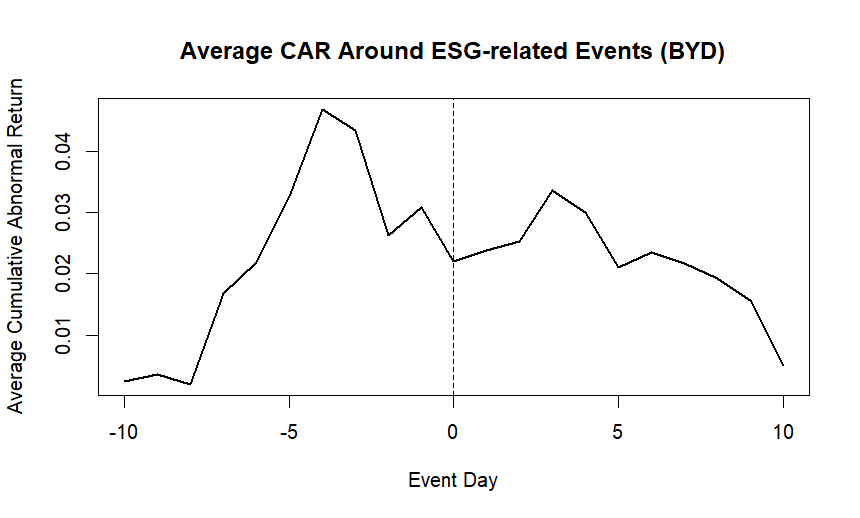
The relevance of Environmental, Social, and Governance (ESG) performance in corporate valuation has been growing, in tandem with investors' increasing focus on sustainability and non-financial risks. As a leading enterprise in China's new energy vehicle industry, BYD plays a pivotal role in the A-share market, making it a suitable case study for examining how ESG-related information is priced by the capital market. This study adopts a case firm approach, focusing on BYD, to investigate the quantitative impact of ESG factors on firm valuation. To this end, an event-based analytical framework implemented in R is utilised. ESG-related disclosure events are identified based on publicly available announcements from the CNINFO platform and third-party ESG rating updates. The present study employs an event study approach to examine market reactions around these events by calculating abnormal returns and cumulative abnormal returns within specified event windows. The empirical evidence indicates that the stock market demonstrates discernible valuation responses in the vicinity of ESG-related disclosure events, thereby suggesting that ESG information is indeed a relevant factor in investor valuation decisions.
Show more
Read Article PDF
Cite
Research Article Open Access
The "Turnover Paradox" in Direct-to-Consumer Transformation: Financial and ESG Evidence from Anta
This study explores the interplay between financial reporting and ESG performance of Anta Sports Products Limited during the Direct-to-Consumer (DTC) transformation. The study finds that rising profits, while slower operational efficiency mostly reflects structural changes of moving from a wholesale to an asset-heavy DTC system, not weaker efficiency. Financial indicators capture immediate accounting outcomes. But ESG disclosures reveal the long-term value creation from staff training, environmental management, and supply chain governance. Meanwhile, improved ESG practices coincided with more prudent accounting, supporting the governance effect of ESG. This indicates that reliable ESG governance helps constrain earnings management. Overall, combining financial and ESG information gives a more comprehensive understanding of corporate performance during periods of strategic transformation in an emerging market.
Show more
Read Article PDF
Cite
Research Article Open Access
Digital Transformation and Revenue Divergence in China's Coffee Market: A Comparative Analysis of Starbucks and Luckin Coffee
China's coffee market has undergone rapid digital transformation, resulting in a completely different revenue development trajectory among leading brands. This study aims to explore how the digital transformation strategy leads to the widening revenue gap between Starbucks and Luckin Coffee in the Chinese market. Through the comparative case analysis of the audit financial report of the U.S. Securities and Exchange Commission (SEC) and peer-reviewed academic literature, this study evaluates the digital transformation strategies of the two from multiple dimensions such as mobile platform architecture, member ecosystem, artificial intelligence application deployment and supply chain digitization. Research results show that Luckin Coffee has successfully implemented the "light asset" expansion strategy with its "digital native" business model. By fiscal year 2024, the scale of its store network had expanded to about three times that of Starbucks in China, and its total annual revenue in RMB was about 64 percent higher than that of Starbucks China. The study identified four core elements that promote this revenue differentiation: strategic positioning and its fit with digital capabilities, the depth of integration of technology in various business functions, the ability of the organization to adapt to market dynamics, and the breadth and accuracy of the application of data in operational decision-making. Further analysis shows that Starbucks China still maintains a leading position in terms of single-store revenue and operating profit margin, which indicates that the competitive effect of digital transformation is far beyond the simple revenue scale comparison. This research helps to deepen the understanding of how digital transformation can reshape the competitive landscape of the service industry, and provides strategic guidance for traditional brands and digital native brands that seek development in the wave of technology-driven market transformation.
Show more
Read Article PDF
Cite
Research Article Open Access
Stock Market Forecasting Technology Driven by Artificial Intelligence
Article thumbnail
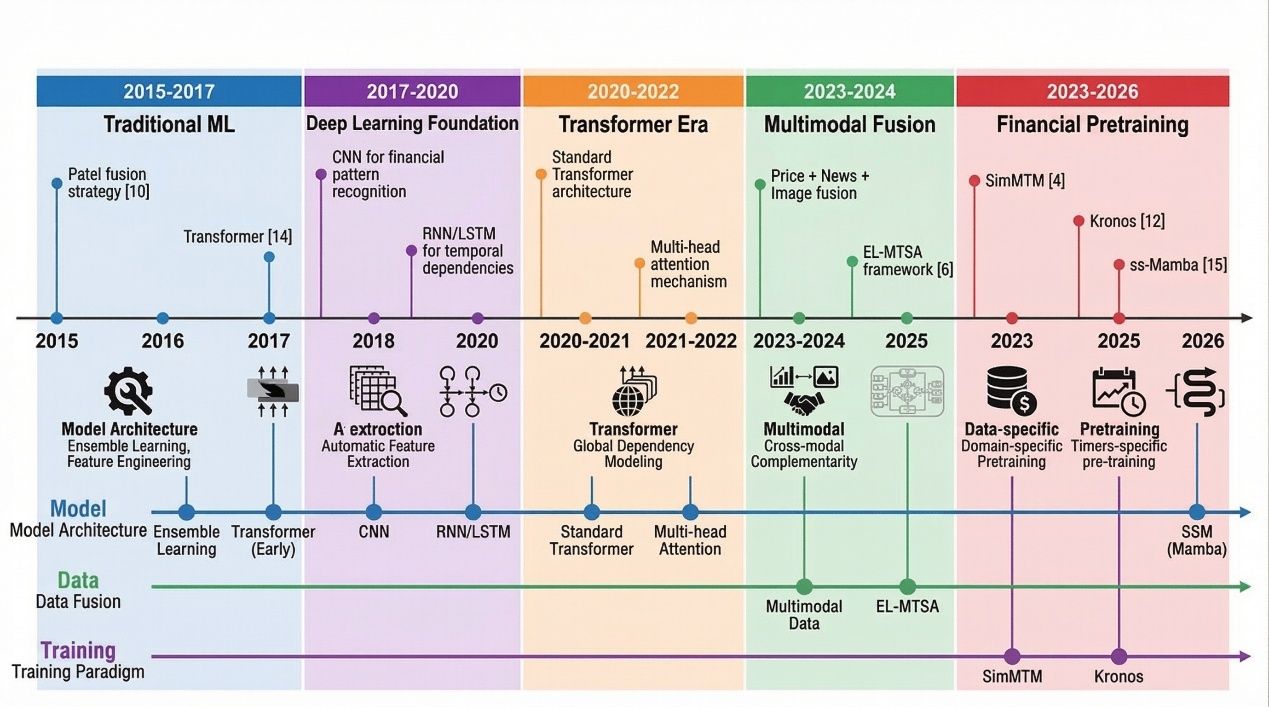
Stock market prediction has become a difficult problem in the field of financial engineering due to high data noise, non-stationarity and nonlinear characteristics, which traditional methods can hardly handle effectively. This paper systematically combs the research achievements of artificial intelligence technology in the field of stock forecasting from 2015 to 2026. Starting from traditional machine learning to deep learning, from single modality to multimodal fusion, and from general architectures to financial-specific pre-training, it adopts a five-dimensional evaluation framework to quantify model performance. Studies have found that convolutional neural networks enable the automatic recognition of financial patterns, recurrent neural networks address the challenge of modeling temporal dependencies, Transformer and state-space models break through the efficiency bottleneck of long sequences, and multimodal fusion and financial pre-trained models significantly improve domain adaptability. Current research still faces challenges such as insufficient out-of-distribution generalization and lack of interpretability. Lightweight architectures and causal inference represent the main future directions. This study provides systematic technical references for the design of stock prediction models.
Show more
Read Article PDF
Cite
Research Article Open Access
Financial Risk Identification of Listed Companies under Multimodal Information: Default Prediction Analysis Based on Light GBM and Z-score Methods
Article thumbnail
In the current era, corporate bond default incidents occur frequently, and the financial sector has been focusing on how to accurately identify potential default risks of enterprises. Most traditional default prediction methods rely on financial indicator data, which have certain explanatory power, but they are still subject to factors such as information lag and susceptibility to manipulation, leading to limitations in prediction effectiveness. This paper introduces the Management's Discussion and Analysis (MD&A) textual information and integrates it with financial data to construct a default prediction model. The study selects annual report data from 2021 to 2024 of 67 A-share listed companies in our country, generating panel data with 251 observations. This article chooses Light GBM as main algorithm, while financial indicators such as the debt-to-asset ratio and net profit rate, are selected to depict the financial condition of enterprises. From textual data, features such as sentiment orientation and forward-looking descriptions are extracted, by using Bert semantics. This features are then formed into a feature system through dimensionality reduction. The results shows that the model possesses strong discriminatory capability and good identification of high-risk enterprises and a low misjudgment ratio. At the same time it is discovered that forward-looking information contributes to enhancing the accuracy and forward-looking nature of default risk identification, which proves the supplementary value of the text information.
Show more
Read Article PDF
Cite
Research Article Open Access
An Empirical Study on the Relationship Between Corporate ESG Performance and Financing Costs
Under the background of strengthening sustainable development, companies' ESG performance is also becoming an important part in the capital market. In this paper, it is studied that the influence of corporate ESG performance on COD with the samples which are Chinese A-shares listed corporations from 2018-2023. And also we study on the different role of governance dimensions and the moderating role of externals information environment. Use the 2-way Fixed effect method to control firm size, financial leverage, profit level, growth potential, etc., and do an empirical study of our hypothesis. After controling for the firm and year fixed effects, it's clear that overall ESG is in line with what we'd expect from theory regarding its influence on COD, but not stat sig. It is clear from this that its probably mostly there because of longer run risk and such. Of all the dimensions, only governance's performance shows weak explanation, but this does not change its overall effect on ESG composite, so governance is still important. As for the moderation result, it's observed that external information environment did not have significant effect on ESG-COD relation but its interaction term has sign that matched with our theoretical expectations which implies that the value of ESG information might be higher when surrounded by opaque information. We look at the dynamics through a creditor's view, prices of risk, it gives us empirical takeaways from China's capital market on ESG implies. And it helps us know more about the way of ESG information, corporate governance and COD.
Show more
Read Article PDF
Cite
Research Article Open Access
Analysis of Consumer Behaviour in the Context of the Blind Box Economy
Article thumbnail
The blind box market has been a booming business among young population groups in the past few years largely due to its aspect of ambiguity and limited availability. Various factors affect the consumer decisions. These are psychological, social and environmental factors. Based on the behavioral economics theory and using Pop Mart as an example case study this paper discusses how three major cognitive forces such as loss aversion, perceived scarcity, and influence buying behavior. Variable-ratio reinforcement- influences the buying choices in the blind box consumption. Research has shown that the products make consumers buy the merchandise again by heightening their feeling of missing stuff concealed in them. Also, the fact that they are being widely disseminated via social media platforms enhances this act of consumption, redirecting the motivation of buying blind boxes towards more personalized values of possession to those of belonging and identification with a social group. In general, it seems that the results indicate that, as much as the use of blind box marketing leads to a substantial increase in brand value and user loyalty, it also brings up possible negative aspects to it, such as the tendency to make purchases on impulse and relying on unstable consumption habits. The study can be regarded to facilitate the understanding of the functioning of the blind box economy and provide empirical research that may be used to explain the formulation of a more effective consumer protection strategy.
Show more
Read Article PDF
Cite