Articles in this Volume

Research Article Open Access
An Intelligent Investment Framework Based on an Improved BILSTM-Attention Model
Article thumbnail
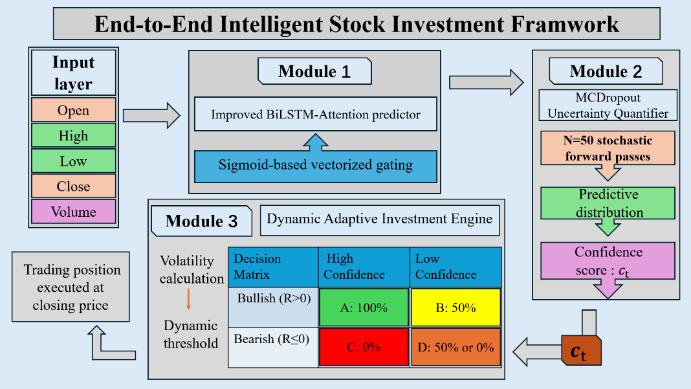
Regarding the lack of uncertainty quantification and the threshold rigidity in predictions of deep learning models, this paper proposes an intelligent investment framework based on an improved Bidirectional Long Short-Term Memory (BILSTM)-Attention model. The model chooses Sigmoid gating instead of Softmax attention to achieve non-competitive information aggregation. It also uses Monte Carlo Dropout by performing multiple random forward passes during the prediction phase and estimates the uncertainty of the predictive distribution, which is mapped to confidence. Based on this, the paper designs a dynamic threshold mechanism, adjusting the threshold according to market volatility and generating a 'prediction & confidence' signal to guide portfolio rebalancing. The experiments on three A-share semiconductor stocks show that the improved model generally outperforms the standard Long Short-Term Memory (LSTM) and the baseline BILSTM-Attention model. The backtesting shows that after introducing the confidence, the strategy's total return increased from 3.64% to 5.12%, and the maximum drawdown decreased; the dynamic threshold further increased the return and Sharpe ratio to 5.97% and 2.17. The framework of this paper improves prediction accuracy and investment performance, providing new ideas for quantitative investment.
Show more
Read Article PDF
Cite
Research Article Open Access
The Impact of Limited-Quantity and Time Discount Strategies on Impulse Purchases in Live Shopping
With the rapid development of the internet, online shopping has become one of the main channels for consumers. Among these channels, influencer live sales have emerged as a particularly popular business model, in which limited-time, limited-quantity discounts are commonly used as marketing tactics. This study examines how these two scarcity-based strategies influence consumers' impulse purchasing behavior through emotional and psychological mechanisms, along with other related factors. This study employed a mixed-methods approach, gathering data from consumers who regularly engage in live shopping through questionnaires and interviews. The data were analyzed using descriptive statistics, correlation analysis, and thematic analysis.
Show more
Read Article PDF
Cite
Research Article Open Access
Revisiting the Risk-Return Relationship: A Decade-Long Study of the CAPM in the U.S. Consumer Discretionary Sector
This study re-evaluates the validity of the Capital Asset Pricing Model (CAPM) in the U.S. Consumer Discretionary sector over the turbulent 2015–2025 decade, a period marked by pandemics, inflationary surges, monetary tightening, and shifts in tariff policy. Adopting a two-pass regression framework with the Shanken (1992) correction to mitigate errors-in-variables bias, we analyze 20 representative S&P 500 firms across subsectors of the sector. Empirical results show the sector's average beta at 1.25, significant beta instability during structural shocks, and a flatter Security Market Line (SML) than CAPM's theoretical prediction. The market risk premium is positive but statistically insignificant after Shanken correction, and the low-beta anomaly is pronounced, with defensive stocks outperforming high-beta counterparts on a risk-adjusted basis. We find that non-market systematic factors—including tariff policy risk, interest rate duration, and operating leverage—undermine CAPM's explanatory power, alongside behavioral herding and speculative bubbles. Multifactor models (e.g., Fama-French Three-Factor) exhibit better performance but still struggle with tail-risk events. This research concludes that CAPM serves as a useful first-order risk approximation but is insufficient for the modern Consumer Discretionary sector. Dynamic, multifactor frameworks that incorporate policy and macroeconomic sensitivities are necessary for accurate asset pricing and investment decision-making in this volatile sector.
Show more
Read Article PDF
Cite
Research Article Open Access
Research on the Impact of Social Trust on Corporate Greenwashing
Under the changing conditions around us, companies now engage in "greenwashing" which creates problems about climate regulation since it affects how policies go around and money is used. Moving beyond traditional institutional analysis frameworks, this study focuses on social trust as a non-institutional factor. Using an empirical analysis with some sample Chinese A-share listed companies (2014-2022) combined with media attention as a moderator. The research shows that social trust significantly hinders corporate greenwashing. Further analysis also showed that increased media scrutiny intensified the inhibiting impact of social trust upon greenwashing which created a sort of governance synergy through greater information disclosure. More over it's influence of social trust shows heterogeneity, it becomes greater among non-state-owned enterprises other than state-owned enterprises. These findings enrich existing literature on corporate greenwashing and provide decision-making references for mitigating such practices.
Show more
Read Article PDF
Cite
Research Article Open Access
Analysis of the Impact of Data Asset Capitalization on Corporate Cost Stickiness-A Comparative Analysis Before and after Implementation Based on Enterprises Capitalizing Data Assets in 2023–2024
This paper selects 78 companies having incorporated data inventories into their financial statements from 2023 to 2024 as the research samples to empirically examine how data inventory incorporation influences and varies in enterprise cost rigidity. According to the research, when companies include data inventories on their balance sheets, it tends to beef up their cost stickiness index, which in turn helps them rein in this particular financial tendency. This conclusion still holds true even after replacing the explanatory variables with the proportion of data inventories in the company's revenue. And the control variable test shows that state-owned enterprises and enterprises with high debt-to-asset ratios have lower cost stickiness, while large-scale enterprises have higher cost stickiness. In addition, the heterogeneity evaluation shows that integrating the data list into the balance sheet can obviously reduce the cost stickiness, and this effect is obvious in public, private, large companies and small enterprises. However, private companies are more sensitive to cost stickiness, which is related to their operation scale and efficiency. Because of the problems of internal management quality and operation ability, the cost of small companies fluctuates more, and the inventory level in financial statements has a slightly stronger influence on them than that of large companies. This study discusses how to integrate inventory data into the balance sheet, which can better reflect the economic significance of accounting policy adjustment, and also provide practical methods for enterprises to help them reduce cost stickiness by this method.
Show more
Read Article PDF
Cite
Research Article Open Access
Does Task-Oriented Policy Dilute the Star Inventor Resources of Listed Companies? — Quasi-Experimental Evidence Based on Smart City Pilots
Article thumbnail
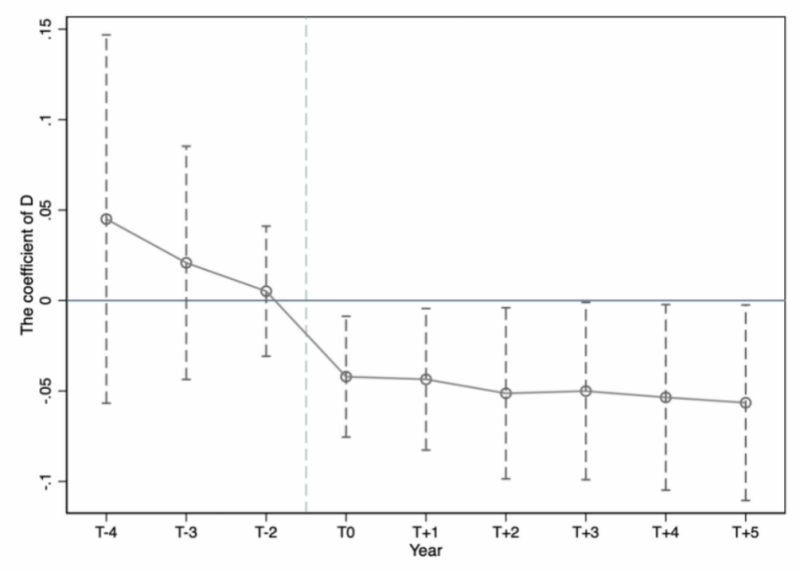
This paper examines whether China's National Smart City Pilot Program (NSCP) reduces the pool of star inventor resources in listed companies. Using a multi-period Difference-in-Differences model, it finds a significant decline in star inventors at pilot enterprises following policy implementation, with the effect more pronounced among firms reliant on government subsidies or with digital strategies misaligned with government plans. Mechanism analysis identifies tighter financing constraints and the crowding-out of corporate capital expenditures as key drivers. The study recommends optimizing resource allocation to avoid the "policy siphon effect" and expanding innovation support for non-pilot firms to sustain a balanced and efficient innovation ecosystem.
Show more
Read Article PDF
Cite
Research Article Open Access
Research on the Impact of Patient Capital on Corporate Green Innovation
Driven by policies and market demands, enterprise green innovation is hindered by financing constraints. This paper conducts an empirical study using panel data of A-share listed enterprises from 2007 to 2022 based on the theoretical model of patient capital's influence on green innovation. Findings show: (1) Patient capital significantly promotes corporate green innovation; (2) It indirectly boosts green innovation by facilitating the construction of a unified national market and enterprise digital transformation; (3) Its promoting effect presents heterogeneity—more significant in the central region, large enterprises and non-state-owned enterprises. Finally, policy suggestions are put forward from optimizing patient capital investment structure, advancing the unified national market construction, and guiding the integration of digital and green technologies.
Show more
Read Article PDF
Cite
Research Article Open Access
Timing and Firm Resilience: A Macroeconomic Case Study of Zoom During the Early 2020 Pandemic
Article thumbnail
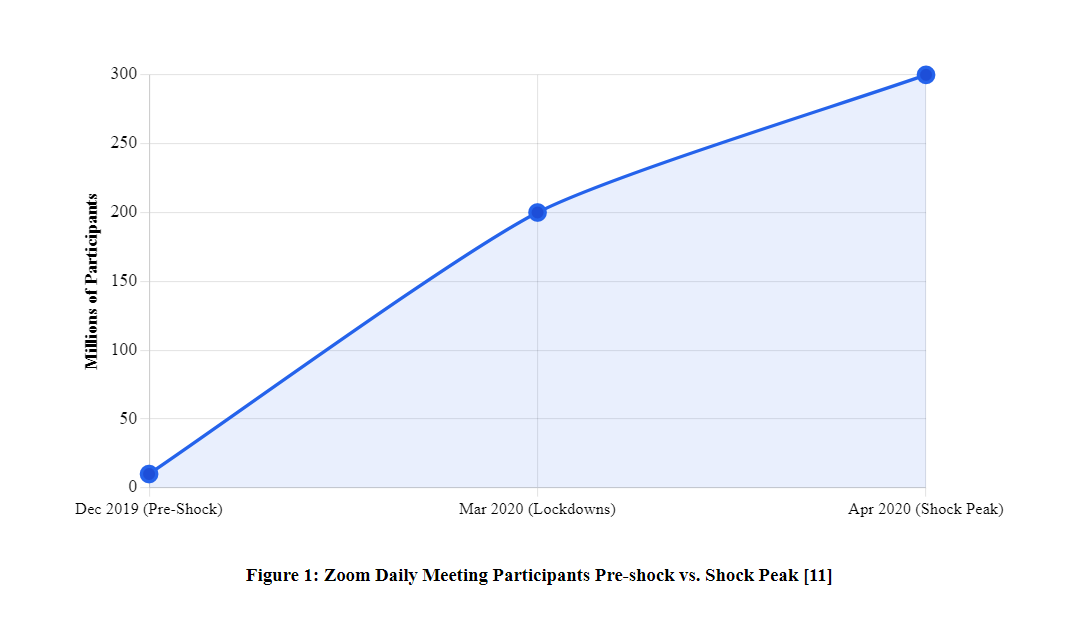
The international health crisis that struck the world in early 2020 has resulted in an unprecedented systemic outage and caused the macroeconomic ecosystem to attempt an abrupt and incoherent shift to remote operation. Although there is extensive literature on how damaging such recessions can be on aggregate employment and other conventional industries, one key reason behind this study is to find out the reasons why some digital infrastructure companies became shock-absorbers and recorded unprecedented growth. Considering Zoom Video Communications, this paper explores the niche mechanics that gave a niche enterprise software a chance to monopolize this new macroeconomic demand. The research methodology used in the study is literature review of institutional articles, combined with company-level financial reports. In addition, this research performs a totality analysis of data on it based on the U. S Census Bureau Business Dynamics Statistics (BDS) in order to quantify job reallocation among sectors. The results also indicate that the crisis was a violent accelerant of reallocation of resources destroying employment in the physical sectors, and increasing the information sector considerably. In conclusion, this paper derives that outstanding corporation achievement during a harsh crisis cannot be simply ensured by the efficiency of the product; but by the ideal timing of a frictionless service hitting a colossal exogenous shock.
Show more
Read Article PDF
Cite
Research Article Open Access
The Impact of Government Promotion Policies on Technological Innovation in New Energy Vehicle Enterprises: Ten Cities, One Thousand Cars Policy as an Example
In the face of the world's trend towards green development and sustainable energy, China started the "Ten Cities, Thousand Cars" project in 2009, which was one of its major plans to cut down emissions and encourage green technology. To speed up the industrialization of NEVs via demonstration and promotion, it began with 10 cities and 1000 cars. This paper uses a difference-in-differences approach to assess the impact of the program on technological innovation using panel data on automotive companies listed on the Shanghai and Shenzhen A-share market from 2007 to 2014. The sample contains both pilot and non-pilot city firms, making it possible to make a clean comparison. The results show that joining the pilot cities greatly improves the number of innovations measured by patents filed and increases the R&D intensity of NEV companies. Evidence shows that the policy works mainly by easing firms' financing problems, probably because of subsidies and better chances to get money for loans, so they can put more money into being innovative. Heterogeneity tests show that the innovation effect is stronger for bigger firms, which fits with them having more power to use policy help. In general, this program does succeed at spurring technological progress among individual companies and helping spread green car tech. These findings give some ideas about how to make industrial policies that help create sustainable innovation in growing countries.
Show more
Read Article PDF
Cite