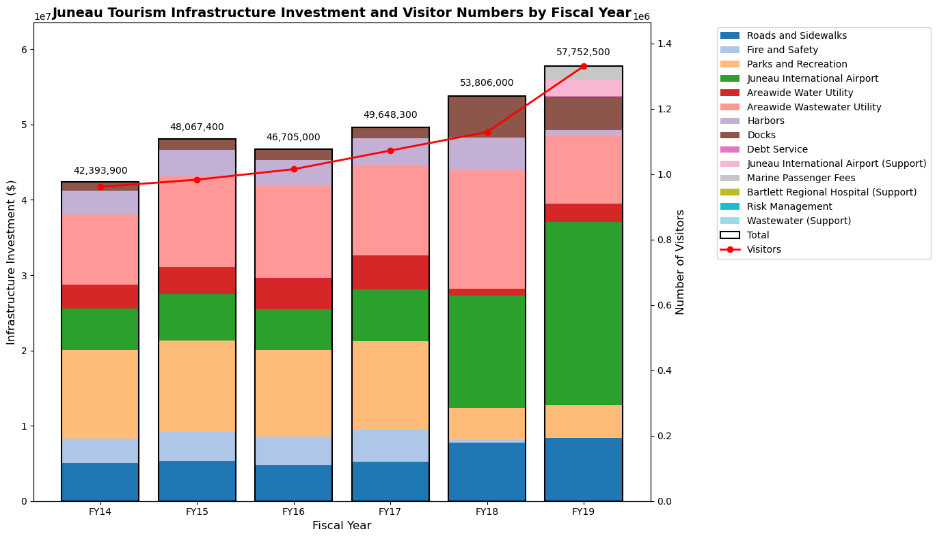
With the continued growth of the tourism industry, increasing attention has been devoted in recent years to how tourist cities should formulate appropriate tourism policies. As a well-known cruise destination in Alaska, Juneau faces the critical challenge of balancing the economic growth generated by tourism with the visitor carrying capacity of the local area, which has become a key concern for local policymakers. This paper develops a GDP growth accounting model based on data on tourism consumption, tax revenue, and government investment. By formulating the maximization of tourism-driven GDP growth as the objective function, the model identifies the optimal number of visitors and the corresponding tax policy for the region, thereby providing concrete policy recommendations for local government decision-making. A sensitivity analysis with respect to the visitor-capacity limit further shows that relaxing the maximum visitor capacity increases both the feasible visitor scale and the upper bound of GDP gains, while the optimal tax policy remains relatively stable in the low-capacity region. These findings provide a quantitative basis for sustainable cruise-tourism management in Juneau and other small port destinations with similar structural characteristics.