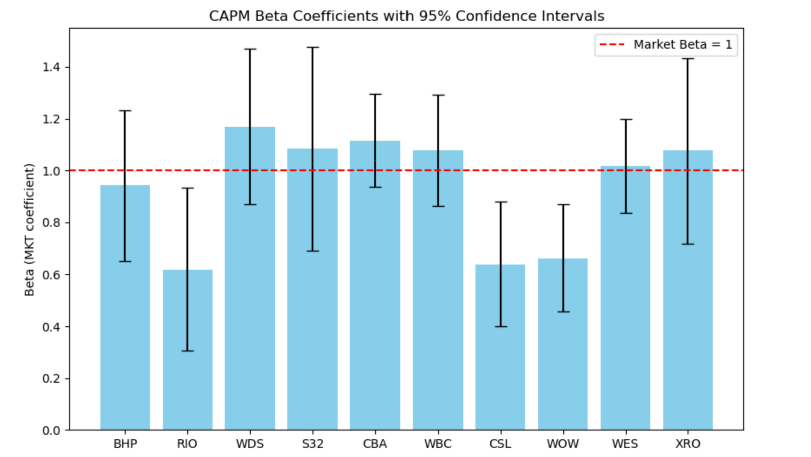
This study examines how a portfolio-level carbon intensity cap impacts efficiency and tail risk behaviour in the context of climate change, as well as whether reported corporate emissions can account for risk in large-cap Australian stocks. The analysis focuses on decision-useful, auditable inputs using a compact empirical setup that includes rolling time-series regressions to estimate market and climate sensitivities and a mean-CVaR optimisation with an emissions cap evaluated on a common scenario base with embedded transition shocks. Three outcomes are particularly noteworthy. First, since reported emissions and estimated climate transition betas co-vary, emissions provide a clear indication of transition exposure and are instructive for asset-pricing diagnostics. Second, carbon budgeting can be implemented: costs increase nonlinearly as the cap tightens, but at low-to-moderate stringency, the cap significantly reduces financed carbon emissions with little loss of efficiency. Third, risk is state-dependent: constrained portfolios show better tail metrics and fewer negative returns when transition risk is high, while there is little give-back during calm times. By comparing constrained and unconstrained portfolios on the same scenario set, mean-variance efficiency is generally maintained and state-contingent differences are clearly discerned. For ESG-aware allocation in the Australian context, the study provides a manageable, empirically supported framework.