Articles in this Volume

Research Article Open Access
Study on Financial Risks and Response Strategies of New Energy Vehicle Enterprises
Driven by the "dual-carbon" strategic goals and strong support from national policies, the scale of the new energy vehicle industry has expanded rapidly, gradually becoming an important force promoting economic transformation. However, development trends such as intensified homogeneous market competition and rapid technological iteration have led new energy vehicle enterprises to face multi-dimensional financial risks. Based on the industry status quo and the practices of typical enterprises, this paper analyzes the dimensions of financing, investment, operation, and profitability, and proposes risk response strategies, providing theoretical support for solving enterprise problems and maintaining the stable development of the industry.
Show more
Read Article PDF
Cite
Research Article Open Access
Climate Policy Uncertainty: A “Wild Card” for Corporate Risk-Taking?
The research paper develops a China Climate Policy Uncertainty Index and analyzes how this uncertainty affects corporate risk behaviors. By leveraging data from publicly-traded companies in China, I've discovered that a rise in climate policy uncertainty is directly tied to more risky corporate actions. Even when I swapped out key variables, omitted outlier years, included additional control factors, adjusted for fixed effects, and introduced lagged models, this conclusion held steadfast.Continued examination shows that sustained growth in climate policy ambiguity increases corporate risk-taking due to decreased investment effectiveness and decreased credit access. Additionally, the impact is notably greater among privately held businesses, companies with significant pollution, and those reliant on substantial capital investment. This study broadens the existing research on the link between climate policy uncertainty and corporate risk-taking, offering practical insights for business strategy, government policy formulation, and regulatory oversight.
Show more
Read Article PDF
Cite
Research Article Open Access
The Path and Effect of Digital Transformation in Chemical Enterprises: A Case Study of Wanhua Chemical
Driven by the Digital China Strategy, process industries represented by the chemical industry are currently facing core propositions of safety and controllability, green and low-carbon development, and high-end breakthroughs. Through new-generation information technologies such as the industrial internet and artificial intelligence (AI), digital transformation reconstructs the entire R&D-production-service chain, serving as a key path to address the "bottleneck" dilemma. Taking Wanhua Chemical as a case study, this paper explores the specific path of its digital transformation and evaluates the transformation effect from both financial and non-financial dimensions, aiming to provide practical experience for the digital transformation of chemical enterprises. The study finds that Wanhua Chemical has carried out digital transformation at three levels—foundation, application, and ecology—achieving improvements in financial performance such as operational capacity and growth capacity, while also benefiting from non-financial aspects including organizational structure, R&D innovation, and green and low-carbon development.
Show more
Read Article PDF
Cite
Research Article Open Access
The Intrinsic Logic and an Empirical Study of the Coupling Between the Digital Economy and Rural Economic Resilience
The coordinated advancement of the digital economy and rural economic resilience is a new dynamic engine for high-quality rural and agricultural development. To quantitatively evaluate the degree of coordinated development between the digital economy and rural economic resilience, this paper selects provincial panel data from 10 Chinese provinces for 2016–2023, and constructs an indicator system for the digital economy that reflects digital infrastructure and industrial digitalization, as well as a chained economic-resilience evaluation system reflecting “resistance–adaptation–transformation.” Indicator weights are determined comprehensively using the entropy-weight method. Based on a coupling-coordination-degree model, a comparative analysis is then conducted on the coupling-coordination types of urban digital economy and ecological resilience across 30 provinces nationwide. The study finds that: in terms of temporal evolution, the coupling-coordination degree of the provinces has grown steadily, although many provinces remain in a state of disequilibrium; overall the development trend is positive. Spatially, the coupling-coordination degree exhibits an “east-high, west-low; south-high, north-low” pattern. By 2023, most regions were in a coordinated state.
Show more
Read Article PDF
Cite
Research Article Open Access
Early Warning of Bond Defaults in Wholesale and Retail Enterprises: An Integrated Random Forest–BP Neural Network Approach
Article thumbnail
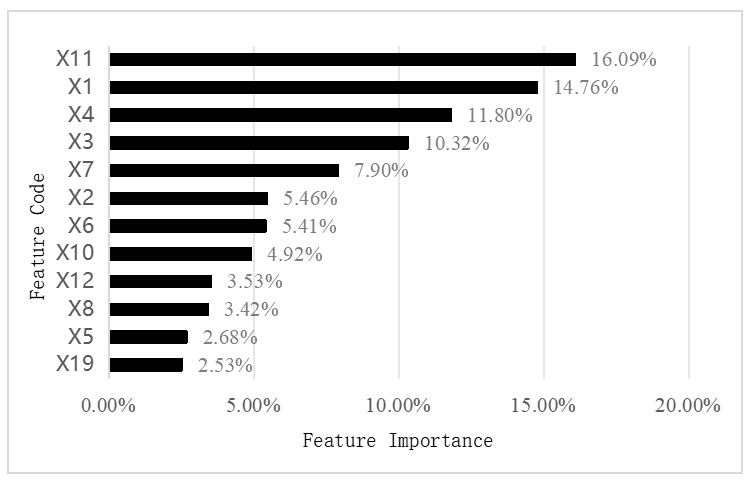
Aiming at the problem that traditional default early warning models have insufficient discriminative power and robustness under the scenario of strong correlation among high-dimensional indicators and unbalanced samples, this study proposes a serial fusion model integrating Random Forest (RF) and Back Propagation (BP) Neural Network. First, RF is used for feature selection: the minimum sufficient feature set is screened out based on the criterion of cumulative contribution ≥ 90%, which corresponds to the input layer nodes of the BP Neural Network. Subsequently, the BP Neural Network is applied to perform nonlinear fitting on the selected features. During the training phase, ADASYN (Adaptive Synthetic Sampling Approach) oversampling is only implemented on the training set to balance samples while preventing information leakage. The model is trained and evaluated using samples from the wholesale and retail industry, and its early warning effect is verified by predicting the default probability of Gome Electrical Appliances. The results show that the RF-BP model has strong early warning capability for small to medium-sized samples and can issue risk early warning signals in advance.
Show more
Read Article PDF
Cite
Research Article Open Access
Policy-Driven and Standardization Research on Quality Management in the New Energy Vehicle Battery Supply Chain: An Empirical Analysis Based on Policy Comparison among China, the EU, and the US
Under the impetus of global carbon neutrality goals, quality management in the new energy vehicle (NEV) battery supply chain has become a central focus of national policy agendas. This study systematically analyzes policy documents and industry data from China, the European Union, and the United States between 2015 and 2024, with emphasis on three aspects. First, regarding differences in policy instruments: China’s mandatory coding and traceability system (GB/T34014) has reduced defect recall rates by 32%; the EU’s market-oriented carbon footprint labeling scheme under the New Battery Regulation increased compliance costs by 15% but reduced accident rates by 28%; and U.S. state-level legislation (e.g., California’s AB-2832) requiring ESG disclosure has influenced corporate quality practices. Second, concerning the dilemma of lagging standards: emerging technologies such as fast charging and solid-state batteries lack internationally unified standards, compelling firms to establish independent testing systems at a 40% higher cost (with CATL as a case example). Third, in terms of policy synergy and innovation: Guangdong Province’s traceability platform enables cross-departmental sharing of full life-cycle battery data, raising the efficiency of dispute resolution by 60%. This study advances three recommendations: (1) establish a dynamic standards framework combining “basic national standards” with “technical consortium standards”; (2) implement a dual-carbon assessment system for battery supply chain quality; and (3) strengthen mutual recognition of China–EU policies. The findings provide theoretical support for constructing a global governance framework for battery quality.​
Show more
Read Article PDF
Cite
Research Article Open Access
Research on the Mechanisms by Which Data Resources Empower the Development of New-Quality Productive Forces
Article thumbnail
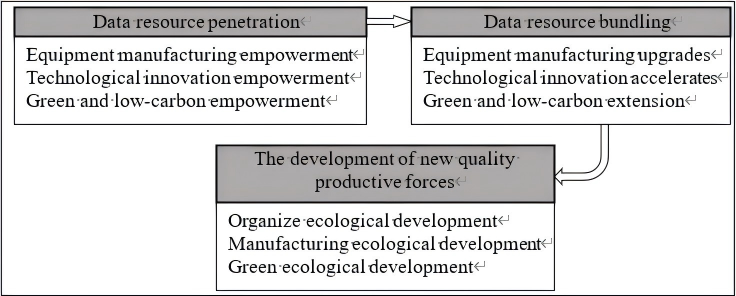
The development of new-quality productive forces must be supported by science and technology. As a product of the digital age, data resources are bound to become the core support for the development of these new-quality productive forces. Starting from data resources and taking equipment manufacturing enterprises as the analytical context, this paper examines the pathway mechanisms through which data resources empower the development of new-quality productive forces, thereby promoting iterative upgrading toward new-quality productivity. The study shows that data resources, as a new production factor, can dynamically and iteratively empower the development of new-quality productive forces; while enabling significant improvements in the quality and efficiency of these productive forces, they also facilitate the gradual construction and refinement of the data ecosystem. The process mechanisms explored here extend existing research on data resources, new-quality productive forces, and practices of value creation, and provide references and insights for the application of data resources in manufacturing and for the development of new-quality productive forces.
Show more
Read Article PDF
Cite
Research Article Open Access
Analysis on the Effect of Financial Flexibility of Guangpu Electronics under the Background of Digital Transformation
Article thumbnail
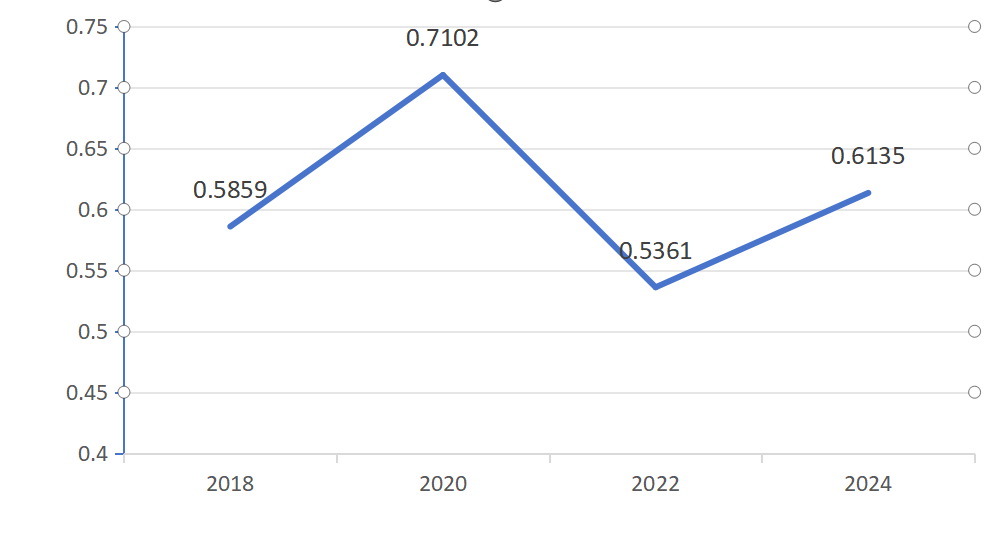
As the vanguard of China's innovative manufacturing, "specialized, refined, characteristic, and innovative" enterprises should actively integrate into the wave of digitalization and leverage digital transformation to achieve leapfrog improvement in innovation efficiency. Financial flexibility, as the core capability of enterprises to resist external shocks and seize technological opportunities, is naturally fragile due to the scale constraints of specialized, refined, characteristic, and innovative enterprises. This study aims to verify the impact of financial flexibility of Guangpu Electronics under the background of digital transformation. It analyzes the process of "technology empowerment - resource integration - resource leveraging - financial flexibility enhancement" in each stage of enterprise digital transformation, and explores the process of improving financial flexibility through resource orchestration in the continuous digital transformation of enterprises. An effect evaluation system is constructed, weights are assigned to each indicator, and the impact of the case company's digital transformation on the effect of enterprise financial flexibility is analyzed.
Show more
Read Article PDF
Cite
Research Article Open Access
A Study on the Pathways Through Which New-Quality Productive Forces Drive Financial Digital Transformation
As a new form of productive force characterized by high innovation and high quality, new-quality productive forces have become the core driving power behind the financial digital transformation of enterprises. This paper aims to explore the intrinsic connection between new-quality productive forces and financial digital transformation, with a focus on the specific pathways through which the former drives the latter. The study argues that the two form a virtuous cycle of mutual promotion: new-quality productive forces penetrate core business processes, accelerating digital transformation, while the success of transformation in turn fosters the optimization and upgrading of these productive forces. On this basis, the paper proposes that new-quality productive forces drive financial digital transformation mainly through three pathways: (1) refining human resources, (2) promoting technological innovation, and (3) cultivating data elements. Ultimately, through the synergistic effect of these three pathways, enterprises can establish an ecosystem deeply integrating data, technology, and talent, thereby realizing mutual reinforcement and a virtuous cycle between financial digital transformation and the development of new-quality productive forces.
Show more
Read Article PDF
Cite
Research Article Open Access
Research on the Improvement of the Coordinated Capability of Ambidextrous Innovation in "SRDI" Enterprises
Article thumbnail
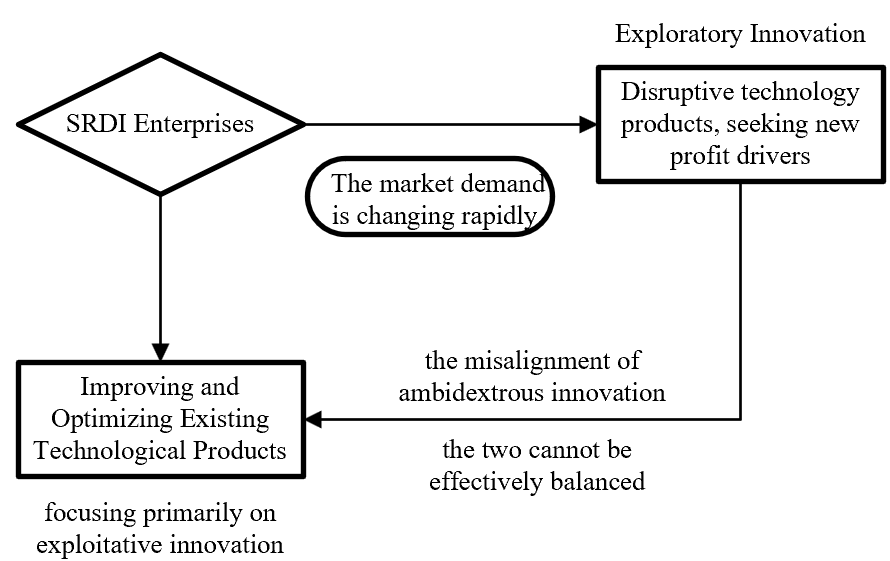
Enhancing the coordinated capability of ambidextrous innovation is of great significance for "Specialized, Refined, Differential, and Innovative (SRDI)" enterprises to address the dilemma of being unable to effectively balance the improvement of existing products and the creation of disruptive products. From the perspective of ambidextrous innovation, this paper finds that the development characteristics of such enterprises are highly compatible with the theory of ambidextrous innovation, and the main reason for their dilemmas lies in the insufficient coordination of ambidextrous innovation. In response, enterprises need to enhance the coordinated capability of ambidextrous innovation: first, make complementary use of resources to achieve complementary empowerment between the two types of innovation; second, managers should dynamically adjust according to different development stages of the enterprise to promote high-level complementary coordination between exploratory innovation and exploitative innovation, thereby resolving dilemmas and achieving high-quality development.
Show more
Read Article PDF
Cite