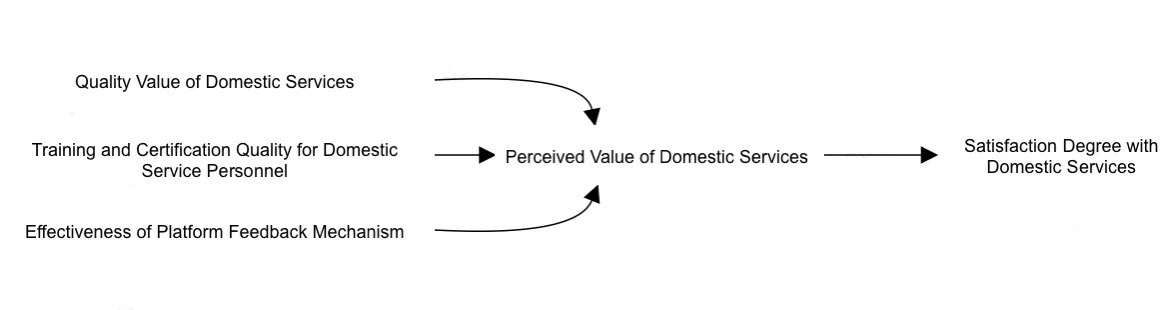
Against the backdrop of surging domestic service demand in Beijing and stratified consumption among middle-aged and young groups, this study identifies a core paradox: improved economic status has not translated into greater willingness to adopt such services, rooted in the combined issues of insufficient service cognition and industry trust deficits. Empirical analysis of 6,100 valid questionnaires reveals structural industry pain points: 62.3% of users refuse contract renewals due to uncontrollable service quality; formal contract rates stand below 60%; and only 42% of practitioners hold certifications, all indicating inadequate standardization. Regression analyses confirm that service quality value, training and certification standards, and effective platform feedback significantly positively influence perceived value. Notably, perceived value shows no significant correlation with satisfaction, suggesting interference from unobserved variables. Theoretically, this study transcends behavioral economics by constructing a "cognition-emotion-behavior" tripartite mediating model integrating the Theory of Planned Behavior (TPB) and social exchange theory. Practically, it proposes an AI-driven dynamic matching system for stratified markets, blockchain-based certification to enhance regulatory transparency, and a dual-track qualification scheme, providing data support for Beijing’s policies on high-quality domestic service development.