Articles in this Volume

Research Article Open Access
The Dual-Process Mechanism of Game Player Recharge Behavior: Cognitive Biases, Emotional Drives and Ethical Interventions
The global in-game purchase market reached $160 billion in 2023, yet 45% of players exhibit irrational spending behaviors. Grounded in Kahneman’s dual-process theory, this study deconstructs the multidimensional drivers of recharge decisions through a tripartite methodological approach. Combining large-scale questionnaires (n=500), high-precision eye-tracking (n=30), and fMRI neuroimaging (n=20), this study addresses two core research questions: (1) How do achievement, social, and emotional motivations hierarchically stratify decisions across player typologies (whales vs. non-payers)? (2) To what neurocognitive extent do scarcity-based designs inhibit prefrontal regulation mechanisms? Key findings reveal that "virtual self-consistency" as the core psychological driver (β=0.42–0.61), explains 21.3% additional variance beyond established scales like PENS. Neuroimaging confirms a 29% suppression of prefrontal cortex (BA10) activation during scarcity exposure, validating impaired cognitive control. Crucially, achievement motivation dominated whale spending (M=4.32 vs. 1.35 on Likert-5 scales), while emotional compensation correlated with amygdala hyperactivity (t(19)=3.42, p=0.003). The study’s theoretical significance lies in extending dual-process frameworks to digital contexts by: quantifying cross-motivational modulation (social→achievement β=0.51); establishing BA10 hypoactivation as a neural biomarker for impulsivity, and developing the Virtual Self-Consistency Scale (α=0.91) as a novel metric. Practically, this paper proposes an ethical intervention framework where 15-second cooling popups reduce impulsive recharges by 23% with minimal revenue impact (3.2%), while bank-API-integrated budget locks curtail excessive spending by 61.3% in high-risk users. These findings offer empirically validated tools for policymakers balancing consumer protection and sustainable industry growth, addressing urgent societal challenges evidenced by 37% annual growth in minor-related reimbursement complaints.
Show more
Read Article PDF
Cite
Research Article Open Access
Quantitative Research on the Impact Mechanism of Emotional Marketing in Brand Live Streaming on Consumers' Impulsive Purchase Intentions
Article thumbnail
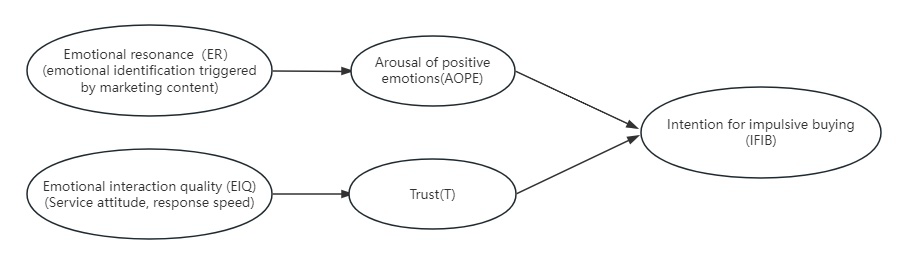
In the fiercely competitive e-commerce live streaming landscape, brand owners are increasingly shifting their marketing focus from mere product promotion to engaging consumer emotions. This strategic pivot involves crafting emotionally charged atmospheres and facilitating effective emotional interactions within live streaming rooms, with the goal of evoking positive emotions and stimulating impulsive buying behavior. The present study explores the impact mechanism of emotional marketing strategies on consumers' impulsive purchase intentions through questionnaire surveys. The findings reveal that emotional resonance and the quality of emotional interactions are critical factors in driving impulsive purchase intentions. Specifically, emotional resonance significantly amplifies purchase intentions by stimulating positive emotional arousal, while high-quality emotional interactions catalyze purchasing behavior by enhancing brand trust. Based on these insights, practical recommendations are proposed, including enhancing emotional resonance, improving emotional interaction quality, establishing robust trust mechanisms, and refining live streaming content. These measures aim to provide strategic guidance for brands in live marketing and ultimately boost sales performance.
Show more
Read Article PDF
Cite
Research Article Open Access
Environmental Costs and Future Transformation of Global Agriculture: A Perspective on the Two-Way Impacts of Intensive Agriculture and Climate
Focusing on the environmental challenges and transformation pressures facing global agriculture, this paper provides an in-depth analysis of intensive agriculture and the two-way coupling relationship between climate change. Through literature analysis and multidisciplinary approaches such as case comparison, it reveals the intensive agriculture on the climate system, the pressure pathways, and the feedback effects of climate change on agricultural production, while introducing the planetary boundary theory to quantify the safety threshold of agricultural activities. In addition, through the case comparison of oil palm cultivation in Southeast Asia and the green transformation of agriculture in Europe and the Netherlands, this paper discusses the innovative practices and policy tools for sustainable agricultural transformation and proposes the path of negative externality and the synergistic path of technology-policy-consumption, which provides a synergistic governance solution for the green transformation of global agriculture.
Show more
Read Article PDF
Cite
Research Article Open Access
Research on the Marketing Strategy of Xiaomi Automobile Based on 4P Theory
In the context of fierce competition in the global new energy vehicle industry, Xiaomi Auto has entered the market and achieved remarkable market results, with its marketing strategies drawing attention from the industry. Despite its highly effective marketing practices, systematic 4P-strategy research on Xiaomi Auto remains scarce. Grounded in 4P theory, this study examines how Xiaomi Auto has secured a competitive edge in the NEV market. The findings reveal that flexible 4P execution has attracted substantial consumer interest, establishing a robust brand foundation. However, there is still room for improvement in its channel construction and brand promotion. Offline direct-sale and service-center coverage remains limited, necessitating accelerated expansion into lower-tier cities. Simultaneously, the online–offline service experience must be streamlined and delivery efficiency enhanced. Brand awareness still needs to be strengthened, and the stickiness of young consumers should be enhanced. Additionally, the word-of-mouth spread of its after-sales service system also needs continuous optimization.
Show more
Read Article PDF
Cite
Research Article Open Access
Carbon Emission Forecasting in Electric Power Sector in Shanxi Province Based on ARDL Model and Machine Learning Algorithm
With the nation's introduction of the "double carbon" objective, given that the power industry's total carbon emissions constitute a major part of these emissions, precise forecasting of these carbon emissions becomes crucial. Consequently, this document develops a combined model utilizing the autoregressive distributed lag model (ARDL) and machine learning algorithm (Transformer) for forecasting Shanxi's power sector's carbon emissions. Shanxi, a significant coal resource province, boasts a precise carbon emission measurement technique, making it an ideal location for gathering the dataset. Initially, data pertaining to Shanxi's electric power sector over the last decade undergoes preprocessing, followed by normalization of yearly electricity production figures. Subsequently, these figures are fed into the time series ARDL model in a suitable manner to examine the long-term and short-term correlations between electricity production and carbon emissions. Ultimately, the residuals are processed by entering the data into the ARDL and Transformer models, leading to the creation of the fusion model. model of fusion. The study demonstrates the hybrid model's extensive benefits in merging predictive precision, capturing long-term trends, and theoretical clarity, making it ideal for policy simulations and intricate energy structure analyses. Consequently, this paper's methodology introduces an innovative approach for forecasting carbon emissions in other coal-dependent provinces, serving as a benchmark for future prediction techniques.
Show more
Read Article PDF
Cite
Research Article Open Access
Leveraging Social Media for Athlete-Brand Building: A Multi-Model Analysis of Li-Ning’s Digital Transformation
This study examines how social media contributes to Li-Ning's brand value in China's competitive sportswear market, focusing on its dual identity as both an Olympic heritage brand and a digital innovator. Employing a multi-model analytical framework—integrating the AISAS model for consumer behavior mapping, SWOT analysis for internal and external brand positioning, and PEST analysis for macro-environmental factors—this paper investigates Li-Ning's 2024 "Name It After Me" campaign. Findings reveal that the brand effectively leverages athlete IP through historical authenticity, emotional resonance, and algorithmic amplification across social platforms such as Douyin, Weibo, and Xiaohongshu. The AISAS model highlights Li-Ning’s effective consumer journey management, with cross-platform strategies driving attention, engagement, and conversions. Strategic recommendations include optimizing product lines, strengthening online-offline integration, and utilizing artificial intelligence tools for personalized communication. It offers practical implications for domestic sportswear brands navigating digital transformation and contributes to broader discussions on athlete branding, consumer co-creation, and platform-based marketing in the Chinese context.
Show more
Read Article PDF
Cite
Research Article Open Access
Innovation in Global Supply Chain Risk Management in the Post-epidemic Era
The ongoing impact of the COVID-19 pandemic has exposed the vulnerabilities in traditional supply chains, presenting both challenges and opportunities that drive the digital transformation and systematic innovation of supply chain risk management in the post-pandemic era. This paper reviews the feasibility of supply chain transformation by focusing on areas such as systemic restructuring of supply chains, big data innovation, fintech applications, collaborative logistics, and intelligent risk control. Big data can integrate heterogeneous data to improve risk prediction accuracy, but privacy security risks and data silos still constrain practical implementation; fintech's involvement in supply chain management can effectively enhance transparency between interactions, yet it carries the risk of weakening human intervention mechanisms; third-party logistics companies have increased information flexibility but face challenges of functional ambiguity and resource integration; intelligent risk control systems rely on artificial intelligence to achieve multi-party collaboration, but the marginalization of small and medium-sized enterprises due to technological inadequacies cannot be overlooked. The study finds that the synergy between technology inclusiveness and institutional innovation is the core path to resolving structural imbalances in supply chains and achieving resilient leaps. Today, innovations in technology application in supply chains must not ignore traditional organizational adaptability and coordination culture conflicts. This research emphasizes that technology inclusiveness and institutional innovation are key to supply chain risk management innovation.
Show more
Read Article PDF
Cite
Research Article Open Access
A Review of Factors Influencing Corporate Environmental Performance
With mounting multi-stakeholder pressure on carbon emission reduction, Corporate Environmental Performance (CEP) has emerged as both a critical indicator of social legitimacy and a constitutive element within sustainable business frameworks. Based on authoritative literature for the period 2020-2025, this review adopts a systematic analytical approach that aims to identify and categorize the key factors influencing CEP. The review first examines the regulatory and disclosure mechanisms that incentivize companies to improve CEP, and explores internal drivers including initiatives such as corporate social responsibility and environmental management systems. Subsequently, the study elucidates the dual catalytic role of green financial instruments and digital transformation in accelerating environmental initiative adoption at scale. Market dynamics and stakeholder pressures are subsequently analyzed. The review also identifies gaps in the research, especially the aspect that the interaction of multiple factors is under-researched. The findings underscore that factor synergies constitute the most effective pathway for CEP enhancement to advance the theory and practice of sustainable environmental performance in business.
Show more
Read Article PDF
Cite
Research Article Open Access
The Impact of Digital Transformation on Corporate Carbon Performance —Empirical Evidence from A-Share Listed Manufacturing Firms in China
This study takes A - share listed manufacturing companies in China from 2013 to 2023 as the sample to deeply explore the impact mechanism of digital transformation on corporate performance. It first puts forward research hypotheses, then constructs the corresponding research models, and finally verifies them through empirical analysis, aiming to provide theoretical references for the digital transformation practice of manufacturing enterprises, the improvement of technological upgrading capabilities, and the optimization of carbon performance. The research finds that the implementation of digital transformation by A - share listed companies can not only significantly enhance corporate performance but also strongly promote technological upgrading. Moreover, digital transformation has a positive effect on corporate performance through its impact on technological upgrading.
Show more
Read Article PDF
Cite
Research Article Open Access
The Impact of Gender Diversity on Board Decision-Making Quality
This study examines the correlation between gender diversity and the decision-making efficacy of corporate boards. In recent years, gender equality has risen to prominence as a key issue in global governance, particularly under the influence of ESG (Environmental, Social , and Governance) standards. The lack of female representation in boardrooms has prompted scholars and policymakers to investigate how diversity can enhance leadership effectiveness. With the growing importance of ESG standards, gender diversity has become a focal point of global corporate governance discussions. This study analyzes data from recent reports on listed companies in China and global benchmarks to examine the representation of women on boards and their impact. It draws on existing literature and statistical findings to demonstrate how female directors contribute to better risk management, corporate resilience, and long-term strategic thinking. The study concludes that despite notable progress, sustained efforts are requisite to transcend symbolic inclusivity and authentically integrate gender diversity into decision-making architectures. Furthermore, this research presents a theoretical framework for elucidating the mechanisms through which gender diversity impacts board effectiveness.
Show more
Read Article PDF
Cite