Articles in this Volume

Research Article Open Access
The Role of Green Finance in Supporting Low-Carbon Economic Development: Impacts, Challenges, and Countermeasures
With the growing worldwide emphasis on reducing carbon output, China announced its plan to hit peak emissions before 2030 and reach full carbon neutrality by 2060. This pair of objectives—commonly known as the "dual carbon" targets—has made economic restructuring around cleaner energy a national priority. Within this context, financial tools oriented toward ecological sustainability have become increasingly relevant. The present paper uses a review of existing scholarships to investigate how such tools shape progress toward a less carbon-intensive economy. Four main impact channels are identified: steering investment into cleaner sectors, pressuring traditional polluters to modernize, reshaping the energy mix, and spurring the creation of novel environmental technologies. At the same time, several obstacles limit progress. Product offerings remain poorly matched to the needs of smaller firms, public familiarity with these instruments is low, spending on breakthrough clean technologies falls short, and oversight frameworks lack teeth. Based on these findings, a set of practical recommendations is put forward to strengthen the contribution of ecologically oriented financial mechanisms to building a genuinely low-carbon economy.
Show more
Read Article PDF
Cite
Research Article Open Access
A Comparative Study of GBM and GARCH Models for Pricing Automatically Redeemable Structured Products—Taking HSBC Trigger Autocallable Notes as an Example
Article thumbnail
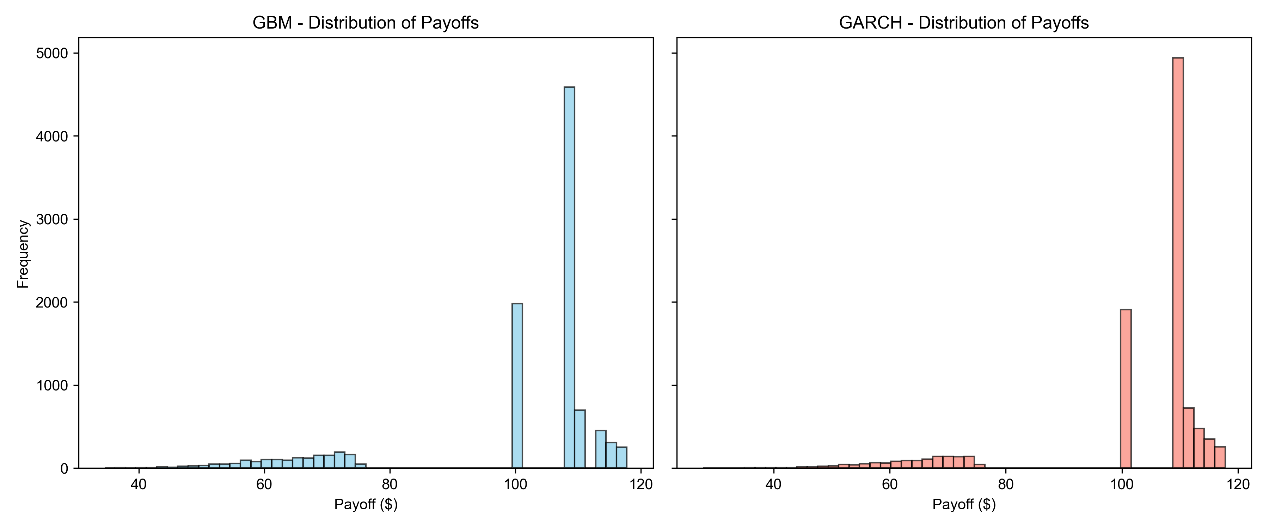
Automatically redeemable structured products exhibit path dependence, and their pricing is typically achieved using Monte Carlo simulations, assuming the underlying asset price follows a geometric Brownian motion (GBM); this means that volatility is constant. However, real financial markets exhibit volatility clustering and fat tails, and the constant volatility assumption can lead to pricing biases. This paper takes a trigger autocallable note issued by HSBC and linked to the S&P 500 index as an example. It uses both GBM and GARCH(1,1) models to generate the underlying asset price path, calculates the product's theoretical value and expected loss (ES) using Monte Carlo simulations within a risk-neutral framework, and compares the results from four dimensions: fair value, risk indicators, return distribution, and sample path. The results show that the constant volatility of GBM leads to overly dispersed paths and an overestimation of loss frequency, while GARCH, by characterizing time-varying volatility and mean reversion, provides a risk-return profile that better reflects market realities. Therefore, this paper recommends using the GBM model when the market is stable, or the product structure is simple, and using the GARCH model when the market is volatile, or the product exhibits strong path dependence.
Show more
Read Article PDF
Cite