
Articles in this Volume

Research Article Open Access
The Impact of Carbon Trading Price Volatility on the Financial Risk of Manufacturing Enterprises--A Study Based on Listed Companies in China
Article thumbnail
In the context of the global active response to climate change and the continuous development and improvement of the carbon trading market, the manufacturing industry is increasingly linked to financial risk. Theoretically, the fluctuation of the carbon trading price affects the cost of enterprises and the competitive situation in the market, which in turn affects the financial risk. The empirical evidence is based on the sample of 1107 listed companies in the manufacturing industry from 2014 to 2021, and the regression model is constructed, and the results show that carbon trading price volatility is significantly positively correlated with the financial risk of manufacturing enterprises. The heterogeneity test finds that state-owned enterprises and large-scale enterprises are more affected by carbon price volatility on financial risk, and the difference in this effect among enterprises with different R&D investment intensity is not significant. After replacing the regression model and the robustness test of the reduced-tail treatment, the results are reliable.
Show more
Read Article PDF
Cite
Research Article Open Access
The Increase of Federal Funds Rate and the QQQ ETF Illiquidity
The modification of the Federal funds rate is crucial for regulating inflation, fostering employment opportunities, and ensuring sustained economic growth. The QQQ ETF is an exchange-traded fund designed to track the NASDAQ 100 index— an important stock price barometer in the United States that reflects technology companies' development. As the United States Federal Reserve continues to change the interest rates during this period, whether the QQQ ETF illiquidity of the world's major technology companies will be affected has become increasingly important. This paper selects one important period of the Fed's interest rate increase in succession. It analyzes the trend of the QQQ ETF illiquidity aiming to explore the different impacts of the decrease in the Federal funds rate on the QQQ ETF illiquidity. The research indicated that the elevation of the Federal funds rate substantially impacts the illiquidity of the QQQ ETF. The research results are expected to help investors predict changes in the QQQ ETF during the same period in the future to make more reasonable responses.
Show more
Read Article PDF
Cite
Research Article Open Access
A Study of the Impact of China's Digital Infrastructure on Coordinated Regional Economic Development
This paper centers on the theme of "Research on the impact of China's digital infrastructure on the coordinated development of regional economy", and systematically analyzes the role of digital infrastructure in the economic development of China's regions and its influence mechanism. the impact of digital infrastructure on the coordinated development of regional economy is explored in depth using coupled model and linear regression analysis. It is found that mobile Internet access traffic, as an important indicator of digital infrastructure, has a significant positive impact on regional economic development, while the negative correlation between the market volume of technological transactions and GDP needs to be further analyzed. Finally, the article looking forward to the potential and prospects of digital infrastructure in promoting coordinated regional economic development.
Show more
Read Article PDF
Cite
Research Article Open Access
The Impact of Digital Transformation on Green Innovation in Business
When it comes to global sustainability and digital growth right now, digital transformation has a huge effect on businesses. This paper is mostly based on statistics from China's publicly traded companies from 2014 to 2023. The study looks at the real-world connection between going digital and green innovation, and it talks about the role of government funding in this connection. The study clearly showed that, at its core, digital change plays a pretty big part in encouraging businesses to come up with green ideas. For the most part, government subsidies also make the link between digital transformation and green innovation less strong.
Show more
Read Article PDF
Cite
Research Article Open Access
Does Climate Risk Promote Green Innovation in Enterprises?
Can enterprises respond to climate risks through green innovation? This is a question of shared concern across society. Using a sample of Chinese A-share listed companies from 2009 to 2022, this paper empirically examines the impact of climate risk on green innovation in enterprises and its mechanisms. The study finds that climate risk can indeed significantly promote green innovation in enterprises. On average, for every one standard deviation increase in the climate risk index, the level of green innovation in enterprises rises by 2.196 percentage points. Mechanism analysis reveals that climate risk drives enterprises to engage in green innovation through digital transformation and R&D investment. This promoting effect is stronger in non-state-owned enterprises and high-pollution industries. Further research finds no significant relationship between green innovation and green total factor productivity in enterprises, suggesting that the motivation for green innovation may not solely arise from addressing climate risks but could also be influenced by government subsidies and other factors. The conclusions of this paper are significant for improving enterprises' ability to cope with climate risks and provide theoretical support for governments in formulating climate adaptation policies.
Show more
Read Article PDF
Cite
Research Article Open Access
The Impact of Executives' Environmental Background on Corporate Environmental Performance
This study focuses on the relationship between executives' environmental background and corporate environmental performance. Based on the company data of A-share listed companies from 2012 to 2022, we analyze the samples of multi-industry companies in depth, and use multiple regression models and two-way effect fixed models to reveal the significant role of executives' environmental background in corporate environmental strategy formulation, resource allocation, and the promotion of environmental management practices, as well as the mediating role of green innovation and the moderating role of environmental regulation. The study also examines the mediating role of green innovation and the moderating role of environmental regulation. The study finds that executives with environmental background can, by virtue of their professional knowledge and environmental awareness, more actively guide enterprises to adopt energy-saving, emission reduction, green production and other environmentally friendly initiatives through corporate green innovation, which in turn significantly improves the environmental performance of enterprises; and the moderating role of environmental regulation has a certain critical effect. This study not only enriches the theoretical research in the field of corporate social responsibility and sustainable development, but also provides valuable practical references for enterprises in management selection and environmental strategic planning.
Show more
Read Article PDF
Cite
Research Article Open Access
A Study of the Impact of Investor Sentiment on Corporate Investment Efficiency--Based on the Intermediation Effect of Asset Mispricing
We examine how investor sentiment influences the efficiency of corporate investment, with a particular focus on the role of asset mispricing. Our analysis is based on a sample of publicly listed companies in the Shanghai and Shenzhen A-share markets, covering the period from 2014 to 2023. The findings show that the rise of investor sentiment significantly reduces corporate investment efficiency, and this effect is persistent. Meanwhile, asset mispricing plays a partial mediating role between investor sentiment and corporate investment efficiency, i.e., investor sentiment indirectly reduces corporate investment efficiency partly through increasing asset mispricing. In addition, the detrimental effect of investor sentiment on the investment efficiency of firms is more significant in companies with lower analyst attention and lower long-term institutional investor ownership. Finally, managerial overconfidence reinforces the negative impact of investor sentiment on firms' investment efficiency, and this moderating effect is partly realised through the path of asset mispricing. In view of this, corporate management should maintain rational decision-making and avoid being disturbed by market sentiment; financial regulators need to strengthen sentiment monitoring and information disclosure to enhance market transparency; and investors need to enhance rationality and pay more attention to corporate fundamentals and long-term value.
Show more
Read Article PDF
Cite
Research Article Open Access
Study on the Impact of Enterprise Digital Transformation on Green Innovation Performance — The Mediating Role Based on Financing Constraints
As digital technology advances rapidly, digital transformation has emerged as a crucial strategy for enterprises to bolster their competitiveness and pursue green development. Nevertheless, enterprises frequently encounter hurdles such as financing constraints during this transformation, which can hinder the enhancement of green innovation performance. This paper intends to explore the influence of corporate digital transformation on green innovation performance, emphasizing the mediating role of financing constraints in this relationship. This research reveals that digital transformation notably enhances a company's innovative capabilities and market competitiveness, with green innovation performance serving as a pivotal indicator of sustainable development.Funding constraints play an intermediate role between digital transformation and green innovation performance, but it is a role often overlooked in existing studies.By easing financing constraints, digital transformation provides greater financial backing for green innovation projects, fostering green development and improving green innovation performance. These findings not only contribute to the theoretical understanding of the connection between digital transformation and green innovation performance but also offer practical insights for governments formulating policies and enterprises implementing digital transformation strategies.
Show more
Read Article PDF
Cite
Research Article Open Access
The Promoting Effect of Regional Incubator Operational Efficiency on Regional Industrial Structure Upgrading
Since the 1980s, Western countries have utilized business incubators with notable success. In China, research on incubators remained largely theoretical in the 1990s, and practical implementation did not occur until around 2010. However, their impact on the economy, society, and technology remains unclear. Using panel data from 30 provinces in China between 2014 and 2023, this study examines how the operational efficiency of regional business incubators affects industrial structure upgrading. The study finds that: First, the operational efficiency of regional business incubators significantly promotes industrial structure upgrading and is an important driving force for high-quality economic development. Second, there is a U-shaped relationship between the operational efficiency of business incubators and the level of industrial structure upgrading. In the early stages of incubator development, efficiency may inhibit industrial upgrading, but as efficiency improves, its positive impact becomes more evident. Third, the effect of business incubator operational efficiency on industrial structure upgrading varies across regions, with more pronounced effects in the eastern region. The paper recommends enhancing incubator efficiency, improving infrastructure, and fostering regional cooperation to optimize industrial structures and support sustainable economic development.
Show more
Read Article PDF
Cite
Research Article Open Access
Mechanisms of the Impact of Digital Transformation on Corporate Sustainability Performance
Article thumbnail
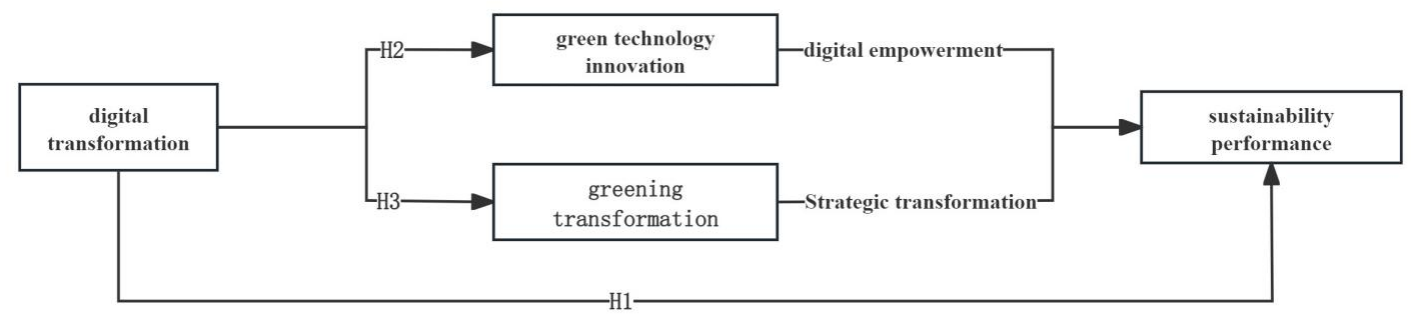
Under the "dual-carbon" strategic framework, corporate digitalization emerges as a pivotal driver for advancing sustainable development and facilitating high-quality economic and social development. This investigation employs a dataset of Chinese A-share listed companies (2014-2023) to systematically examine the mechanism through which digital transformation enhances sustainability. The empirical analysis found that digital transition elevates sustainable development outcomes through dual mediation pathways: green technological innovation and greening transformation. Specifically, digital transformation fosters the development and adoption of green technologies and promotes organizational and operational changes, which in turn enhance sustainability performance. Heterogeneity analysis reveals significant differential impacts that digital transformation exerts a greater dominant effect on the sustainability performance of state-owned firms, heavily polluting industry firms, and those in the central and western regions. These findings provide empirical evidence for optimizing digital transformation pathways, theoretical references for the implementation of sustainable development strategies, and actionable insights for enterprises to achieve carbon neutrality through technological innovation and green transformation.
Show more
Read Article PDF
Cite