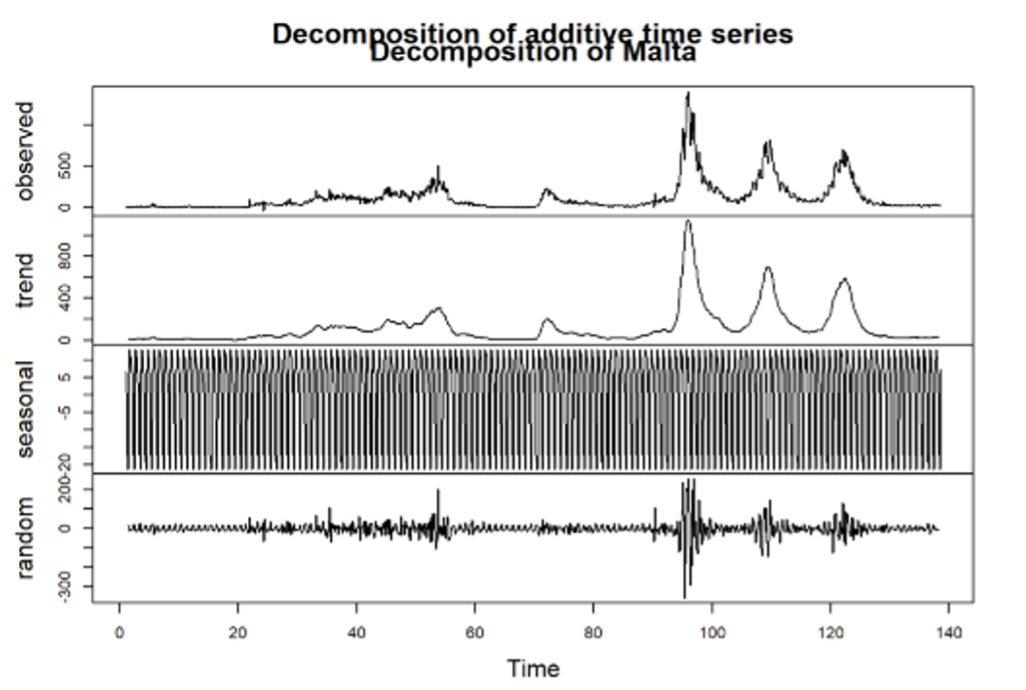
The COVID-19 pandemic has posed significant challenges to global public health, necessitating the development of effective predictive models to anticipate future outbreaks and allocate healthcare resources efficiently. This study aims to forecast the number of COVID-19 infections in four European countries—Germany, Italy, Malta and Sweden—during April and May of 2022. Two distinct forecasting models are employed: the Seasonal Autoregressive Integrated Moving Average (SARIMA) model and a Random Forest regression model. The analysis utilized data up to the end of March 2022, incorporating factors such as lagged case numbers, vaccination rates, temperature, and jurisdictional policies. The results indicate that while the SARIMA model captures the general seasonal trends, the Random Forest model outperforms SARIMA in predictive accuracy, as reflected by lower Root Mean Square Error (RMSE) and Mean Absolute Error (MAE) values. Moreover, feature importance analysis from the Random Forest model highlights that recent infection rates (lagcases7) significantly impact future case predictions, suggesting the utility of machine learning techniques in capturing complex interactions within epidemiological data. These findings provide valuable insights for policymakers in planning effective pandemic responses.