
Articles in this Volume

Research Article Open Access
Tariff Shocks and Export Values in China's Electronics Sector Before and During the US-China Trade War from 2015 to 2025
Article thumbnail
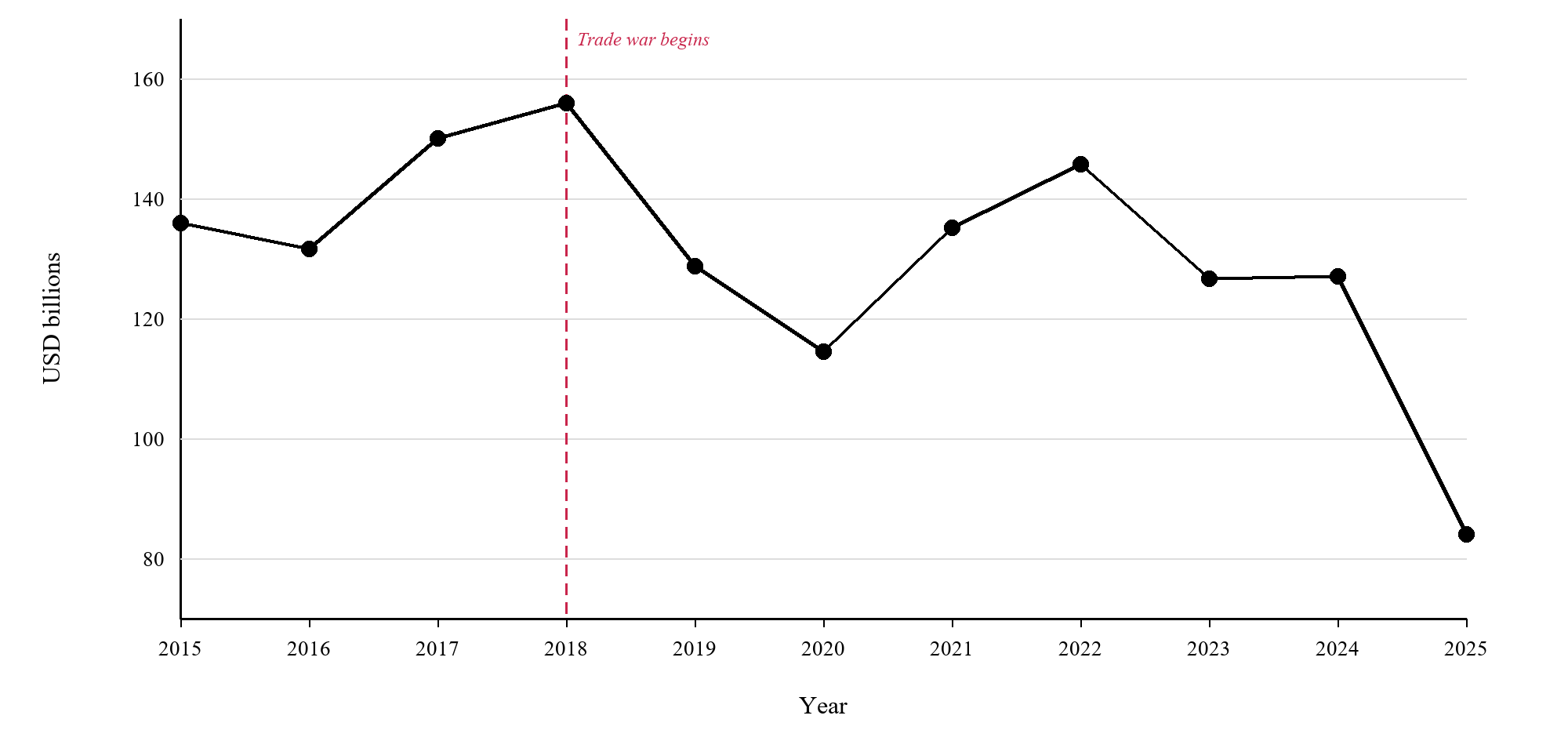
This paper evaluates the impact of the US-China trade war on China's electronics exports, with a particular focus on whether such effects vary by products' pre-existing reliance on the US market. This study covers 46 electronic product categories and 7 major destination markets. By using the HS4 product-destination-year panel, the Difference-in-Difference (DID) model is applied to estimate the effects of trade war shocks. The baseline results show that US electronics imports from China decreased by approximately 23.3% compared to other six major markets after the trade war in 2018, supporting the hypothesis that the trade war significantly reduced China's electronics exports to the US. The parallel-trend test reveals no significant pre-policy differences, while the placebo test provides additional useful support for the baseline result. However, the interaction between the trade war shock and the dependence on US market during the pre-policy period is statistically insignificant, illustrating that products that depended more on the US market initially did not experience more significantly negative effects. Overall, the findings underscore the negative shocks of the trade war to China's electronics exports, while offering limited support for heterogeneous effects based on pre-policy US market exposure.
Show more
Read Article PDF
Cite
Research Article Open Access
A Study on Marketing Strategies of Domestic Cosmetics Brands from the Perspective of Emotion and Cultural Narratives
As Generation Z has become the primary consumer force in the cosmetics market, the domestic affordable makeup segment has become deeply mired in homogeneous price competition, with these brands often positioning themselves as "budget alternatives" to luxury brands. Relying solely on product performance, low-price promotions, and traffic-driven marketing strategies makes it difficult to build lasting brand barriers. Taking Judydoll as a case study, this paper adopts a case study method, examining its marketing initiatives such as "Iron Can Poetry Collection" and "Let Beauty Be Seen" from the perspectives of emotional and cultural storytelling. Drawing on STP, 4C and 5P marketing theories as well as consumer behavior theory, the study analyzes how Judydoll successfully shifts product consumption toward emotional identification and cultural engagement by focusing not only on individual user emotions but also on intangible cultural heritage values. This strategy enables the brand to transcend functional price competition and establish a distinctive cultural positioning. The paper further interprets Judydoll's marketing practices through three key frameworks, highlighting its strengths in emotional connection, cultural empowerment, and user communication. It offers optimization suggestions for emotional and cultural marketing in the domestic affordable cosmetics sector, aiming to provide insights for building long-term competitiveness among similar brands.
Show more
Read Article PDF
Cite
Research Article Open Access
From Pop‑Up to Permanent: Market Experimentation and the Experiential Turn in Chinese Consumption
Article thumbnail
China's consumer market is shifting from transaction‑oriented retail toward experiential consumption. Pop‑up retail has become mainstream commercial infrastructure, and the debut economy is now a national strategic priority that supports brands as they move from temporary market experiments to a lasting commercial presence. Existing research offers little process‑based analysis of this transition under debut‑economy policies. Research on consumer experience and management strategy also remains disconnected. Through a multiple‑case study of To Summer, On, and Photoism, this article examines how temporary experimentation leads to permanent retail. The analysis identifies feedback‑driven, staged progression as the central mechanism. Brands use pop‑ups or slow pop‑ups as low‑cost experiments, gather market signals in actual consumption settings, and assess whether those signals justify further investment in permanent operations. Debut‑economy policies lower transition costs and help brands near the investment threshold proceed, while market experimentation remains central to the decision. The article brings together the experience economy, pop‑up retail, and the debut economy in a single analytical framework. Its five interrelated theoretical propositions explain the retail innovation pathway from temporary experimentation to permanent stores.
Show more
Read Article PDF
Cite
Research Article Open Access
The Impact of Digital Inclusive Finance on Enterprise Innovation Output
This paper matches data on Chinese A-share listed companies from 2011 to 2022 with city-level digital inclusive finance indices to obtain a panel sample covering 36,599 firm-year observations, 4,699 firms, and 282 cities, and tests the relationship between digital inclusive finance and enterprise innovation output. The baseline model includes city and year fixed effects, with standard errors clustered at the city level. The results show that the development of city-level digital inclusive finance is significantly positively correlated with both invention patent applications and total patent applications. Further analysis finds that digital inclusive finance is significantly correlated with lower financing constraints, and that stronger financing constraints are associated with lower invention patent output by firms, a result consistent with the theoretical expectation of the financing constraints channel. Grouped regressions show that the positive relationship mainly appears in non-state-owned and private enterprises, and is more prominent in the central and western regions. After replacing the innovation measures, winsorizing, using the one-period lagged digital inclusive finance index, and excluding the financial industry, the core conclusions do not change substantially. Overall, the development of digital inclusive finance is significantly associated with improved enterprise innovation output, and the alleviation of financing constraints may be an important channel.
Show more
Read Article PDF
Cite
Research Article Open Access
A Survey of Matrix Decomposition Methods in Financial Data Analysis
This paper reviews the application of matrix decomposition techniques in financial data analysis, with particular emphasis on singular value decomposition, principal component analysis, non-negative matrix factorization, and robust principal component analysis. High-dimensional financial datasets, such as stock return matrices, bond yield curves, and high-frequency trading records, often contain substantial noise and hidden factor structures. Matrix decomposition techniques address these difficulties by transforming complex financial datasets into lower-dimensional representations. Drawing on classical studies of low-rank approximation, principal component analysis, factor models, covariance estimation, asset pricing, and portfolio theory, this survey shows that matrix decomposition methods serve several major functions in financial analysis: extracting latent risk factors, improving high-dimensional covariance matrix estimation, supporting asset pricing and portfolio optimization, and separating systematic risks from idiosyncratic shocks. In yield curve analysis, principal components can be economically interpreted as level, slope, and curvature factors. In risk management, low-rank structures help identify common risk drivers, while residual components reflect asset-specific shocks. However, the review also highlights several limitations, including market non-stationarity, weak economic interpretation of statistical factors, and limited capacity to model tail risk. Overall, matrix decomposition provides a useful bridge between mathematical dimension reduction and practical financial modeling, while future research should further develop dynamic, nonlinear, and economically interpretable decomposition frameworks.
Show more
Read Article PDF
Cite
Research Article Open Access
Research on Optimization Strategy of Enterprise Cost Management under Digital Transformation
With the rapid iteration of big data, machine learning, and generative artificial intelligence technologies, traditional enterprise management models, which rely on manual experience, hierarchical supervision, and static data analysis, are gradually unable to adapt to the dynamic, personalized, and high-efficiency market competition environment. AI technology, with its advantages of autonomous learning, intelligent prediction, high-speed computing, and scenario-based decision-making, comprehensively penetrates enterprise organizational management, human resource management, financial management, operational management, and strategic management. It fundamentally optimizes enterprise resource allocation, improves operational efficiency, and promotes the innovative upgrading of management logic. However, while AI empowers enterprise management, it also creates practical challenges, including pressure for organizational restructuring, mismatches in employee competencies, data security risks, and ethical dilemmas in management. Drawing on authoritative research in China and abroad as well as enterprise digital transformation case studies, this paper systematically analyzes the positive impact of AI on modern enterprise management, sorts out the key difficulties in the current intelligent management transformation process, and proposes targeted optimization strategies. The research aims to provide a theoretical reference and practical guidance for enterprises to realize intelligent, refined, and modern management in the AI era.
Show more
Read Article PDF
Cite
Research Article Open Access
Research on the Impact of Digital Inclusive Finance on Corporate Financing Costs: Theoretical Mechanisms and Empirical Tests
This paper takes Shanghai and Shenzhen A-share non-financial listed companies from 2012 to 2023 as the sample, matches city-level digital inclusive finance indexes of firms' registered places with corporate financial data, and examines the relationship between regional digital finance development and corporate financing costs. The empirical part uses the natural logarithm of financing costs as the dependent variable and the prefecture-level city digital inclusive finance aggregate index as the core explanatory variable; after adding control variables such as firm size, leverage, profitability, growth and firm age, industry and year fixed effects are controlled, and standard errors are clustered at the firm level. The results show that the estimated coefficient of the digital inclusive finance index is −0.1757 and is significant at the 1% level, indicating that regions with higher digital finance development correspond to lower corporate financing costs. Further analysis finds that digital inclusive finance is significantly positively correlated with both analyst attention and research report coverage, which supports the explanatory channel of external information environment improvement. Grouping results show that this negative relationship is more obvious in the samples of non-state-owned enterprises, larger enterprises and the eastern region. After adopting an alternative financing cost indicator, adding province fixed effects and excluding several special years, the main conclusions remain stable. Overall, the development of regional digital inclusive finance has a stable association with the improvement of corporate financing conditions, and its effect may be related to the external information environment and firm and regional characteristics.
Show more
Read Article PDF
Cite
Research Article Open Access
Analysis of the Impact of Corporate Cultural Differences on Multinational Operation Performance
As economic globalization continues to deepen, more and more domestic companies are engaging in international operations, and differences in corporate culture have become a key soft factor affecting the success or failure of overseas business. This article focuses on multinational corporations. Drawing on relevant theories and literature, it investigates how corporate cultural differences affect international business performance, with a particular emphasis on analyzing their interaction from the perspective of cross-cultural human resource management. The research finds that corporate culture differences have a two-way effect: if a company rigidly sticks to its home country's management style and ignores cultural adaptation, it can easily lead to problems in human resource management such as employee cognitive conflicts, broken psychological contracts, and talent loss, which increases internal management costs, reduces organizational collaboration efficiency, and ultimately hampers international business performance. Cross-cultural awareness, localized HR strategies, inclusive corporate culture, and digital HR platforms are important factors that determine how cultural differences play out. Based on this, the paper proposes optimization strategies from different angles, aiming to provide theoretical guidance and practical insights for companies going global to resolve cross-cultural conflicts.
Show more
Read Article PDF
Cite
Research Article Open Access
Variable Reward, Symbolic Value, and Social Media Performance: A Digital Case Study of Pop Mart Consumption
Research on blind-box consumption often explains repeated purchasing through individual psychological approaches. Less attention has been paid to how uncertainty interacts with symbolic meaning and public presentation. This study addresses that gap through a qualitative case study of ten consumer-generated videos posted on Instagram and Xiaohongshu, documenting visits to Pop Mart stores in the United States between October 2025 and March 2026. The analysis identifies three recurring patterns. Uncertainty is publicly performed, rather than simply experienced, as creators stage anticipation before the reveal. Symbolic value is built by store design and by shared recognition of popular characters. Filming extends the presentation of shopping and unboxing beyond the point of purchase, making communal recognition a part of consumption itself. Viewed through variable-reward theory and commodity fetishism, these patterns suggest that blind-box consumption is organised around performing anticipation, identity and belonging, and not only around acquiring objects. The data record public behaviour, so the analysis makes no claim about psychological dependency.
Show more
Read Article PDF
Cite
Research Article Open Access
A Study on the Short-Term Impact of Inflation Levels and Geopolitical Conflicts on International Spot Gold Prices
In the wake of the COVID-19 pandemic, many countries have implemented accommodative monetary policies, and inflationary pressures have continued to emerge. With the successive outbreaks of the Russia–Ukraine conflict and the Israel–Palestine conflict, demand for safe-haven assets in the investment market has increased, leading to significant fluctuations in gold prices. Although gold serves as both an inflation hedge and a safeguard against geopolitical risks, most existing studies analyse only the impact of inflation or geopolitical tensions on gold prices in isolation, and few examine the distinct short-term impacts arising from their interplay. This paper takes gold as its subject and, by combining relevant literature with price movements during typical events, analyses how inflation and geopolitical conflicts influence gold prices. The findings indicate that inflation provides long-term support for gold prices, with a longer-lasting impact, geopolitical conflicts, by contrast, can only temporarily drive up gold prices, which tend to fall back once market sentiment stabilises. Should inflationary pressures and geopolitical risks occur simultaneously, fluctuations in gold prices are likely to intensify further. London spot gold offers comprehensive trading data, making it suitable for analysing short-term price movements caused by external risks, the findings of this study may provide some guidance for gold investors.
Show more
Read Article PDF
Cite