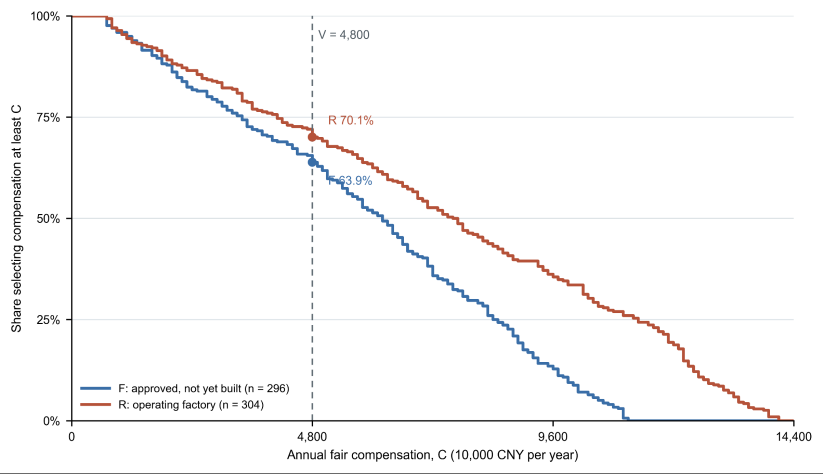
Conventional welfare accounting assigns the same present value to cash flows that occur at the same times, yet third-party compensation assessments may depend on whether the affected activity has already started. This paper randomizes a survey to 600 adults from mainland China. The author asks participants to assess one of two things that are the same in all other respects: a) a factory that stops running after running for one year, and b) a factory that got the approval, fund and site allocation, but was cancelled before the start of construction. In both cases, the facility is expected to generate an annual local net income of CNY 48 million for ten years beginning the following year, and the government considers the same ten-year compensation plan in each case. The result is that people give higher compensation after the start of operations: the average is CNY 74.4 million for the after start of the operations, compared to CNY 58.4 million for the before start of the construction, that is a difference of CNY 16.0 million (which is 33% of the designated income). This difference is small for the low compensation amounts but becomes larger in the upper half of the distribution, where the responses are also more variable. It is slightly smaller at the very top. These results show that the operational status matters for the third-party determinations about the compensation, not only for the equivalence in cash flow. Therefore, the compensation schemes could differentiate between the income substitution documented and a different evidential evaluation of the confirmed transition obligations and not put simply an automatic premium depending on being in an early operational status.