Articles in this Volume

Research Article Open Access
A Review of Monte Carlo Simulation in the Field of Financial Credit Risk Prediction
In recent years, global economic volatility has intensified, and rising market uncertainties have continuously exacerbated, the international situation has shifted, and the uncertainty of the market environment continues to rise. So the operating pressure on small and medium-sized enterprises is constantly increasing. Consequently, the transmissibility and complexity of credit risk have significantly increased. The complexity of credit risk renders traditional static financial risk prediction methods incapable of coping with the complex scenarios involving multiple factors interacting with each other. As a numerical analysis method based on random sampling, Monte Carlo simulation, with its core advantages of being capable of handling multiple variables and supporting dynamic simulation, is increasingly widely applied in the field of financial risk assessment. This essay takes credit risk prediction as the starting point, outlining the core principles of Monte Carlo simulation and the implementation process for risk analysis, and elaborate on their application pathways and modeling logic in three specialized financial fields: real estate investment appraisal, insurance actuarial risk control, and financial derivatives pricing, compare and analyse the adaptability advantages and inherent limitations of this method in different situations. The findings indicate that Monte Carlo simulation can effectively depict the multi-risk resonance effect and the extreme tail loss distribution, addressing the vulnerabilities of traditional single-factor analysis and static rating methods. However, there are also common problems such as weak stability of small samples, high dependence on parameters, and insufficient depiction of heavy-tailed risks. This article summarizes the general characteristics and optimization directions of this method, which can serve as a reference for basic financial risk analysis.
Show more
Read Article PDF
Cite
Research Article Open Access
Smart Health and Elderly-Care Services and Labor-Market Outcomes: Evidence from a Multi-period Difference-in-Differences Analysis
Article thumbnail
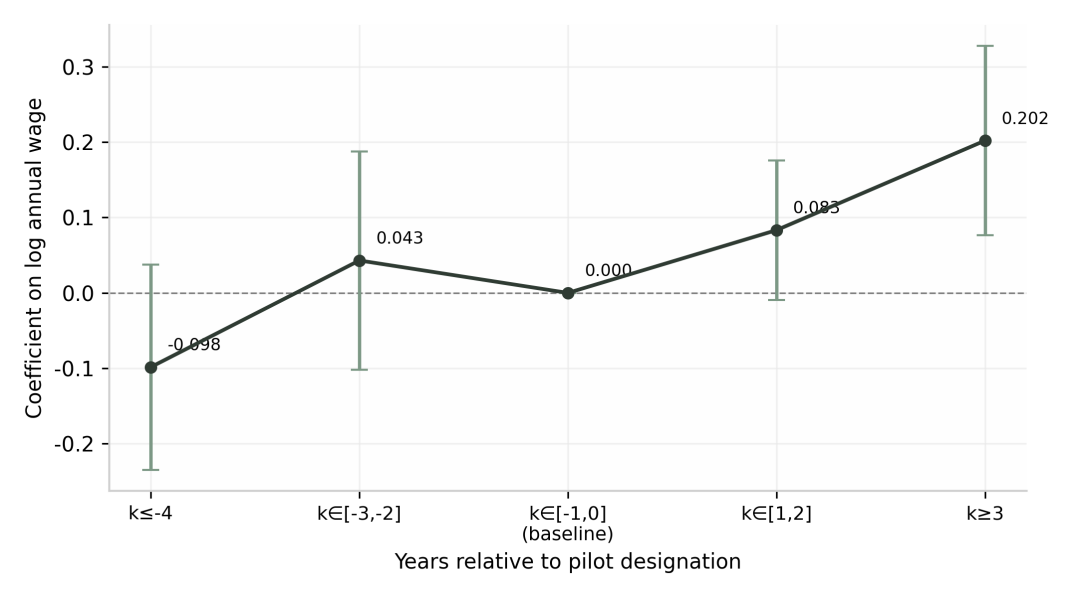
China is aging at an unprecedented pace: by 2020, 264 million residents were aged 60 or above, and the traditional family-based model of old-age care is under mounting strain. Between 2017 and 2019, three central ministries jointly designated 33 Smart Health and Elderly-Care Application Demonstration Bases in three batches, covering 20 prefecture-level cities. This paper exploits the staggered designation as a quasi-natural experiment. Combining the China Family Panel Studies (CFPS) from 2014 to 2020 with prefecture-level statistics, a sample of 32,176 working-age adults in 126 cities is constructed, and multi-period difference-in-differences (DID) models are estimated. The pilot is found to raise the annual wage income of working-age residents by 11.4 percent on average, without reducing employment or working hours. The effect emerges only after designation, grows over time, and survives province-by-year fixed effects, the exclusion of long-term-care-insurance pilot cities, propensity-score-matched samples, and a 500-repetition placebo test. The wage gains are concentrated among women (16.8 percent) and rural-hukou workers (15.2 percent), the groups that typically shoulder family caregiving, suggesting that technology-enabled formal care relaxes the family-care constraint on labor supply and job quality.
Show more
Read Article PDF
Cite
Research Article Open Access
The National Information-for-Citizens-Benefit Pilot Policy and Corporate Digital Transformation
Article thumbnail
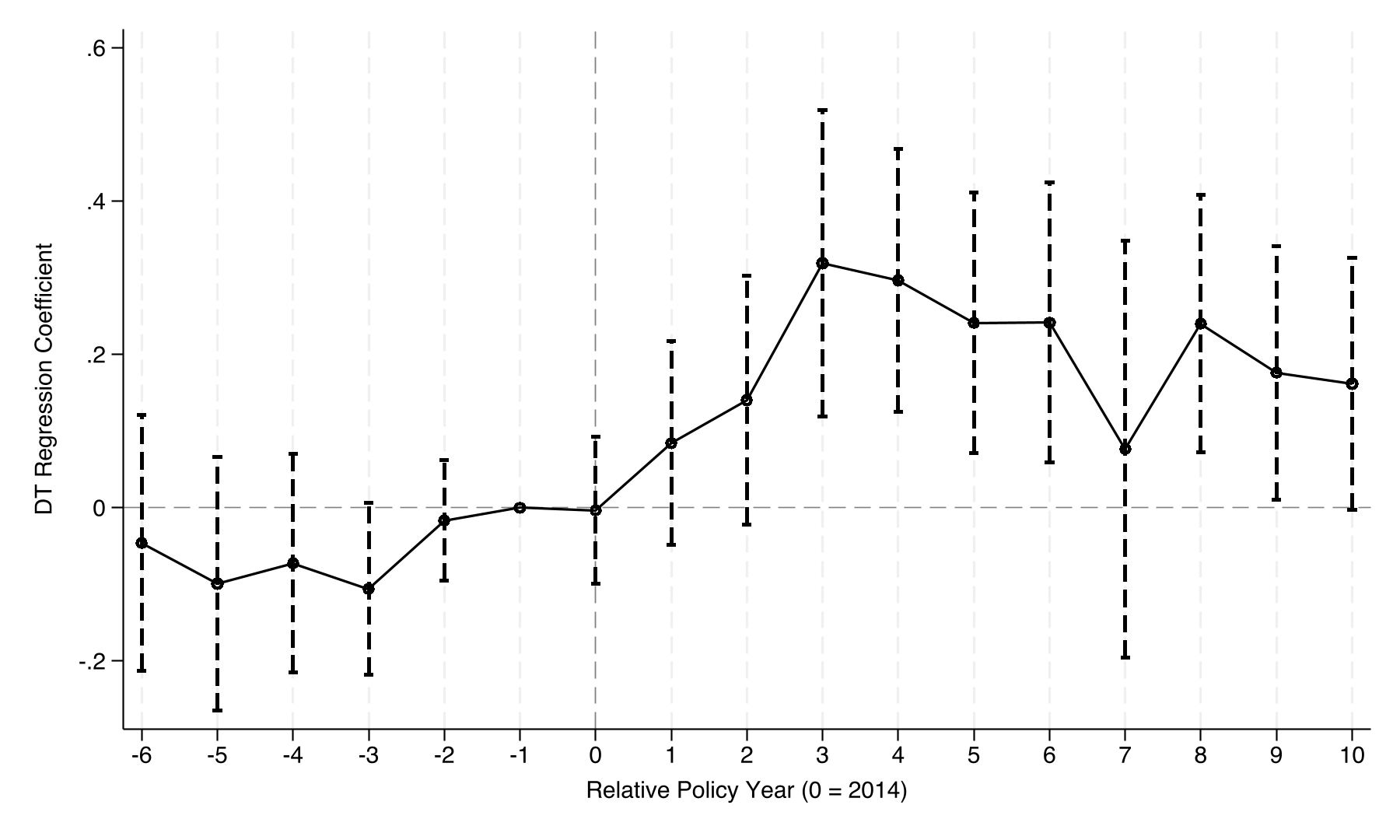
Using the implementation of the national Information-for-Citizens-Benefit pilot, this paper matches the registered location of enterprises with the annual reports and financial data of A-share listed companies on the Shanghai and Shenzhen markets from 2008 to 2024, and uses the difference-in-differences method to examine whether government information integration changes corporate digital behavior. The estimation results show that after entering the pilot, the digital word frequency in corporate annual reports increases significantly. Further analysis finds that bank loan balances rise, the internal control index improves, and the incidence of internal control failure declines. The policy effect is stronger in enterprises with higher ex-ante financing constraints; the within-group effect is significant in cities with better digital foundations, but the between-group difference across cities is not yet significant. The above evidence indicates that government information integration and government process adjustment can influence corporate digital choices, and can be explained from two aspects: external financing and internal governance.
Show more
Read Article PDF
Cite
Research Article Open Access
Government Guidance Funds and Trade Credit Financing: Evidence from Chinese A-Share Listed Firms
This study study whether and how equity participation by Chinese government guidance funds (GGFs) changes the trade credit that firms obtain from their business counterparties. Using 25,149 firm-year observations of nonfinancial Shanghai and Shenzhen A-share companies between 2012 and 2023, this study find that, after controlling for firm characteristics and industry and year fixed effects, GGF-backed firms carry 2.72 percentage points more trade credit as a share of total assets, equivalent to 13.5% of the sample mean. The estimate holds under alternative exposure and trade-credit measures and firm fixed effects, and it survives a series of sample adjustments, propensity-score matching, a Heckman correction, and an instrumental-variable specification. GGF backing is further associated with lower discretionary accruals, more analyst attention, and a higher corporate reputation score, consistent with improved information and trust between the firm and its suppliers. Cross-sectional tests locate the effect mainly among smaller firms and among firms facing fewer financing constraints, lower distress risk, and stronger market positions, indicating that suppliers weigh both public certification and commercial capacity. By identifying supplier finance as a relevant spillover of government-sponsored equity, the paper extends research on public capital and traces a governance–attention–reputation route from equity participation to working-capital access.
Show more
Read Article PDF
Cite
Research Article Open Access
Analysis and Forecasting of FTSE 100 Return Volatility Using an ARMA-GARCH Model
This paper investigates whether a relatively simple ARMA-GARCH specification is useful for modelling and forecasting daily FTSE 100 returns. Closing prices from 31 May 2023 to 28 August 2026 generate 823 percentage log returns. Of these, 758 observations are used for estimation and the final 65 trading days are kept aside as an out-of-sample test. Several low-order ARMA and GARCH specifications, under normal and Student-t errors, are compared using only the estimation sample. BIC selects ARMA(0,0) for the mean equation. For volatility, Student-t GARCH(1,1) is retained because it is parsimonious and its parameters are statistically significant. Out of sample, the mean forecast gives an RMSE of 0.5760 and an MAE of 0.4190, only slightly better than a zero-return benchmark. The reported directional accuracy of 56.9% is largely explained by the positive constant mean, which produces a positive sign forecast on every test day. For conditional variance, GARCH performs better under MAE, whereas the 20-day rolling variance has lower MSE and QLIKE. Overall, the model is more useful for tracking changes in risk than for forecasting the short-run direction of FTSE 100 returns.
Show more
Read Article PDF
Cite