Articles in this Volume

Research Article Open Access
Empowering and Challenging: A Study on the Impact of AI Recruitment Tools in Knowledge-Intensive Industries
Competition for people in knowledge-intensive areas like technology, finance, and R&D has increased considerably due to digital transformation. Traditional manual recruitment is increasingly limited in efficiency, objectivity, and scalability, making it difficult to keep up with organizational growth. This has made artificial intelligence (AI) technology vital to resume screening, job matching, and interview assessments. While technological advances improve productivity, they often present deeper issues, such as reassessing human agency and value in the job.This study asks: How does AI recruitment affect knowledge-based workers for good and bad? How can agricultural HR managers use AI while managing its risks? AI is enhancing efficiency by optimizing processes, lowering human bias by objectively evaluating applications, and facilitating one-to-one matching between individuals and jobs, according to studies. However, algorithms employed to attract candidates might generate structural inequities due to their prejudice, data points, and privacy rights issues. The study will first examine today's technology landscape, then analyze AI's dual impact through case studies, and lastly propose a model for humans and machines recruiting together that accounts for AI's benefits and hazards. Standardizing ethical data use, increasing algorithm transparency, and empowering HR personnel are needed to position AI as an organizational assistant rather than an ultimate decision-maker. Developmentally, it implies long-term surveillance of AI-hired employees' performance and the constant development of fairer, context-aware next-generation models. This research study seeks to help knowledge-intensive firms reconcile efficiency, equity, and technology with humanity during their digital and intelligent transition.
Show more
Read Article PDF
Cite
Research Article Open Access
New-Quality Productive Forces and Corporate Supply Chain Resilience
Article thumbnail
Currently, the security and stability of supply chains have become central issues for corporate survival and even national strategy, and new-quality productivity offers new possibilities for addressing supply chain vulnerabilities. Based on data from Chinese A-share listed companies from 2012 to 2023, this study empirically examines the impact of new-quality productive forces on corporate supply chain resilience. The findings reveal that, first, new-quality productive forces can significantly enhance corporate supply chain resilience. Second, new-quality productivity enhances supply chain resilience by improving firms' total factor productivity and innovation efficiency. Third, for firms without general deficiencies and those not engaged in light-asset operations, new-quality productivity significantly enhances supply chain resilience; however, this effect is not significant for firms with general deficiencies or those engaged in light-asset operations.
Show more
Read Article PDF
Cite
Research Article Open Access
Blockchain-Based Tuition Escrow and Trust Framework for Prepaid Education Services
The prepaid model is widely used in private education and training markets, where parents or students are often required to pay the full tuition fee before instruction begins. Although this arrangement helps institutions secure cash flow, it also exposes consumers to substantial risks when promised courses are delayed, reduced in quality, or never delivered. This paper proposes a blockchain-based tuition escrow and trust framework for prepaid education services. The study adopts a design-oriented research approach and develops a Solidity smart contract prototype to demonstrate the core payment logic. In the proposed framework, tuition is deposited into a smart contract, released gradually as classes are completed, and refunded when the service relationship breaks down before completion. The framework also integrates an on-chain reputation module and a certificate-recording mechanism to strengthen transparency and post-service accountability. The analysis shows that blockchain can transform prepaid tuition from a high-trust, high-risk arrangement into an auditable and partially automated contractual process. At the same time, the paper finds that technological solutions alone cannot fully solve disputes over teaching quality, identity verification, and legal compliance.
Show more
Read Article PDF
Cite
Research Article Open Access
A Business Analysis of BYD's Marketing Strategy, Sales Channels and Profitability in the New Energy Vehicle Market
Article thumbnail
As electric vehicles (EVs) and their related products rapidly expand across the globe, China continues to represent the largest EV market. BYD is a valuable case study for business analysis due to its interconnected nature, which spans battery technology, vehicle manufacturing, marketing, sales distribution and international expansion. Through a case study, along with data visualization, using data collected from BYD's annual reports, industry reports and academic literature, this study analyses the effectiveness of BYD's sales distribution strategy and how it has impacted sales growth and profitability. The results indicate that BYD's growth is driven by its value-for-money positioning, technology branding, wide product offering and multi-channel sales strategies. BYD's sales volumes and revenues significantly increased from 2020 to 2024 and net margins began to increase post-2021. There are potential threats including competitive pricing, regulations governing the sale of EVs internationally and significant investments in sales and distribution channels. Overall, BYD represents a viable, although somewhat pressure-sensitive, business model in the emerging new energy vehicle marketplace.
Show more
Read Article PDF
Cite
Research Article Open Access
Generative AI, Digital Infrastructure, and Firm Productivity: A Task-to-Firm Conversion Framework for Chinese Firms
This paper reviews current published research on how generative artificial intelligence affects firm productivity. Rather than conducting new firm-level data analysis, it synthesizes evidence from artificial intelligence research, task-level productivity experiments, general-purpose technology theory, digital economics, and China-focused digital transformation studies. The central question is why GenAI produces measurable productivity gains in some work settings but uneven or limited firm-level effects in others. The review develops a task-to-firm conversion framework, arguing that GenAI should not be treated as a standalone productivity shock. Its economic value depends on the interaction between model capability, task fit, human-AI calibration, organizational complementary assets, and regional digital infrastructure. Existing studies show that GenAI can improve writing, customer support, consulting, and software-development tasks, but they also reveal risks of overreliance, misalignment, and uneven performance. For Chinese firms, the review suggests that productivity gains are most likely when GenAI adoption is supported by cloud infrastructure, data readiness, skilled labor, workflow redesign, and strong digital ecosystems.
Show more
Read Article PDF
Cite
Research Article Open Access
Mechanism of Risk Regeneration in High-Risk Industries Under Digital Supervision: Evidence from 13 Fireworks Enterprises
Article thumbnail
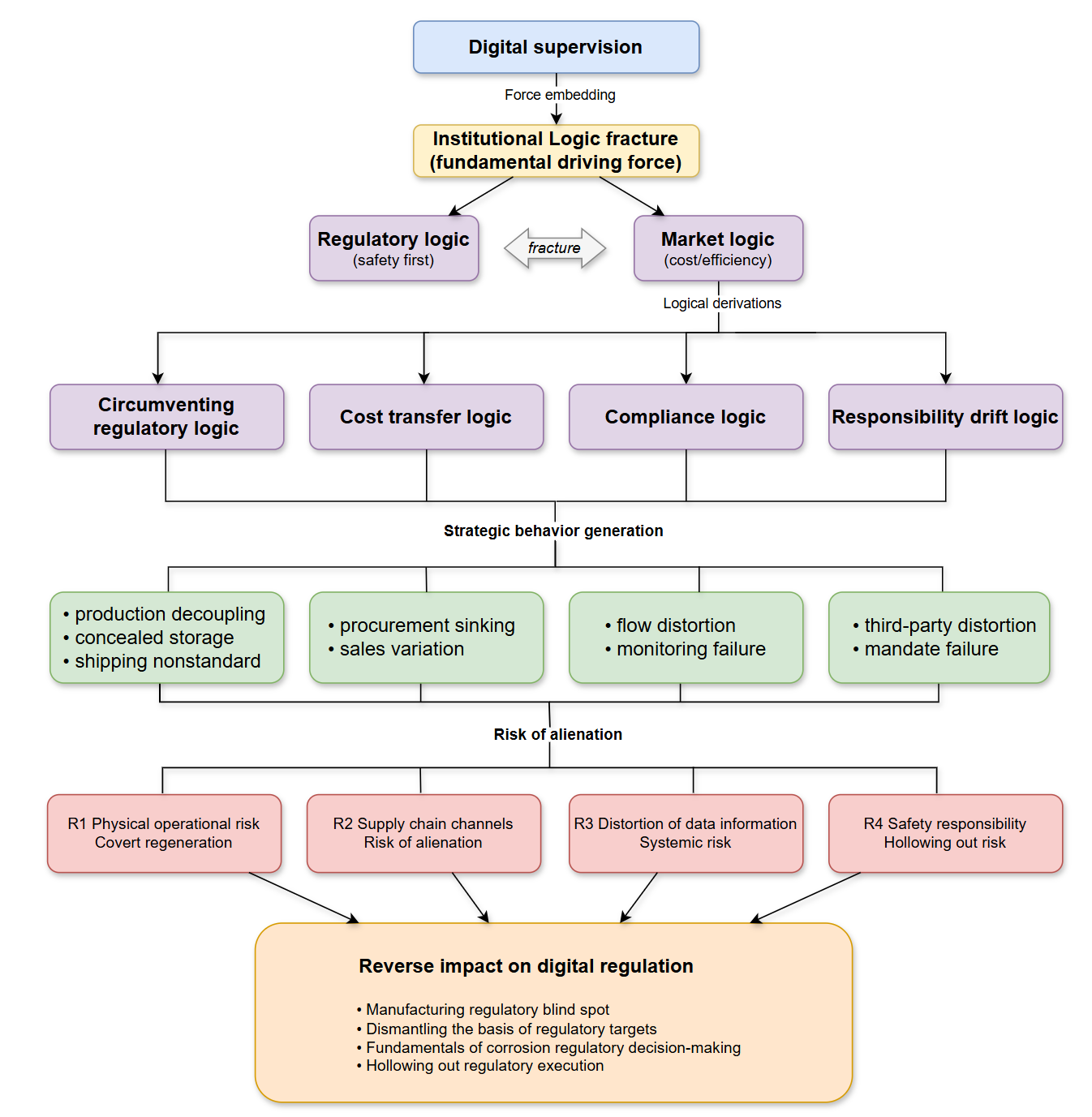
Digital technology is widely seen as a key tool to enhance supply chain transparency and prevent accidents. However, findings indicate that technical compliance alone fails to reduce safety accident risks. This study attributes the paradox to deep institutional logic conflicts from forced digital supervision embedding. Safety-first regulatory logic conflicts with market-efficiency logic in high-risk industries, shifting physical operational risks to digital risks. This paper selects 13 cases of risk regeneration of fireworks and firecracker enterprises that have introduced digital supervision in the past three years, and uses grounded theoretical methods to explore how the fracture of institutional logic changes the trend of risk in the context of forced embedding of digital supervision, which eventually leads to the re-emergence of risk in another form. It is expected to provide a new theoretical perspective for understanding the paradox of digital governance in high-risk industries and practical enlightenment for designing more compatible intelligent regulatory policies.
Show more
Read Article PDF
Cite
Research Article Open Access
The Impact of Short-Video Marketing on Consumer Preferences for Beauty Products
Article thumbnail
In recent years, social media has changed consumer behavior and digital marketing in many ways, especially in the beauty industry. Short-video platforms such as TikTok, Instagram Reels, and Douyin have become important spaces for product promotion and consumer engagement. This paper looks at how short-video marketing influences consumer preferences for beauty products, with a focus on visual content, recommendation algorithms, influencer marketing, and online reviews. The research mainly uses secondary data, academic literature, industry reports, and figure analysis. The findings suggest that short-video marketing has a strong influence on consumer preferences, especially among younger consumers such as Generation Z and Millennials. Influencer credibility also seems to play an important role in building consumer trust. Overall, short-video marketing not only changes the way consumers buy beauty products, but also affects beauty consumption culture in the digital age. The findings not only help explain how short-video marketing shapes consumer behavior in the beauty industry, but also provide useful insights for beauty brands and digital marketers developing marketing strategies in online environments.
Show more
Read Article PDF
Cite
Research Article Open Access
The Impact of ESG Rating Discrepancies on Corporate Green Innovation
Green innovation has become an important way for companies to achieve high-quality development under the supervision of the country's "dual carbon" goals. But the cost of funding is high, and the return on investment for green innovation is uncertain. ESG ratings have had discrepancies that are becoming more frequent lately, making it harder for businesses to make decisions about what they should do. The study takes Chinese A-share listed companies from 2014 to 2024 as samples to experimentally investigate how ESG rating divergence impacts corporate green innovation. From the results of this research we can see that ESG rating difference greatly promotes corporate green innovation; analysts’ attention partially mediates the relationship between them; the level of corporate governance positively moderates the relationship between ESG rating difference and green innovation; good corporate governance can enhance the positive promoting effect of rating difference on green innovation. To assist businesses in dealing with ESG rating differences and improving their ability to innovate greenly, this paper provides a theoretical basis and relevant references.
Show more
Read Article PDF
Cite
Research Article Open Access
Institutional Openness and the Technical Complexity of Corporate Exports
The Central Economic Work Conference in 2018 first proposed "institutional opening-up," marking a shift in China's opening-up strategy from the flow of goods and factors to institutional dimensions such as rules and regulations. The report of the 20th National Congress of the Communist Party of China reaffirmed this core pathway. At the same time, improving export technological complexity has become an inevitable choice for the high-quality development of foreign trade. As an institutional opening-up pilot platform, the Cross-border E-commerce Comprehensive Pilot Zones provide a practical carrier for institutional innovation, accumulating replicable and scalable experience through pilot reforms and strongly supporting high-level opening-up. Against this background, this paper adopts a micro-firm perspective and uses data on the establishment of Cross-border E-commerce Comprehensive Pilot Zones (2012–2023) and Chinese listed firms to empirically examine the impact of such pilot zone establishment on firms' export technological complexity. A multi-period difference-in-differences (DID) model is employed for in-depth analysis. The empirical results show that: (1) The establishment of Cross-border E-commerce Comprehensive Pilot Zones significantly promotes the improvement of firms' export technological complexity. (2) The effect of pilot zone establishment on export technological complexity varies across geographic location and industry characteristics. Compared with coastal cities, the establishment of such zones in inland cities has a significantly stronger positive effect on export technological complexity. From the perspective of industry classification, the establishment of the pilot zones has a significant positive effect on export technological complexity for capital-intensive and technology-intensive manufacturing firms, while the positive effect is not significant for labor-intensive manufacturing firms. (3) Mechanism analysis indicates that the establishment of Cross-border e-commerce pilot zones enhances firms' export technological complexity by promoting firms' innovation input, innovation output, and innovation efficiency.
Show more
Read Article PDF
Cite