Articles in this Volume

Research Article Open Access
Industrial Policy Signals and Firm Entry: Evidence from China's Low-Altitude Economy
Article thumbnail
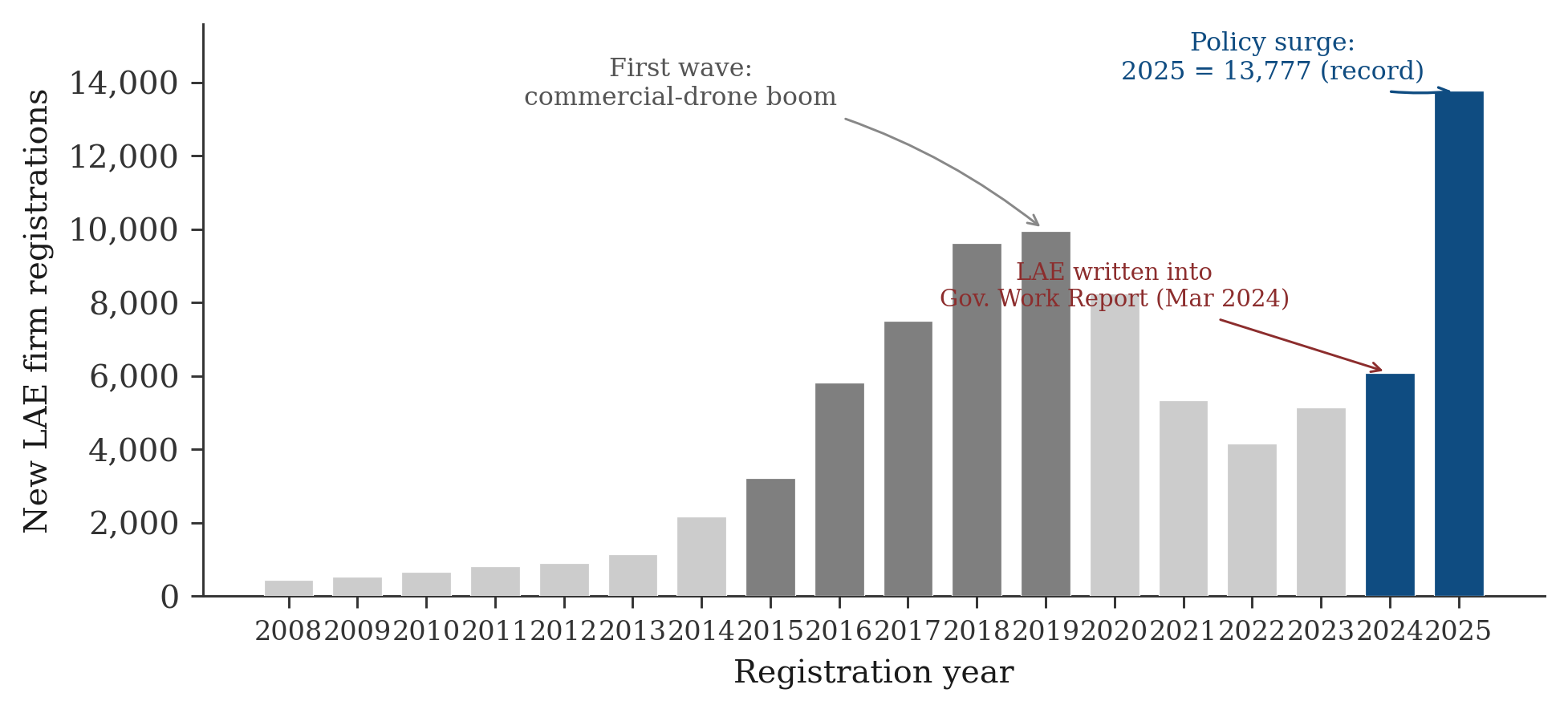
Industrial policy has returned to the centre of economic debate, yet evidence on how quickly and through which margins it reshapes real activity remains thin. We study firm entry, the margin through which resources first flow into a targeted sector, using a near-universe of 88,133 Chinese low-altitude economy (LAE) firms registered between 1966 and 2025. Over a compressed period the state raised the LAE from a niche concept to a national strategic priority, culminating in its first appearance in the 2024 Government Work Report. Monthly entry exhibits a sharp structural break: a supremum-Wald test dates the trend inflection to April 2024, immediately after the designation, while a level surge crystallises by October 2024 at roughly 2.3 times the counterfactual. The response is concentrated in the policy-named core segment, whose share of new entrants rises from 3% to 24%, and it diffuses spatially away from the incumbent Shenzhen-Guangzhou cluster. Entrants are small and thinly capitalised, a pattern consistent with speculative, subsidy-oriented entry.
Show more
Read Article PDF
Cite
Research Article Open Access
Analyse of the Inequality Shocks and Economic Behavioral Changes under Post-Pandemic Inflation
The inflation shock in recent years has brought many problems that have altered the ways people buy and spend. Based on macro-economic indicators and transaction data, it can be observed that the expansion in nominal expenditure after the pandemic was a statistical illusion caused by the rise in commodity prices offsetting a large decline in discretionary demand due to the rigid stability of necessity volume. The inflation had different effects for different groups; according to Engel's Law, the low-income group's disposable income fell sharply and localized credit tightened, but wealthier families could use their accumulated funds to maintain a certain level of consumption by changing the quality of goods and services. At the same time, there was a considerable division in the commercial sector; the number of relatively unstable physical stores dropped, and continuous investment flowed into new-type online and offline enterprises. Finally, due to the prolonged price salience and economic anxiety, the psychological structure of consumers has been permanently changed by the framework of the availability hypothesis and procedural rationality; thus, defensive omni-channel behaviour, store-brand substitution, durable asset deferral and socioeconomic polarisation in debt repayment have occurred. Together, the changes are to be expected in the coming years in total demand, credit stability and macroeconomic fairness.
Show more
Read Article PDF
Cite