Articles in this Volume

Research Article Open Access
Regional Heterogeneity in Temperature Effects on China's Economic Seasonality: Evidence from 30 Provinces
Article thumbnail
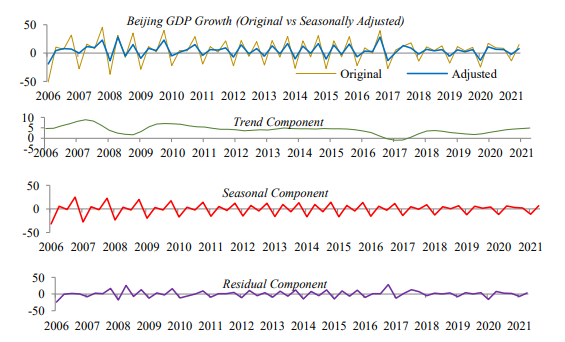
This paper studies the heterogeneous temperature effect on provincial GDP growth fluctuations in China from Q1 2005 to Q2 2021. The temperature effect is divided into two parameters, i.e., the inter-quarter changes of average temperature and the intra-quarter highest-lowest temperature difference. The GDP fluctuations are represented by the quarterly GDP residual seasonality. A mixed-effect panel regression model with random coefficients of the two temperature parameters is compared to the baseline model with fixed coefficients of temperature variables. The result demonstrates strong regional heterogeneous relationships between the temperature variables and quarterly GDP fluctuations. Provinces in the Northern-China plain, such as Shangdong, Henan, and Anhui, exhibit positive GDP seasonality associated with both warmer average temperatures and higher intra-quarter temperature deviations, which benefit the agricultural production. Southwestern provinces (e.g., Guangxi, Yunnan, and Chongqing) experience a negative impact from rising inter-quarter average temperatures and larger intra-period temperature fluctuations, partly due to the hot summer's adverse effect on both industries and tourism. Northwestern and Southeastern provinces get mixed temperature-economic effects, with the former benefiting from higher average temperature and the latter suffering, while the former suffers from large intra-period climate fluctuations and the latter benefits, also due to their agricultural and industrial patterns and their respective geographical locations. The heterogeneity of the provincial temperature-economic effects reinforces the necessity for region-specific climate adaptation strategies, especially the development of green energy and coordinated efforts to integrate local climate risk assessments into national central economic planning.
Show more
Read Article PDF
Cite
Research Article Open Access
The Impact of Artificial Intelligence on Enterprise Risk Management
The rapid development of Artificial Intelligence (AI) has profoundly influenced various aspects of enterprise operations, particularly in the field of risk management. As organizations face increasingly complex, dynamic, and interconnected risk environments, the integration of cutting-edge AI technologies offers new opportunities as well as challenges for identifying, assessing, and mitigating multifaceted risks. This paper explores the impact of AI on enterprise risk management (ERM) by reviewing relevant theories, analyzing practical applications, and discussing associated risks and challenges. Through case studies in financial services, supply chain management, and cybersecurity, the research demonstrates that AI enhances risk detection, improves decision-making, and increases operational efficiency. However, the widespread adoption of AI also introduces new risks, such as algorithmic bias, data privacy concerns, and model transparency issues. The study concludes that while AI significantly advances ERM, organizations must adopt robust, proactive governance frameworks to address these emerging challenges and ensure responsible deployment of AI.
Show more
Read Article PDF
Cite
Research Article Open Access
The Influence of Environmental Policy on Willingness to Pay: The Mediating Effect of Environmental Perception
Article thumbnail
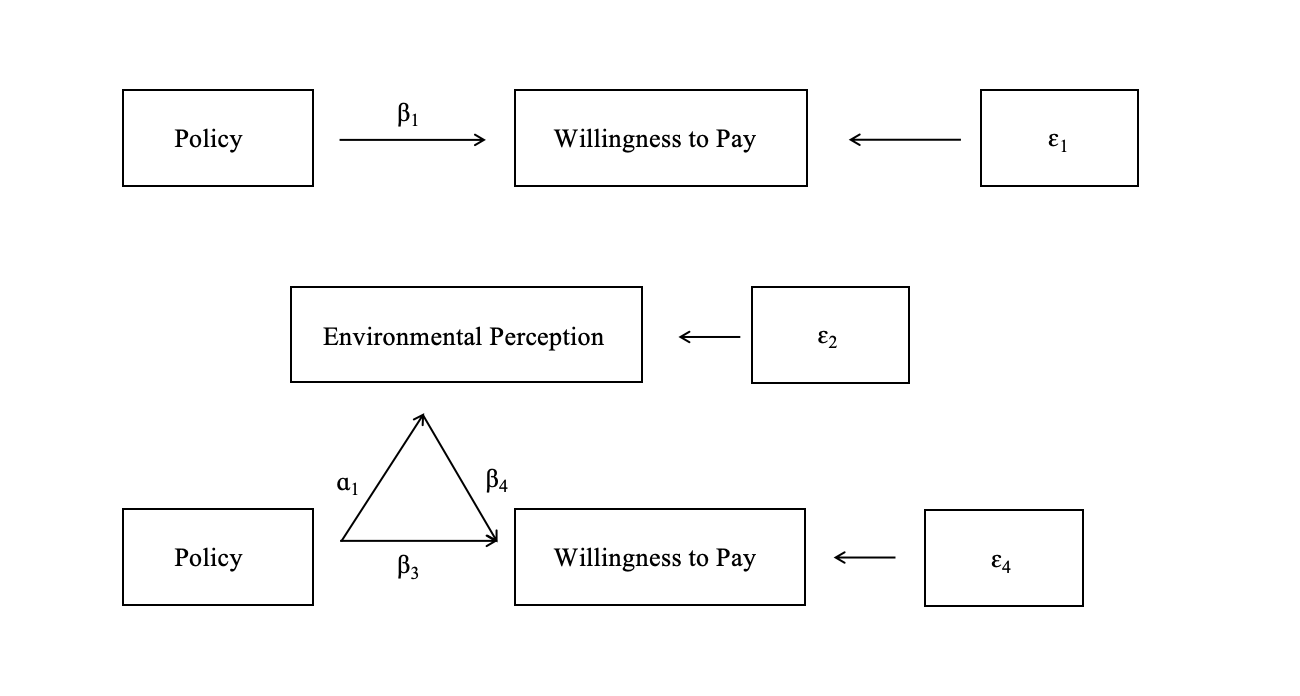
Environmental issues have always been a concern for both the government and the public. How to effectively formulate and implement environmental policies in order to build a better environment is a problem that the government needs to consider. Existing research shows that environmental policies and environmental perception both influence individuals' willingness to pay, but prior research has investigated little about the underlying influential mechanism of policies in changing people's psychological perception and related behaviors. The study examines whether environmental perception mediates environmental policies and individuals' willingness to pay. Using survey data from the 2018 and 2021 waves of the Chinese General Social Survey, the study applies a multiple regression approach. The study finds that environmental policies have a significant negative direct effect on willingness to pay, and environmental perception is an important negative mediator in this relationship. These findings contribute to the formulation of policies by integrating policy and individuals' behaviors, suggesting the importance of emphasizing personal responsibility in environmental protection in reality.
Show more
Read Article PDF
Cite
Research Article Open Access
The Impact of the Pink Tax on Female Consumers: A Socioeconomic Perspective
The phrase "pink tax" refers to the practice of charging higher prices for products and services marketed to women than for similar products marketed to men. This phenomenon has drawn increasing attention as it reflects gender-based price differences in everyday consumption. This paper examines the impact of the pink tax on female consumers from a socioeconomic perspective. It focuses on three major industries: everyday consumer goods, beauty and personal care, and clothing. By comparing the prices of similar goods across genders and reviewing existing consumer reports and studies, the paper analyzes how the pink tax manifests across markets and influences women's consumption decisions. The analysis shows that female consumers often face higher long-term expenses, which can affect their budgeting behavior and purchasing choices. In addition, the pink tax may place a heavier burden on low-income women and reinforce existing gender inequalities. Overall, the paper argues that the pink tax is not only a market issue, but also a social concern, and greater awareness and policy attention are needed to reduce its negative effects on female consumers.
Show more
Read Article PDF
Cite
Research Article Open Access
Logical Analysis of London Gold Price Fluctuations: A Comprehensive Study Based on Interest Rate Cycles, the US Dollar Index, and Geopolitical Risks
Gold, as one of the representative assets in the global financial system, acts as a primary vehicle for long-term value storage and often serves as a safe-haven asset during periods of heightened uncertainty. However, London gold prices exhibit distinct cyclical fluctuations under varying macroeconomic conditions: they may rally amid declining interest rates, rise when the US dollar weakens, and experience short-term surges during geopolitical shocks. This paper examines the drivers of London gold price fluctuations and identifies the macroeconomic scenarios where such volatility is most prominent. It constructs a comprehensive analytical framework centered on interest rate cycles, the US Dollar Index, and geopolitical risks. The research employs a combination of literature review with mechanism analysis, supplemented by studies on price discovery in the London spot and New York futures markets to contextualize market structures. Key findings indicate that real interest rates and opportunity costs constitute critical channels influencing gold's medium-to-long-term trends; US dollar strength impacts gold prices through dual mechanisms of currency valuation effects and cross-asset allocation; geopolitical risks primarily amplify short-term volatility via safe-haven demand and risk premiums. This integrated framework offers investors insights into gold pricing logic and scenario-based asset allocation strategies.
Show more
Read Article PDF
Cite
Research Article Open Access
From Prediction to Decision: A Survey of Machine Learning Applications in Quantitative Finance
With the explosive growth of computer science and big data, quantitative finance is undergoing a huge shift from traditional econometrics to data-driven Artificial Intelligence (AI). This study aims to review the applications of Machine Learning (ML), Deep Learning (DL), and Reinforcement Learning (RL) in vital areas such as asset pricing, algorithmic trading and risk management. Research shows that Deep Neural Networks (DNNs) capture non-linear market patterns, Natural Language Processing (NLP) analyses unstructured data while providing superior sentiment signals compared to generic alternatives. Deep Reinforcement Learning (DRL) can effectively automate execution in dynamic market environments, which optimizes trading decisions. Similarly, Temporal Fusion Transformers (TFT) have emerged as a dominant architecture for multi-horizon time series forecasting, offering superior interpretability and accuracy over standard recurrent networks. These ML models greatly outperform traditional methods like CAPM and ARIMA in prediction accuracy and handling complex data. However, there are still challenges about the lack of interpretability ("black box") and overfitting. In the future, quantitative finance lies in combining "Explainable AI" (XAI).
Show more
Read Article PDF
Cite
Research Article Open Access
The Impact of Artificial Intelligence on Corporate Digital Technology Innovation: A Perspective Based on Workforce Skill Structure
Digital economy is the core driving force for cultivating new quality productivity. According to the policy of Statistical Classification of Digital Economy and Its Core Industries (2021), artificial intelligence plays a significant role in promoting enterprise digital technology innovation, but the transformation process of intelligent technology to innovation achievements still needs to be clarified, and the transmission mechanism of labor skill structure as an intermediary mechanism between the two is not clear. Existing research suffers from unclear mechanisms and insufficient empirical evidence. Therefore, this study adopts the chain analysis framework of technology-skill-innovation, adopts the data of A-share listed companies in Shanghai and Shenzhen Stock exchanges from 2010 to 2022, and adopts the mediating effect model to deeply study its effect and influence mechanism. The study finds that artificial intelligence can promote the digital technology innovation of enterprises, and the skill structure of labor force plays a partial mediating role in it. The results of heterogeneity analysis show that this promotion effect is more pronounced for large SOEs and firms in the central region. This study decomposes the skill mediation indicators and combines the multidimensional data with the theoretical framework to provide firm-level empirical evidence on the transmission mechanism of AI-driven firm innovation and provide ideas for relevant policy formulation.
Show more
Read Article PDF
Cite
Research Article Open Access
Algorithmic Ads-Driven Personalized Advertising: Privacy Leakage Risks and Consumer Acceptance
Nowadays, online shopping platforms are becoming increasingly popular, and advertising has become a highly effective marketing tool. Personalized advertising is emerging in the public eye, referring to predicting users' preferred products based on their preferences and shopping habits to promote consumption. This article uses the literature research method to discuss the advantages and disadvantages of algorithm-driven personalized advertising, public acceptance, and whether it is reasonable to use personalized advertising. First, it analyzes how relevant algorithms drive online platforms to clean data to achieve personalization. Second, algorithm-driven personalized advertising makes it easier for platforms to speculate on users' private information, such as gender, age, and religious beliefs, which brings about the risk of information leakage. It also analyzes consumers' willingness to continue using personalized advertising even though they know there is a risk of personal information leakage; some consumers believe personalized advertising can improve the efficiency of shopping and improve consumer satisfaction, while others worry about privacy leaks. Finally, in today's environment of widespread personalized advertising and increasingly intense public concerns about privacy, this article combines legal analysis with a brief discussion of the current situation and puts forward suggestions for advertising companies to continue to develop in this environment, such as reducing the degree of personalization and strengthening privacy protection measures.
Show more
Read Article PDF
Cite
Research Article Open Access
Empirical Research on Multi-factor Prediction and Algorithmic Trading Strategy Based on Transformer Model
Article thumbnail
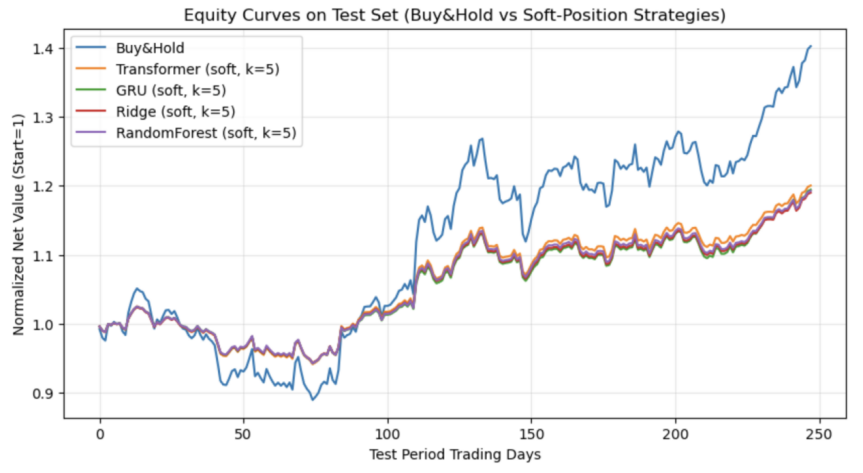
The field of quantitative finance has undergone significant transformations due to the integration of artificial intelligence, particularly in the context of short-term stock return forecasting. Transformer models have demonstrated considerable aptitude in modeling intricate time-series dependencies; nevertheless, their efficacy in predicting the subsequent return of specific stocks, such as AAPL, remains a relatively unexplored domain. In this study, systematic collection of daily price, volume, and other fundamental information for AAPL was conducted from public data sources (e.g., Yahoo Finance), and a multi-factor dataset incorporating volatility, value, liquidity, momentum, yield, and sentiment factors was constructed. A transformer encoder architecture has been developed to capture temporal relationships among these factors and to generate 5-day return forecasts. Empirical results demonstrate that the Transformer exhibits lower forecast accuracy in this limited-sample single-asset setting in comparison with traditional machine-learning benchmarks. However, when model signals are translated into a unified soft-position long-only strategy with transaction costs, strategy-level performance differences become more pronounced, and the Transformer-based strategy achieve marginally higher risk-adjusted returns and total returns. The findings indicate that, while the guarantee of predictive superiority is not provided, Transformer-based factor forecasting may still generate economic value under disciplined execution and position scaling..
Show more
Read Article PDF
Cite
Research Article Open Access
Marketing Strategies of Luxury Brands under the Experience Economy
The Experience Economy has reshaped how luxury brands conceptualize and communicate value, shifting the emphasis from physical product superiority to personalized, immersive experiential interactions. This literature review explores marketing strategies adopted by luxury brands to align with contemporary consumer demands for emotional resonance, aesthetic appreciation, cultural symbolism, and social belonging. Based on Pine and Gilmore's 4E Framework (experience, education, entertainment, aesthetics), this paper systematically evaluates the impact of experiential strategies on consumer loyalty and brand equity through the integration of Schmidt's experiential marketing theory (sensory, affective, cognitive, behavioural, relational) and symbolic consumption theory. Furthermore, digital transformation and the sharing economy have rendered experiential consumption more accessible, thereby redefining exclusivity through participation rather than possession. The paper demonstrates that the application of experiential strategies fulfills customers' emotional, psychological, and social demands, strengthening the bond between consumers and brands and fostering sustainable competitive differentiation.
Show more
Read Article PDF
Cite