Articles in this Volume

Research Article Open Access
Predicting Netflix Stock Price Direction Using Machine Learning and Deep Learning Models
Forecasting stock market trends is notoriously difficult because financial markets are intrinsically volatile and do not follow linear patterns. This project aims to address the problem of predicting the future direction of Netflix (NFLX) stock price, a representative stock with a significant position in the streaming industry. This study utilized daily historical stock price data from May 2002 to October 2024 and constructed a feature set comprising 20 technical indicators. The primary objective of this research is to construct a binary classifier that determines if the stock value will rise over 1% in a t+5 timeframe. To achieve this, this study compared four different machine learning and deep learning models: Logistic Regression, Random Forest (RF), Extreme Gradient Boosting (XGBoost), and Long Short-Term Memory (LSTM). The experimental results show that all models provide predictive capabilities superior to random guessing. Among them, the LSTM model performed the best, achieving an accuracy of 53.73% on the test set, closely followed by XGBoost (53.05%). This result shows the possibility of deep learning models in capturing complex time-series dependencies.
Show more
Read Article PDF
Cite
Research Article Open Access
Administrative Empowerment and Livelihood Impact of Digital Transformation in Africa
This article focuses on the digital transformation of Africa and systematically explores the intrinsic connection and transmission mechanism between administrative empowerment and people's livelihood effects; In the administrative dimension, by citing practical cases from countries such as Kenya, Nigeria, and Rwanda, the empowering role of digital transformation at the administrative level is demonstrated, and its effects are pointed out from three aspects: improving government efficiency, reducing corruption, and enhancing public service transparency; In the dimension of people's livelihood, the actual effects of digitalization are mainly demonstrated in the fields of education, healthcare, and financial services. Typical cases are used to analyze the positive roles of mobile payments, digital education platforms, and health management systems in improving people's livelihood and promoting inclusive development. Meanwhile, through further country comparisons, this article horizontally compares the differences in digital paths and outcomes among different countries due to various factors, and finds that in the future, Africa's digital transformation still faces multiple challenges. The purpose of the study is to emphasize that African countries need to strengthen institutional construction and talent cultivation while promoting technological applications, in order to achieve sustainable and inclusive development of digital transformation and provide theoretical support for Africa to achieve further high-level digitization.
Show more
Read Article PDF
Cite
Research Article Open Access
Based on the Comparable Company Analysis Method - Taking Bama Tea as an Example
The traditional Chinese tea industry, carrying profound cultural connotations, stands as an auniquely distinctive sector in the national economy. Traditional tea enterprises, blessed with rich cultural significance and a stable consumer base, are facing increasingly complex valuation logics due to the rise of emerging tea beverages and shifts in consumer preferences. This study focuses on the Hong Kong stock market and employs the comparable company analysis method to deeply analyse the financial status, brand influence, and product innovation capabilities of two traditional tea enterprises: TenFu's TEA and Lancang Ancient Tea. Through comparative analysis. The aim is to reveal the valuation level and driving factors of Bama Tea, and to explore the true value of traditional tea enterprises. This research aims to assist investors in accurately identifying investment opportunities, effectively avoiding risks, and providing references for strategic adjustments and transformation and upgrading of traditional tea enterprises. It also aims to promote the optimal allocation of industry resources and foster sustainable development in the tea industry.
Show more
Read Article PDF
Cite
Research Article Open Access
Analysis of the Mechanism of Women's Leadership Cultivation at the Community Level-Public Participation and Social Work Empowerment
This study mainly explores ways to enhance community women's leadership from the perspective of social work empowerment. Although more women have joined community governance in recent years, many of them still face long-standing structural limits, gender expectations, and the dilemma of limited institutional support. Combined with existing studies and several theoretical approaches, this paper shows three main empowerment strategies. To begin with, group work allows women to gradually build leadership skills, including speaking, planning, decision skills, while also forming mutual support network in the group in the community. Then, community work helps open more formal leading spaces for women by adding gender-sensitive rules and practices into community meetings, project design, and daily decision-making procedures, which offers more chances for women to move upward from basic participation to real involvement in decision-making. Third, by providing resource links, offer women access to policy institutions, professional organizations, and social resource platforms, thereby obtaining training, funding, and broader development opportunities. In this process, social workers play an important role by serving as coordinators, advocates, and connectors. This paper points out the important conclusion that the cultivation of sustainable female leadership requires the combined effect of personal capacity building, structural reforms, and multi-level resource support.
Show more
Read Article PDF
Cite
Research Article Open Access
Big Data-Driven E-commerce Advertising Push: Its Impact on Consumer Market Efficiency, Potential Risks and Regulatory Insights
With the development of digital technology and e-commerce industry, China’s e-commerce platform advertising push under big data plays an increasingly important role in resource allocation and efficiency improvement in the consumer market. In the past, people's understanding of it was limited to "commodity promotion methods" and did not pay attention to its deep logic of affecting the consumer market. This article uses the case analysis method (analyzing the platform model) to conduct research. Specifically, it seeks to clarify the positive value of big data-driven advertising in optimizing supply-demand matching and enhancing market operation efficiency, while identifying potential issues such as information cocoons, algorithmic bias-induced unfair competition, and consumer privacy risks. Ultimately, the research intends to provide insights for regulating advertising push behaviors, thereby promoting the efficient, sustainable, and healthy development of the consumer market amid digital transformation.
Show more
Read Article PDF
Cite
Research Article Open Access
Externalising Europe’s Borders: The European Union–Tunisia Memorandum of Understanding and the Operationalisation of the 2024 New Pact on Migration and Asylum
The paper examines the implementation of the 2023 -2025 European Union (EU) Tunisia Memorandum of Understanding (MoU) within the external section of the 2024 New Pact on Migration and Asylum. It also talks about resolving the problem of accountability and human rights of the Pact. The migration management system of EU is gradually shifting towards external means. The Tunisia MoU demonstrates the implementation of the Pact priorities of controlling the border, accelerating the returns, and restricting the people who can move. The analysis of documents, policy reports, Non-Governmental Organization (NGO) writings, and legal documents demonstrates that money incentive, informal regulations and cooperation has transformed EU migration control into the work of the Tunisian authorities. Yet not all of these mechanisms are transparent and do not contribute to accountability, resulting in such issues as collective expulsions and the infringement of the principle of non-refoulement. Even such a big investment will not be able to alter migration flows or the impact of the MoU. This study suggests that externalization should be placed under external controls, binding guarantees, and enhanced checks to ensure that the externalization is in tandem with the EU values.
Show more
Read Article PDF
Cite
Research Article Open Access
Asian Countries' Preference for Sino-Japanese Infrastructure Initiatives from the Perspective of the Combination of External Pressure and Domestic Politics
With the development of globalization, regional connectivity has become an important means to enhance cooperation among countries, which helps to reduce the cost of commodity transportation and thereby promotes regional economic prosperity. This article explores why Asian countries have made different choices in the infrastructure competition between China and Japan. For instance, Indonesia has chosen China to build the Jakarta-Bandung High-Speed railway (HSR), while India has opted for Japan to construct the Mumbai-Ahmedabad Corridor. Adopting the framework of neoclassical realism, it holds that these preferences are not only determined by external pressure but also influenced by the domestic political structure. Analysis shows that Indonesia's decision is the combined result of its perception of a low threat to China, its centralized administrative system, and its leadership that prioritizes the existence of short-term political legacies. In contrast, India's choice is driven by its perception of a high threat to China, a domestic political regime with multiple veto powers, and the prime minister's long-term vision of technological nationalism. The conclusion of this study is that the domestic political landscape is the decisive variable in explaining how a country manages its major infrastructure plans.
Show more
Read Article PDF
Cite
Research Article Open Access
Research on the Impact of Digital Economy Policies on Regional Economic Growth from an Econometric Model Perspective
Article thumbnail
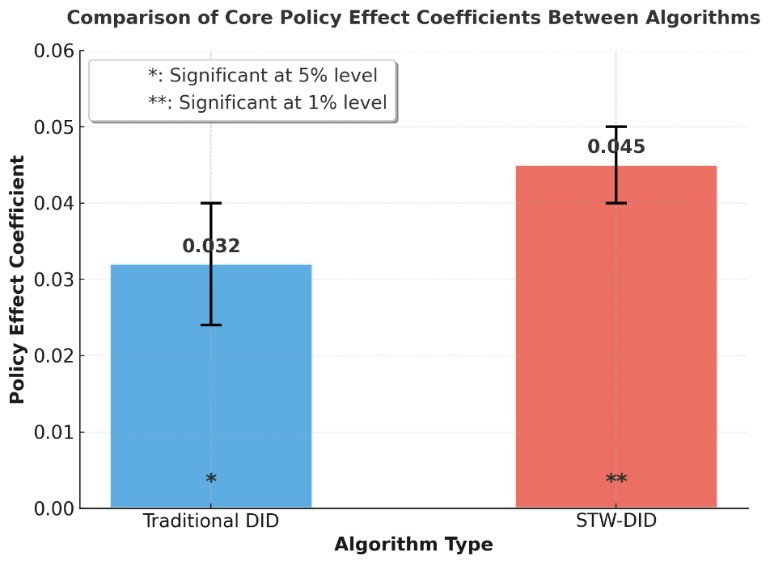
To accurately assess the effects of digital economy policies on economic growth, this study conducted experiments using benchmark regression, heterogeneity analysis, and robustness tests, comparing the performance of the traditional DID and STW-DID algorithms. Data simulations were conducted to validate the results. The benchmark regression results show that the traditional DID algorithm estimated a policy effect coefficient of 0.032 (5% significance) with an adjusted R² of 0.612. The STW-DID algorithm improved the coefficient to 0.045 (1% significance), with an adjusted R² of 0.735 and reduced the residual sum of squares from 0.892 to 0.547. Simulation data confirmed that spatiotemporal weighting significantly improved the explanatory power and fitting accuracy of the model. Heterogeneity analysis simulations show that the policy coefficient for the eastern region (0.058, 1% significance) is higher than that for the central (0.039, 5% significance) and western regions (0.021, 10% significance). The coefficient for the high-base group (0.052, 1% significance) was 2.7 times that of the low-base group (0.019, 10% significance). Robustness tests show that the average coefficient across 1,000 placebo simulations is -0.002, with only 3.2% of the coefficients exceeding 0.03. The STW-DID coefficient remains stable after replacing variables and adding control variables (0.041 and 0.043, both at 1% significance), validating the conclusions and providing a basis for policy optimization.
Show more
Read Article PDF
Cite
Research Article Open Access
Case Study of JD.com's Acquisition of Dada Group
Article thumbnail
In recent years, instant logistics has emerged. As a giant in the logistics field, JD.com began to acquire shares of Dada Group in 2016 and officially issued a privatization offer in January 2025. Given the unique nature of Dada Group's assets, this case is of great significance to the light asset valuation and mergers and acquisitions of the logistics industry and other enterprises. Taking JD.com’s privatization of Dada Group as a case study, this paper employs the event study method to investigate the motives behind the acquisition, examine the fairness of the offer price, and assess the post-acquisition performance and strategic implications. The study draws the following conclusions: (1) The premium paid by JD.com for Dada Group in this merger and acquisition is mainly used for light asset acquisition and tax reduction, and the offer is reasonable; (2) In the short to medium term, JD.com's acquisition has achieved significant results in terms of finance and corporate strategy.
Show more
Read Article PDF
Cite
Research Article Open Access
Can Digital Inclusive Finance Facilitate the Achievement of “Common Prosperity”?
This paper centers on the relationship between digital inclusive finance and common prosperity, exploring the mechanisms through which digital inclusive finance may promote common prosperity as well as its potential risks, and proposing a corresponding policy framework. The study finds that digital inclusive finance can contribute to common prosperity through mechanisms of income generation, equal opportunities, and resource allocation. Specifically, it broadens pathways for income growth among different groups, breaks down financial exclusion, and optimizes regional resource flows. At the same time, risks such as the digital divide and algorithmic discrimination exist, which may exacerbate the Matthew effect. Furthermore, the impact mechanisms are heterogeneous, showing differentiated effects across various groups. Through approaches such as top-level institutional design, product innovation, and financial literacy enhancement, it is possible to effectively balance innovative value with risk constraints. This research holds practical significance for deepening the theoretical connection between digital finance and common prosperity, guiding the optimization of digital inclusive finance practices, and promoting the equitable sharing of development outcomes.
Show more
Read Article PDF
Cite